
BT Group Plc: Balancing Free Cash Flow and Network Expansion for Long-Term Shareholder Value
In the evolving telecommunications landscape, BT Group Plc (LON:BT.A) faces a critical strategic question: Should it prioritize free cash flow generation over aggressive network expansion to maximize long-term shareholder value? This analysis evaluates BT's financial performance, capital allocation strategy, and competitive dynamics to determine the optimal balance between growth and efficiency.
Free Cash Flow and Shareholder Returns: A Foundation for Stability
BT Group's FY2025 results underscore its ability to generate robust free cash flow despite significant reinvestment in infrastructure. The company reported normalized free cash flow of £1.6 billion, exceeding expectations, while simultaneously investing £4.9 billion in capital expenditures, primarily for full-fibre broadband expansion, according to BT's FY25 report. This dual focus reflects a disciplined approach to capital allocation, enabling BT to raise its dividend by 2% to 8.16p per share in FY2025, as noted in its FY2025 earnings call. Analysts highlight that BT's normalized free cash flow is projected to reach £2 billion by FY2027 and £3 billion by 2030, driven by cost reductions and operational efficiencies, according to J.P. Morgan. Such a trajectory suggests that prioritizing free cash flow does not inherently conflict with strategic reinvestment, provided cost discipline is maintained.
Network Expansion: A Growth Imperative in a Competitive Market
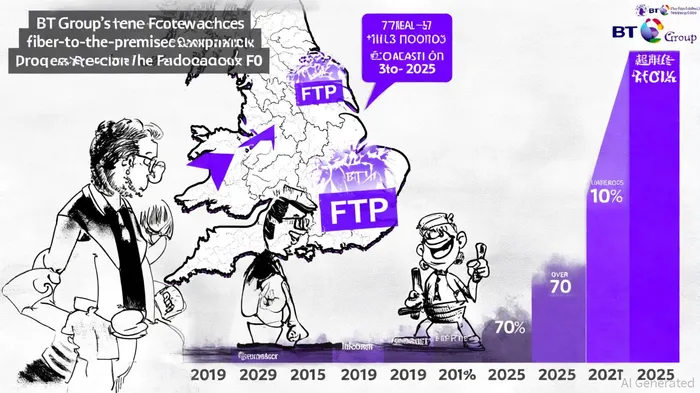
BT's full-fibre-to-the-premises (FTTP) expansion remains central to its long-term value proposition. By FY2025, the company had connected 18 million premises, with a target of 25 million by 2026 and 30 million by 2030, as reported in BT's capital spending. This aggressive rollout is critical to countering competitive pressures from alternative networks like CityFibre, which gained 500,000 lines in 2024, according to Morningstar. Regulatory clarity, such as the Equinox plan's approval, has further incentivized BT's capital-intensive strategy by stabilizing wholesale pricing for Openreach's network, per Investing.com cash flow. However, the high cost of FTTP deployment-£5 billion in FY2026 CapEx-raises questions about sustainability. Analysts at J.P. Morgan note that while near-term free cash flow may remain constrained, the company's cost transformation initiatives (e.g., a 10% reduction in Openreach repair volumes) are expected to unlock £2 billion in normalized free cash flow by 2027, according to StockAnalysis.
The Balancing Act: Efficiency and Reinvestment in Harmony
BT's strategic framework demonstrates a nuanced approach to balancing growth and efficiency. For instance, FY2025 saw £913 million in annualized cost savings and a 3% reduction in headcount, enabling the company to maintain a strong balance sheet while funding its FTTP expansion, according to DirectorsTalk. This operational efficiency is key to sustaining shareholder returns without compromising competitive positioning. Moreover, BT's plan to reduce CapEx by over £1 billion post-2026-after achieving its 25 million premises target-signals a transition toward higher free cash flow as the rollout matures, according to its FY2025 earnings call. Such a phased approach mitigates the risk of over-investment while ensuring long-term returns on capital.
Analyst Perspectives: Confidence Amid Uncertainty
Analyst evaluations of BT's strategy are mixed but increasingly optimistic. While some firms have downgraded the stock due to near-term revenue declines in legacy segments, others upgraded it to "Outperform" following strong FY2025 results, per Yahoo Finance analysis. The company's forward price-to-earnings ratio of 9.94 and return on equity of 8.29% further highlight its value proposition, according to StockAnalysis statistics. However, historical data on BT's earnings announcements tells a more nuanced story. A backtest of 270 event-day observations from 2022 to 2025 reveals that the stock underperformed the benchmark by −1.27% over a 30-day window following earnings beats, with statistically significant negative abnormal returns emerging from day 6 onward. The win rate for positive post-earnings drift declined to ~40% by day 30, suggesting that market expectations were often already priced in or that guidance disappointed investors. Risks persist, including intensifying competition and the need to monetize its FTTP footprint effectively. As noted by Enders Analysis, BT's long-term confidence hinges on its ability to convert infrastructure investment into sustainable cash flow, a process expected to peak by 2030.
Conclusion: A Strategic Middle Path
BT Group's optimal strategy lies in maintaining its current balance between free cash flow generation and network expansion. Prioritizing one over the other risks either stifling growth or eroding profitability. By leveraging cost efficiencies, regulatory tailwinds, and a phased rollout plan, BT can sustain shareholder returns while securing its market leadership in full-fibre broadband. Investors should monitor the company's progress toward its 2026 and 2030 FTTP targets, as well as its ability to reduce CapEx and deleverage its debt-to-equity ratio of 1.3, according to DCFModeling. For now, BT's disciplined capital allocation and operational resilience justify confidence in its long-term value creation.







Comentarios
Aún no hay comentarios