
BSC's Resurgence and BNB's Institutional Momentum: On-Chain Fee Growth as a Leading Indicator of Ecosystem Stickiness
The blockchain industry has long viewed on-chain fee revenue as a barometer of network utility and institutional confidence. For BNBBNB-- Chain (BSC), the past three years have underscored a compelling narrative: while its fee generation lags behind SolanaSOL-- and EthereumETH--, its ecosystem metrics-driven by institutional adoption and technical innovation-signal a resurgence that could redefine its role in the crypto landscape.
On-Chain Fee Growth: A Mixed Picture with Strong Undercurrents
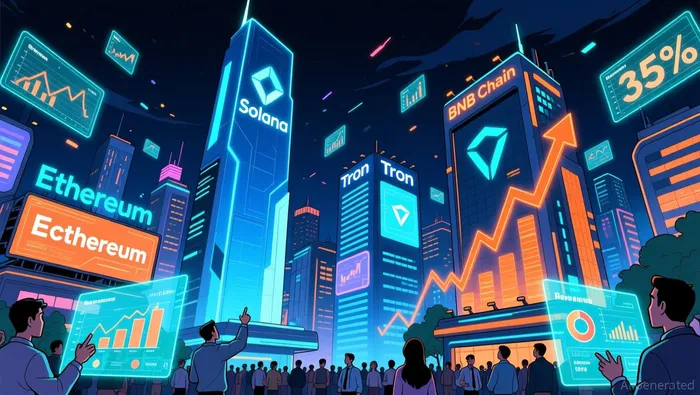
BNB Chain's on-chain fee revenue in 2025 totaled $259.06 million, placing it fourth among major blockchains, trailing Solana ($605.66 million), TronTRX--, and Ethereum. This figure reflects a 35% year-on-year increase in global on-chain revenue for 2025, though it remains 18% below the 2021 peak. Crucially, BNB Chain's fee growth trajectory has been uneven. In 2024, its annual fee revenue stood at $194.78 million, an 8.7% increase from 2023. While this growth rate pales in comparison to Solana's explosive ascent, it aligns with broader institutional adoption trends.
The chain's average transaction fee plummeted to 0.05 gwei in 2025, a 90% drop from 2023 levels, as part of deliberate optimization efforts to remain competitive. This reduction, coupled with the "Gas-Free Carnival" initiative in 2024-which eliminated fees for stablecoin transfers- drove stablecoins to account for 8.8% of all transactions. Such measures highlight BNB Chain's strategic pivot from fee maximization to ecosystem stickiness, prioritizing user retention over short-term revenue.
Institutional Adoption: Metrics That Outpace Revenue
While fee revenue tells only part of the story, BNB Chain's institutional adoption metrics paint a far more robust picture. By September 2025, the network had surpassed 58 million monthly active addresses, outpacing Solana's 38.3 million for the first time since 2024. Daily active addresses surged to 12–17 million, and total value locked (TVL) hit $17.1 billion, driven by DeFi protocols like PancakeSwap and the memecoinMEME-- boom.
Institutional confidence was further cemented by real-world asset (RWA) integrations. By 2024, BNB Chain had onboarded U.S. Treasuries via VanEck, stock tokens from Backed Finance, and T-bill funds from Ondo. These developments, combined with a 150% year-over-year increase in transactions and a 40% TVL growth, underscored the chain's appeal to institutional players seeking scalable infrastructure for both speculative and traditional assets.
Technical Upgrades and Future Scalability
BNB Chain's "Yellow Season" roadmap, aimed at achieving 20,000 transactions per second (TPS) by 2026, has been pivotal in attracting institutional capital. Technical upgrades like Lorentz and Maxwell reduced block times and fees, while the Gas-Free Carnival initiative positioned the chain as a high-speed, low-cost payment rail. These innovations not only enhanced user experience but also aligned with institutional demands for reliability and cost efficiency.
Security improvements further bolstered trust. Financial losses from breaches dropped 67% in 2024 compared to 2023, and incident frequency fell by 66%. Such metrics are critical for institutions wary of operational risks in decentralized ecosystems.
The Investment Thesis: Fee Growth as a Leading Indicator
The correlation between BNB Chain's fee growth and institutional adoption is evident. While its 2025 fee revenue ($259.06 million) trails Solana's, its ecosystem stickiness-measured by TVL, active addresses, and RWA integrations-has grown at a pace that outstrips its fee generation. This suggests that fee revenue is not the sole metric of institutional interest; rather, it is a lagging indicator of deeper network effects.
For investors, the key insight lies in BNB Chain's ability to balance fee optimization with ecosystem expansion. Its technical roadmap, institutional partnerships, and user-centric policies position it as a top-three blockchain with long-term utility. As the "Yellow Season" upgrades roll out in 2026, the chain's capacity to handle 20,000 TPS with sub-second finality could further solidify its role as a backbone for institutional-grade DeFi and RWA applications.
Conclusion
BNB Chain's resurgence is not a tale of fee dominance but of strategic adaptation. By prioritizing scalability, security, and user retention, it has cultivated an ecosystem that attracts both retail and institutional capital. While Solana and Ethereum may lead in fee revenue, BNB Chain's institutional momentum-reflected in its TVL, active addresses, and RWA integrations-suggests a future where its network effects outpace its current metrics. For investors, this divergence between fee generation and ecosystem stickiness presents a compelling case for long-term exposure to BNB.






Comentarios
Aún no hay comentarios