
BRP Inc.'s Share Buyback Strategy: A Strategic Move to Enhance Shareholder Value in a Volatile Market?
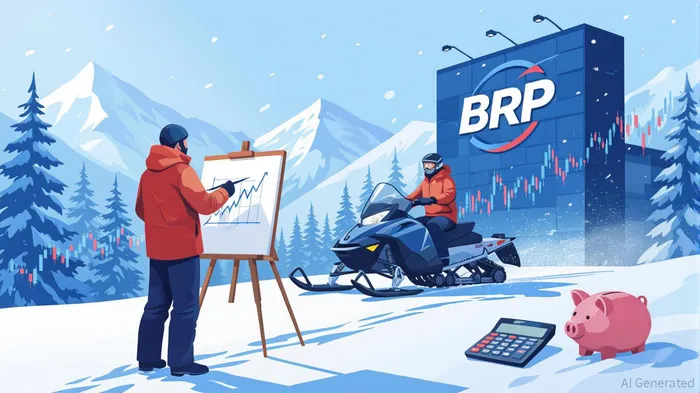
BRP Inc. (TSX: DOO) has renewed its Normal Course Issuer Bid (NCIB) for 2025, authorizing the repurchase of up to 3,331,852 subordinate voting shares—approximately 10% of its public float—over the next 12 months. This move, approved by the Toronto Stock Exchange (TSX), allows BRPDOOO-- to buy shares at market price or through private agreements, with an automatic share purchase plan (APP) ensuring continuity during blackout periods [1]. The company’s board frames the NCIB as a strategic use of available cash to enhance shareholder value, but the financial prudence of this decision requires scrutiny in light of BRP’s volatile earnings, high debt levels, and evolving capital allocation priorities.
Financial Context: A Mixed Bag of Performance
BRP’s 2025 financial results reveal a company navigating cyclical headwinds. Full-year revenue fell 21.4% to $7.83 billion, with a Q4 net loss of $44.5 million contrasting against a $302.8 million profit in the prior-year period [2]. Normalized EBITDA declined 42% to $1.04 billion, while Return on Invested Capital (ROIC) dropped to 9.32%—a sharp decline from 56% in 2022 [3]. Despite these challenges, BRP deployed $277 million in shareholder returns through buybacks and dividends, including a 10% increase in its quarterly dividend to $0.215 per share [2].
The company’s debt burden remains significant, with long-term debt at $2.08 billion as of January 2025 and a debt-to-equity ratio of 6.41 [4]. While BRP’s interest coverage ratio of 3.1x suggests manageable debt servicing, its cost of debt (6.17%) exceeds its ROIC, raising questions about the efficiency of capital allocation [5].
Capital Allocation: Buybacks vs. Debt Reduction and R&D
BRP’s renewed NCIB represents a $277 million commitment to share repurchases, but this must be weighed against alternative uses of capital. The company has allocated $475 million in 2025 for R&D and software infrastructure, focusing on electrification initiatives like the Can-Am Pulse and electric ATVs [6]. These investments target a $109.2 billion EV market by 2034, signaling long-term growth potential. However, with ROIC declining from 56% to 9.32% over three years, the returns on such investments remain uncertain [3].
Debt reduction could also be a compelling alternative. At a cost of debt of 6.17%, retiring high-cost liabilities would improve BRP’s capital structure and reduce financial risk. Yet, with a weighted average cost of capital (WACC) of 8.02%, the company’s cost of equity is higher, suggesting that buybacks might be more accretive if executed at a discount to intrinsic value [5].
Valuation Considerations: Overvalued or Strategic?
BRP’s stock currently trades at $86.43 CAD, above intrinsic value estimates of $75.72 (DCF model) and $59.94 (GuruFocus) [7]. This suggests the market may be pricing in future growth from electrification and inventory normalization, which reduced North American powersports inventory by 18% in 2025 [6]. However, if shares are overvalued, repurchasing them at a premium could erode shareholder value. BRP’s previous NCIB achieved an average price of $90.76, implying the current program may be executed near intrinsic value [1].
Strategic Rationale and Risks
BRP’s NCIB aligns with its broader strategy to balance short-term liquidity with long-term innovation. By reducing inventory and normalizing dealer relationships, the company aims to stabilize pricing power and restore demand. However, the program’s success hinges on execution: repurchasing shares during periods of undervaluation and avoiding overpaying in a volatile market.
The risk lies in prioritizing buybacks over debt reduction or R&D during a period of declining ROIC. While the board views the NCIB as a “strategic use of available cash,” investors must assess whether this approach optimizes capital efficiency or merely propped up short-term metrics [1].
Conclusion
BRP’s renewed NCIB reflects a calculated effort to enhance shareholder value amid a challenging operating environment. However, the decision to allocate $277 million to buybacks rather than debt reduction or R&D requires careful evaluation. With a declining ROIC, high debt, and mixed valuation signals, the program’s long-term impact will depend on BRP’s ability to execute repurchases at favorable prices and drive returns from its electrification bets. For now, the NCIB appears to be a defensive move, balancing immediate shareholder returns with the risks of a capital-intensive, cyclical business.
Source:
[1] BRP ANNOUNCES THE RENEWAL OF ITS NORMAL COURSE ISSUER BID [https://brp.gcs-web.com/news-releases/news-release-details/brp-announces-renewal-its-normal-course-issuer-bid-7/]
[2] BRP PRESENTS ITS FOURTH QUARTER AND FULL-YEAR 2025 RESULTS [https://www.prnewswire.com/news-releases/brp-presents-its-fourth-quarter-and-full-year-2025-results-302411464.html]
[3] #104 BRP Inc.DOOO-- - A Stock Analysis - Kroker Equity Research [https://krokerequityresearch.substack.com/p/104-brp-inc-a-stock-analysis]
[4] BRP Inc. (DOOO) Statistics & Valuation [https://stockanalysis.com/stocks/dooo/statistics/]
[5] BRP (TSX:DOO) WACC % [https://www.gurufocus.com/term/wacc/TSX:DOO]
[6] BRP Inc. (DOOO): Assessing Earnings Volatility and Strategic Outlook Q2 Earnings Decline [https://www.ainvest.com/news/brp-dooo-assessing-earnings-volatility-strategic-outlook-q2-earnings-decline-2508]
[7] DOO Intrinsic Valuation and Fundamental Analysis - BRP Inc [https://www.alphaspread.com/security/tsx/doo/summary]





Comentarios
Aún no hay comentarios