
Brookfield Renewable's Q2 2025 Earnings: A Contrarian Opportunity Amid Earnings Miss and Strategic Growth Catalysts?
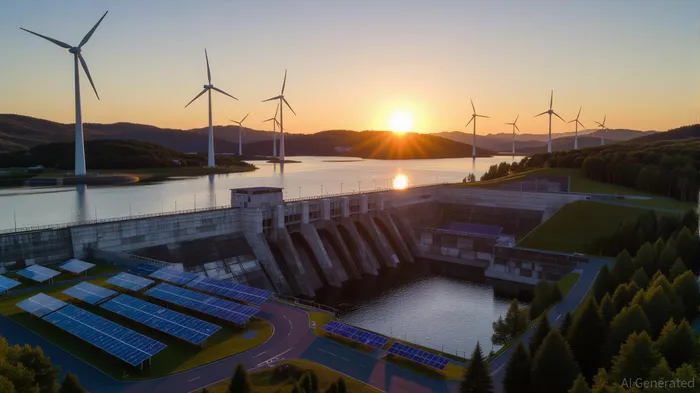
Brookfield Renewable Partners LP (BEP) reported Q2 2025 earnings that highlight a classic tension between short-term accounting metrics and long-term strategic value. While the company posted a net loss of $0.22 per unit—a slight improvement from $0.28 in Q2 2024—investors should look beyond the headline EPS miss to uncover a compelling story of operational resilience, capital discipline, and positioning for the energy transition.
The EPS Miss: A Red Herring in a High-Operating-Cash-Flow Business
Brookfield Renewable's Q2 net loss reflects non-cash items and the inherent volatility of its infrastructure-heavy business model. However, the company's Funds From Operations (FFO) surged 10% year-over-year to $0.56 per unit, a metric far more relevant for assessing its cash-generating capacity. This divergence underscores a critical truth: Brookfield RenewableBEP-- is a cash-flow engine, not a traditional earnings-focused business.
The hydroelectric segment, which contributes nearly half of total FFO, delivered a staggering 50% year-over-year increase, driven by above-average hydrology in its U.S. and Colombian assets. Meanwhile, the Distributed Energy, Storage, and Sustainable Solutions segment grew FFO by 40%, fueled by Westinghouse's nuclear operations and expanding battery storage projects. These results suggest the company is not only surviving but thriving in a fragmented energy landscape.
The $4.7 Billion Liquidity Buffer: A Strategic Weapon
Brookfield Renewable's balance sheet is a fortress, with $4.7 billion in liquidity as of June 30, 2025. This liquidity, bolstered by $1.5 billion in asset sale proceeds and $19 billion in year-to-date financings, provides unmatched flexibility to navigate near-term headwinds and accelerate growth.
The company's asset recycling strategy—selling non-core hydro and wind assets to fund high-margin renewables—has been a masterstroke. For example, the sale of U.S. hydro assets netted $520 million, which will be reinvested into projects with higher IRRs. This approach mirrors Warren Buffett's “buy, fix, sell” playbook but with a green twist.
Diversified Portfolio as a Hedge Against Energy Market Volatility
Brookfield Renewable's strength lies in its diversified energy portfolio, spanning hydro, wind, solar, nuclear, and battery storage. This mix ensures stable cash flows even as individual segments face cyclical pressures. For instance, while solar and wind face interconnection delays in PJM, the company's hydroelectric and nuclear assets provide baseload reliability.
The recent Hydro Framework Agreement with Google to deliver 3 GW of U.S. hydro capacity is a game-changer. This partnership not only secures long-term contracts but also positions BrookfieldBN-- as a preferred partner for tech giants seeking clean energy. The CEO, Connor Teskey, hinted that the agreement could unlock M&A opportunities in a now-liquid hydro market, further amplifying growth potential.
M&A and Tax Credit Tailwinds: The 2025 Catalysts
Brookfield Renewable's M&A playbook is uniquely positioned to capitalize on the energy transition. The company's $230 GW development pipeline, including 4,300 GWh/year of contracted generation, is a goldmine for strategic acquisitions. Recent moves, like increasing its stake in Colombia's Isagen and acquiring Urban Grid for its interconnection advantages, demonstrate a sharp focus on scalable, high-IRR projects.
Moreover, the company's ability to secure tax credit eligibility for U.S. projects through 2029—despite regulatory uncertainties—signals a deft operational playbook. This is critical, as tax credits will be a make-or-break factor for renewable developers in the coming years.
Risks and Mitigants
Critics will point to interconnection bottlenecks, tax credit expiration risks, and the cyclical nature of hydrology. However, Brookfield Renewable has already baked these into its strategy. Its battery storage expansion and hybrid financing structures (e.g., the €6.3 billion Poland offshore wind deal) mitigate transmission constraints, while its asset recycling model ensures capital is allocated to highest-conviction opportunities.
Investment Thesis: Buy the Dip, Not the Earnings Report
Brookfield Renewable's Q2 results may underwhelm on paper, but the underlying fundamentals tell a different story. With 10%+ FFO per unit growth guidance for 2025, a $4.7 billion liquidity buffer, and a diversified portfolio insulated from single-sector risks, the company is a prime example of a business where the “miss” is a buying opportunity.
For investors with a 5–10-year horizon, Brookfield Renewable offers a rare combination of reliable cash flows, strategic agility, and exposure to the energy transition. The key is to focus on FFO and liquidity metrics, not quarterly EPS.
Final Call to Action:
Brookfield Renewable's Q2 earnings may not dazzle, but they reveal a company that's outmaneuvering peers in a fragmented energy market. For those who can look past the EPS noise, the long-term value proposition is clear. The question isn't whether Brookfield Renewable is a buy—it's how much of your energy transition portfolio you're willing to allocate to it.
"""





Comentarios
Aún no hay comentarios