
Brookfield's $20 Billion Transition Fund and the Future of Sustainable Infrastructure Investing
In the race to decarbonize the global economy, BrookfieldBN-- Asset Management has emerged as a pivotal player with its Brookfield Global Transition Fund II (BGTF II), a $20 billion private fund dedicated to financing the energy transition. Finalized on October 7, 2025, BGTF II not only surpasses its predecessor-BGTF I, which raised $15 billion in 2022-but also redefines the scale and ambition of sustainable infrastructure investing, according to a GlobeNewswire report. This fund, co-led by former Bank of England Governor Mark Carney and Brookfield's Connor Teskey, is structured to capitalize on the dual imperatives of climate action and capital reallocation, targeting a 12% net internal rate of return (IRR) while aligning with science-based net-zero pathways, according to an InforCapital profile.
Capital Reallocation: A Strategic Shift in Infrastructure Investing
BGTF II represents a deliberate reallocation of capital from traditional infrastructure models to high-growth, low-carbon sectors. According to a report by Bloomberg and a Brookfield announcement, the fund's strategy is anchored in three pillars: clean energy expansion, industrial decarbonization, and sustainable solutions. Over $5 billion has already been deployed into strategic investments, including the acquisition of Geronimo Power (a U.S. solar and storage developer) and a joint venture with India's Evren to develop 10 GW of renewable energy and storage projects, as GlobeNewswire reported. These moves reflect Brookfield's focus on geographies and technologies where decarbonization demand is surging, particularly in energy-intensive sectors like manufacturing and transportation.
The fund's structure also diverges from conventional infrastructure funds. While traditional models often prioritize stable cash flows from toll roads or utilities, BGTF II emphasizes alpha generation through early-stage bets on scalable technologies. For instance, its partnership with Microsoft and Google to secure long-term energy supply deals underscores its ability to lock in demand for renewable assets, mitigating revenue volatility (reported by GlobeNewswire). This approach aligns with Brookfield's broader thesis that the energy transition will unlock trillions in value by 2030, driven by AI-driven energy demand and the electrification of industries, as noted in the InforCapital profile.
Long-Term Alpha: Balancing Risk and Reward
The fund's 12% net IRR target-up from the 10% target of BGTF I-signals Brookfield's confidence in the financial viability of the energy transition, according to the InforCapital profile. However, achieving this requires navigating complex risks, including regulatory shifts, technological obsolescence, and the inherent volatility of renewable energy markets. A comparative Substack analysis highlights that while Brookfield's private infrastructure funds have historically delivered competitive IRRs, their realized gains often lag behind industry benchmarks due to low exit multiples. This raises questions about the sustainability of BGTF II's returns, particularly in a market where greenfield projects face higher upfront costs and longer payback periods.
Nonetheless, BGTF II's focus on capital-light, high-leverage transactions-such as the public-to-private takeover of Neoen (a French renewable energy firm)-positions it to amplify returns through operational efficiencies, as reported by GlobeNewswire. Additionally, the fund's $3.5 billion in co-investments from institutional partners like Norges Bank and ALTÉRRA suggests strong market validation of its risk-adjusted return profile (GlobeNewswire). These co-investments also allow Brookfield to scale its impact without diluting its capital base, a critical advantage in a sector where scale determines competitive edge.
The Road Ahead: Challenges and Opportunities
While BGTF II's ambitions are bold, its success hinges on broader systemic factors. For example, the fund's reliance on decarbonization policies in key markets like the U.S. and India exposes it to political and regulatory uncertainty. Moreover, the energy transition's pace is constrained by supply chain bottlenecks and the high cost of critical minerals like lithium and cobalt. Brookfield's ability to navigate these challenges will depend on its agility in structuring partnerships and leveraging its global infrastructure expertise.
Yet, the fund's potential to reshape sustainable infrastructure investing is undeniable. By integrating environmental, social, and governance (ESG) metrics into its investment criteria and prioritizing projects with measurable carbon-reduction outcomes, BGTF II sets a new benchmark for aligning financial and environmental goals, according to the Brookfield announcement. As Mark Carney noted in a recent press release, "The transition to net-zero is not just an environmental imperative-it's a $10 trillion opportunity for investors who act decisively" (GlobeNewswire).
Conclusion
Brookfield's BGTF II exemplifies the next phase of sustainable infrastructure investing: a model where capital reallocation and alpha generation are inextricably linked to the global energy transition. While risks persist, the fund's strategic focus on scalable technologies, its alignment with decarbonization demand, and its ability to attract top-tier co-investors position it as a leader in this rapidly evolving space. For investors, the question is no longer whether the energy transition will deliver returns-but how quickly Brookfield and its peers can scale the infrastructure to make it happen.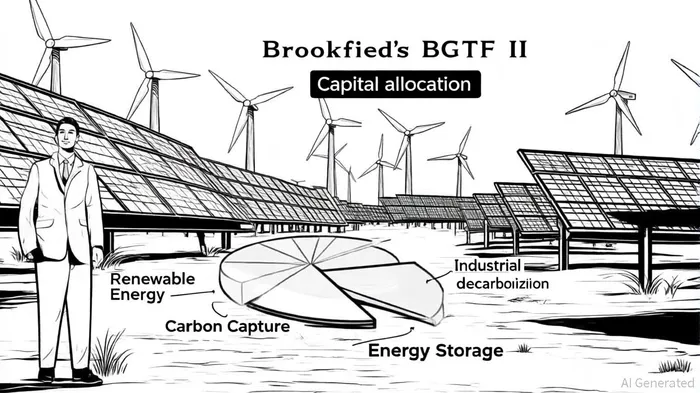





Comentarios
Aún no hay comentarios