
Brookfield's $20 Billion Transition Fund: A Catalyst for Sustainable Infrastructure and Market Confidence in the Green Energy Shift
Brookfield's $20 Billion Transition Fund: A Catalyst for Sustainable Infrastructure and Market Confidence in the Green Energy Shift
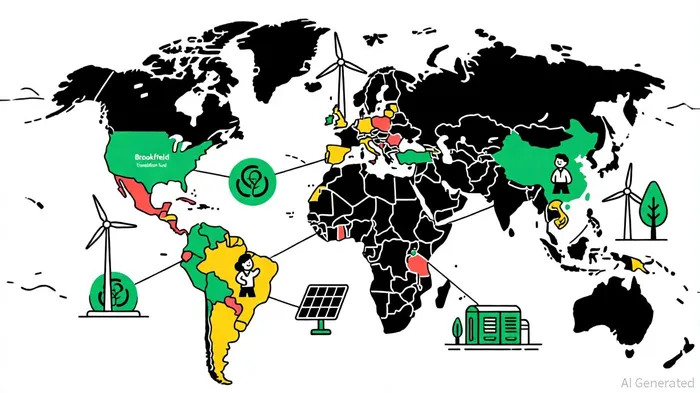
In the race to decarbonize the global economy, BrookfieldBN-- Asset Management has emerged as a formidable force. The firm's recent announcement of a $20 billion transition fund-Brookfield Global Transition Fund II (BGTF II)-has not only set a new benchmark for capital mobilization in sustainable infrastructure but also underscored the growing alignment between investor priorities and the urgent need for climate action. This fund, alongside its complementary Catalytic Transition Fund (CTF), represents a strategic pivot toward emerging markets, where the energy transition remains underfunded despite its critical role in achieving net-zero goals.
A Record-Setting Capital Raise and Strategic Structure
Brookfield's BGTF II, which reached its final institutional close in October 2025, secured $20 billion in commitments, surpassing the $15 billion raised by its predecessor, BGTF I, according to a GlobeNewswire report. The fund's success is a testament to the firm's ability to attract both traditional and new institutional investors, including ALTÉRRA (a $2 billion commitment) and Norges Bank Investment Management (a $1.5 billion commitment). This capital is now being deployed into high-impact projects such as renewable power generation, battery storage, and joint ventures in India and Latin America.
The CTF, a $5 billion private equity and infrastructure fund, further amplifies Brookfield's reach. Anchored by a $1 billion catalytic capital commitment from ALTÉRRA, the CTF has already raised $2.4 billion as of September 2024, with additional backing from CDPQ, GIC, and Temasek, per a Brookfield press release. Brookfield's 10% co-investment in the CTF-a move that aligns its interests with investors-has also signaled confidence in the fund's ability to unlock private capital for decarbonization in underfunded regions.
Market Confidence and the Investor Sentiment Shift
The record fundraising for BGTF II reflects a broader shift in investor sentiment. The GlobeNewswire report highlights the fund's diverse investor base-including new participants like Norges Bank-which demonstrates a growing appetite for green energy investments. This trend is not isolated to Brookfield. According to an Infor Capital analysis, the global transition to a net-zero economy has spurred demand for private capital in clean energy, with Brookfield positioned as the largest transition investor among private fund managers.
Expert analyses further validate this optimism. As noted in a Nasdaq analysis, six analysts have evaluated Brookfield in recent months, with a predominantly bullish outlook. They highlight the firm's leadership in renewable energy and its strategic focus on markets where the energy transition is lagging, such as South and Southeast Asia. As one analyst noted, "Brookfield's ability to scale projects in emerging markets addresses a $1.6 trillion annual investment gap, making it a critical player in the climate finance ecosystem."
Capital Allocation and the Road Ahead
The deployment of capital into Brookfield's transition funds has already begun. By October 2025, over $5 billion had been allocated to projects including the acquisition of Geronimo Power and a joint venture with India's Evren to develop 10 GW of wind and solar capacity. These investments are not just about scale; they are about transforming carbon-intensive sectors. Brookfield's focus on industrial decarbonization, sustainable living, and climate technologies aligns with the International Energy Agency's (IEA) call for a 50% increase in annual clean energy investment by 2030, as laid out in an IEA report.
However, challenges remain. While the CTF aims to close its first round by early 2025, the fund's success will depend on its ability to navigate regulatory complexities and currency risks in emerging markets. Brookfield's track record in infrastructure development-spanning decades of experience in renewable energy and public-private partnerships-positions it to mitigate these risks, but the broader market will be watching closely.
Implications for Sustainable Infrastructure Investing
Brookfield's transition funds are more than a financial milestone; they are a blueprint for how private capital can accelerate the energy transition. By leveraging catalytic capital from entities like ALTÉRRA, Brookfield is creating a model where public and private interests converge to address systemic gaps in climate finance. This approach is particularly vital in regions where government funding is insufficient, and where the cost of capital remains prohibitively high for clean energy projects.
For institutional investors, the funds offer a compelling proposition: exposure to high-growth, mission-driven assets in markets poised for rapid decarbonization. As energy demand surges-driven by AI-driven data centers and electrification-Brookfield's investments in battery storage and renewable infrastructure are likely to generate both environmental and financial returns.
Conclusion
Brookfield's $20 billion transition fund is a landmark achievement, but its true impact will be measured by its ability to scale clean energy projects in the world's most challenging markets. The firm's success in raising capital and deploying it into strategic initiatives underscores a broader truth: the energy transition is no longer a niche pursuit but a central pillar of global investment strategy. As the clock ticks toward 2030, Brookfield's efforts-and the confidence they have inspired-may well determine whether the world meets its climate goals or falls short.







Comentarios
Aún no hay comentarios