
Broadstone Net Lease's $350M Senior Notes Offering and Capital Structure Implications
Broadstone Net Lease, Inc. (BNL) has executed a $350 million senior unsecured notes offering at a 5.000% coupon, maturing in November 2032, to fund acquisitions, repay debt, and support corporate initiatives[1]. This move, coupled with its March 2025 $1.5 billion credit facility refinancing, underscores a strategic shift toward optimizing capital structure while maintaining aggressive growth in industrial real estate. However, the decision to issue higher-yielding debt amid existing lower-cost financing raises critical questions about cost-effectiveness and long-term capital deployment efficiency.
Refinancing Strategy: Balancing Rates and Maturity
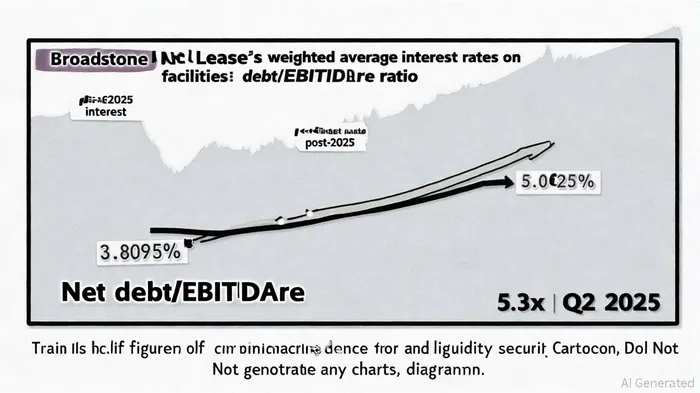
BNL's existing credit facilities, restructured in March 2025, include a $1.0 billion revolving credit facility (maturing March 2029) and a $500 million term loan (maturing March 2028). These facilities replaced a $400 million term loan due in February 2026 and offer improved borrowing rates, with a weighted average interest rate of 4.80% (hedged to 3.89% via swaps) as of June 30, 2025[3]. The new $350 million senior notes, priced at 5.000%, carry a higher coupon than the hedged rate of existing debt.
This apparent mismatch reflects a calculated trade-off. By issuing long-term notes at 5.00%, BNLBNL-- extends its debt maturity profile, reducing refinancing risk in a rising-rate environment. The notes' 2032 maturity aligns with the 10.8-year weighted average lease term of its recent acquisitions[4], ensuring cash flow stability to service debt. Additionally, the offering allows BNL to repay portions of its $1.0 billion revolver, preserving liquidity for opportunistic acquisitions. As of Q2 2025, the company held $800 million in revolver availability[5], a buffer that supports its $269 million build-to-suit pipeline through Q3 2026[2].
Capital Deployment Efficiency: High-Yield Industrial Focus
BNL's capital allocation strategy remains anchored in industrial real estate, where it achieved a 7.2% initial cash capitalization rate and 8.3% straight-line yield in Q2 2025[2]. These metrics outperform the 7.3% average cap rate of 2024 acquisitions[4], reflecting disciplined underwriting. The company's 99.1% occupancy rate and 99.6% rent collection efficiency[4] further validate the resilience of its portfolio.
However, elevated leverage ratios—5.3x net debt/EBITDAre in Q2 2025[5]—highlight the risks of aggressive deployment. While BNL's liquidity position (including $800 million in revolver availability) mitigates immediate concerns, the 5.00% senior notes' cost exceeds the hedged rate of existing debt by 111 basis points. This premium could erode returns if future acquisitions fail to match current cap rates or if interest rates rise further.
Long-Term Implications and Risks
BNL's refinancing strategy prioritizes maturity extension over rate optimization, a prudent approach given its long-lease, stable-cash-flow assets. The 2032 notes provide certainty in a volatile rate environment, while the 2025 credit facilities' extension options (e.g., two six-month extensions for the revolver) offer flexibility to navigate economic cycles[1].
Yet, the company's leverage trajectory warrants scrutiny. A 44.8% year-over-year decline in Q2 2025 net income to $19.8 million, driven by an $8.1 million impairment charge[2], signals potential underperformance in non-core assets. BNL's reduction of its clinical healthcare portfolio to 3.2% of average basis rent[2] suggests a recalibration toward higher-quality sectors, but asset-level risks persist.
Conclusion: Strategic Alignment with Market Realities
BNL's $350 million notes offering and broader refinancing efforts reflect a strategic alignment with its industrial-focused growth model. While the 5.00% coupon exceeds existing hedged rates, the extended maturity and liquidity preservation justify the cost in a risk-averse environment. Investors should monitor the company's ability to sustain high-cap-rate acquisitions and manage asset-level risks, particularly as leverage ratios remain elevated. For now, BNL's disciplined capital deployment and robust portfolio occupancy position it to capitalize on industrial real estate's long-term tailwinds.





Comentarios
Aún no hay comentarios