
Broadcom's Strategic Move into AI with OpenAI: A Paradigm Shift for Semiconductor Demand
The semiconductor industry is undergoing a seismic transformation, driven by the exponential growth of artificial intelligence (AI). At the forefront of this shift is Broadcom's landmark collaboration with OpenAI, a partnership that signals a pivotal reorientation of semiconductor demand toward custom AI accelerators and integrated networking solutions. This $10+ billion agreement to co-develop and deploy 10 gigawatts of AI infrastructure by 2029 not only underscores the urgency of scaling AI capabilities but also redefines the competitive landscape for chipmakers and infrastructure providers.
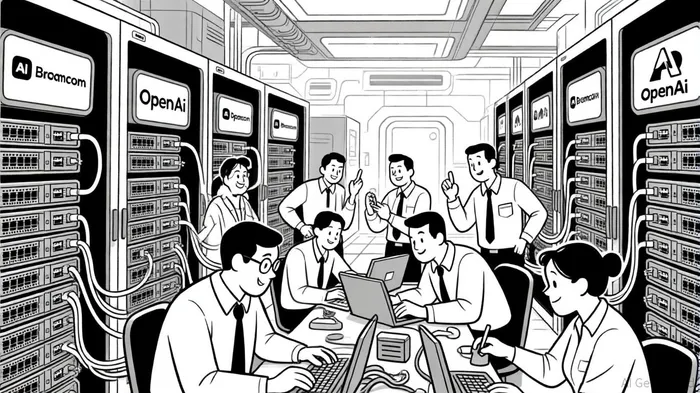
A Strategic Alliance for Custom AI Infrastructure
OpenAI's decision to design its own AI accelerators, while leveraging Broadcom's Ethernet networking solutions, marks a departure from traditional reliance on off-the-shelf GPUs. By embedding AI model insights directly into hardware, OpenAI aims to optimize performance for training and inference workloads, a strategy that aligns with broader industry trends toward domain-specific silicon. For BroadcomAVGO--, the partnership represents a strategic deepening of its AI infrastructure footprint, with AI already accounting for 25% of its revenue. The deployment timeline-beginning in late 2026 and concluding by 2029, as Broadcom's press release notes-positions Broadcom to capitalize on a multi-year AI supercycle of demand for specialized computing power.
Rethinking Semiconductor Demand: From General-Purpose to AI-Optimized
The Broadcom-OpenAI deal exemplifies a broader industry pivot toward custom silicon. Unlike general-purpose GPUs, AI accelerators are tailored to the unique computational needs of neural networks, enabling higher efficiency and lower costs per inference, a trend that CNBC has also reported. This shift is accelerating as AI models grow in complexity, with OpenAI's pursuit of artificial general intelligence (AGI) demanding unprecedented compute capacity, according to a TechCrunch report. By co-designing hardware with its software stack, OpenAI gains tighter control over performance bottlenecks, while Broadcom benefits from a long-term, high-margin contract in a sector projected to grow at 30% CAGR.
Competitive Dynamics and Market Implications
Broadcom's entry into this space intensifies competition with rivals like NVIDIA and AMD, both of whom have existing partnerships with OpenAI, as reported by The New York Times. However, Broadcom's strength lies in its Ethernet and networking expertise, which are critical for scaling AI data centers. The integration of Broadcom's connectivity solutions into OpenAI's infrastructure highlights the growing importance of holistic AI ecosystems-where accelerators, networking, and software are co-optimized. This approach could set a new standard for AI infrastructure, compelling other chipmakers to either diversify their offerings or risk obsolescence.
Financial and Strategic Payoffs for Broadcom
The financial stakes are immense. Bloomberg reported that a $10+ billion deal over three years would significantly boost Broadcom's revenue and reinforce its leadership in the AI semiconductor market. Moreover, the partnership aligns with Broadcom's broader strategy to dominate high-growth segments, as evidenced by its recent acquisitions in optical networking and cybersecurity. Analysts note that this collaboration could drive long-term value creation by securing a recurring revenue stream from OpenAI and its partners, according to TechSpot, while also enhancing Broadcom's R&D capabilities through co-development opportunities described in industry coverage.
Conclusion: A New Era for Semiconductor Innovation
Broadcom's partnership with OpenAI is more than a commercial agreement-it is a harbinger of a new era in semiconductor innovation. As AI transitions from a niche application to a foundational technology, the demand for custom accelerators and integrated infrastructure will only intensify. For investors, this collaboration underscores the importance of positioning in companies that can navigate the dual challenges of hardware specialization and ecosystem integration. In this rapidly evolving landscape, Broadcom's strategic foresight and technical capabilities position it as a key beneficiary of the AI supercycle.





Comentarios
Aún no hay comentarios