
Is Broadcom (AVGO) Still Undervalued Amid a Cooling Tech Rally?
The global tech sector, once ablaze with exuberance, has entered a phase of recalibration. As valuations across the industry face scrutiny, investors are recalibrating their focus to companies with durable competitive advantages and growth trajectories that transcend short-term volatility. BroadcomAVGO-- (AVGO), a titan in the semiconductor space, has emerged as a focal point of this debate. While its valuation metrics appear elevated relative to industry peers, a deeper analysis reveals a compelling interplay between its current pricing and its prospects in the AI-driven semiconductor revolution.
Valuation Metrics: A Premium Justified by Growth?
Broadcom's valuation metrics stand out in the semiconductor sector. As of 2025, the company trades at a price-to-earnings (P/E) ratio of approximately 73.3, significantly exceeding the U.S. semiconductor industry average of 42.3. Similarly, its price-to-sales (P/S) ratio of 26.09 dwarfs the sector norm. At first glance, these figures suggest overvaluation. However, the price-to-earnings-to-growth (PEG) ratio of 0.96 offers a more nuanced perspective, indicating that the stock's premium is largely supported by robust expectations for future earnings growth.
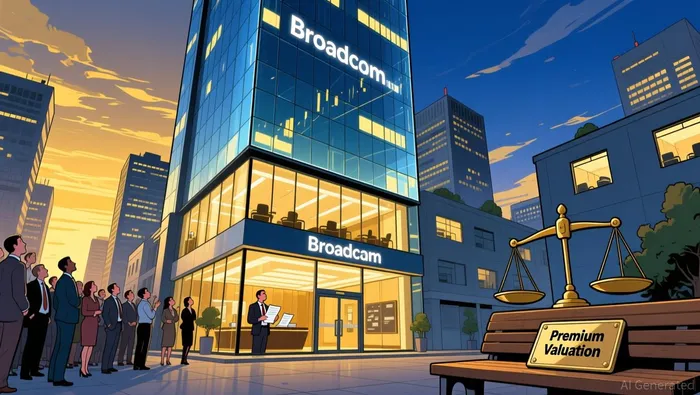 This dynamic reflects a broader trend: investors are willing to pay a premium for companies with clear pathways to capturing the AI semiconductor boom. Broadcom's fiscal 2025 fourth-quarter results underscore this rationale, with AI semiconductor revenue surging 74% year-over-year to $6.5 billion. Such performance not only validates the company's strategic bets but also reinforces the argument that its valuation is tethered to tangible, high-growth fundamentals rather than speculative hype.
Future Earnings Potential: Leading the AI Semiconductor Charge
Broadcom's positioning in the AI semiconductor market is arguably its most compelling asset. The company has secured critical contracts with hyperscalers and AI startups, including a $10 billion order from Anthropic and a multi-billion-dollar deal with OpenAI. These partnerships highlight its ability to deliver application-specific integrated circuits (ASICs) that offer cost-effective alternatives to traditional GPU-based solutions, a niche where it is outpacing even established leaders like Nvidia.
Looking ahead, Broadcom's revenue guidance for 2026 is nothing short of transformative. The company anticipates a doubling of AI semiconductor revenue in the first quarter of fiscal 2026, projecting $8.2 billion in sales. Analysts have further amplified these expectations, forecasting a 52% revenue growth in 2026 and an additional 37% in 2027. Citigroup analysts, for instance, predict that AI revenue could leap from $20 billion in fiscal 2025 to over $50 billion in fiscal 2026. Such trajectories, if realized, would cement Broadcom's status as a cornerstone of the AI infrastructure ecosystem.
The broader market context also bolsters these projections. AI capital expenditures are projected to grow by 50–60% in 2026, driven by demand for advanced data center capabilities. While Nvidia remains the dominant force in AI chips, Broadcom's focus on ASICs is carving out a distinct and expanding niche. This diversification of the AI chip market reduces reliance on any single player and positions Broadcom to benefit from multiple growth vectors.
Balancing the Equation: Is the Premium Sustainable?
The critical question remains: Can Broadcom sustain its valuation premium amid a cooling tech rally? The answer hinges on two factors. First, the company must continue to outperform expectations in AI semiconductor revenue, particularly as competition intensifies. Second, macroeconomic conditions-such as interest rates and global demand for AI infrastructure-will play a pivotal role in determining whether the sector's growth remains resilient.
Broadcom's current valuation, while elevated, appears calibrated to its growth prospects. A PEG ratio near 1.0 suggests that the market is pricing in earnings growth that aligns with analyst forecasts. Moreover, its ability to secure large-scale contracts and innovate in ASICs provides a buffer against the volatility that has plagued broader tech stocks. For investors with a medium- to long-term horizon, the company's strategic alignment with the AI revolution may justify the premium.
Conclusion
Broadcom's valuation metrics may initially seem unattractive compared to industry averages, but they are underpinned by a clear and accelerating growth story in the AI semiconductor sector. As the company scales its AI revenue and solidifies its leadership in ASICs, the premium it commands appears increasingly justified. While the broader tech rally has cooled, Broadcom's trajectory suggests that it is not merely riding the wave but actively shaping the future of AI infrastructure. For discerning investors, the question is no longer whether AVGOAVGO-- is undervalued, but whether its growth potential can outpace the challenges of a maturing market.





Comentarios
Aún no hay comentarios