
BRICS as a Strategic Hedge Against U.S. Trade Volatility: Navigating the Rise of the Global South
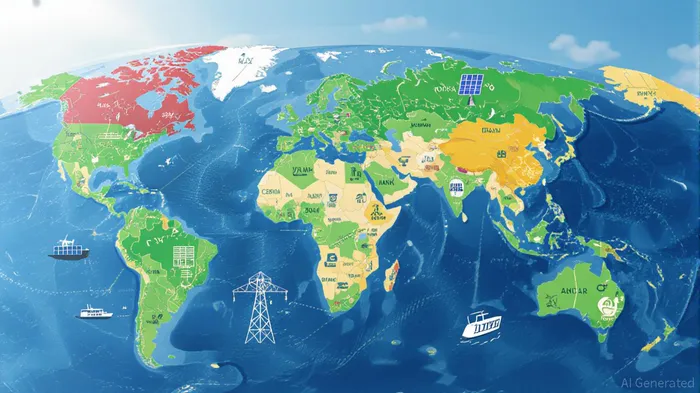
The global economic order is undergoing a seismic shift. As U.S. trade policies increasingly prioritize protectionism—exemplified by President-elect Donald Trump's proposed tariffs on BRICS nations—the world's largest emerging economies are accelerating their pivot toward self-reliance. The BRICS group, now expanded to 10 members, is no longer a loose coalition of anti-Western sentiment. It is a strategic bloc building alternative financial systems, infrastructure networks, and trade corridors to insulate itself from U.S. dollar volatility and geopolitical fragmentation. For investors, this represents a unique opportunity to hedge against the risks of a U.S.-centric world order while capitalizing on the rise of the Global South.
Geopolitical Realignment: Brazil's Diplomatic Balancing Act
Brazil's leadership in the 2025 BRICS Summit in Rio de Janeiro underscored a broader trend: the bloc's shift from ideological posturing to pragmatic economic integration. Under President Luiz Inácio Lula da Silva, Brazil has skillfully navigated its relationships with China, India, and Russia. For instance, while deepening trade ties with China—Brazil's largest trading partner—Lula has also pushed for a more equitable voice for emerging economies in institutions like the IMF. This balancing act reflects a strategic understanding: BRICS must avoid over-reliance on any single power while leveraging its collective weight to reshape global governance.
Brazil's advocacy for a BRICS currency and its push to reform the “gentlemen's agreement” on IMF leadership appointments highlight the bloc's ambition to democratize global finance. These efforts are not merely symbolic. They signal a long-term strategy to reduce exposure to U.S. sanctions and dollar-driven volatility, which have become increasingly weaponized in geopolitical conflicts.
BRICS Infrastructure: A $40 Billion Engine of Resilience
At the heart of BRICS' economic resilience is the New Development Bank (NDB), which has approved $40 billion in projects since 2016. The NDB's focus on infrastructure—logistics, digital networks, and green energy—positions it as a counterweight to Western-dominated institutions. For example, the bi-oceanic railway linking Brazil and Peru, though still in feasibility discussions, could revolutionize South American trade by bypassing U.S. and European ports. Similarly, India's 100% renewable energy targets are being supported by NDB-funded solar and wind projects, with battery storage solutions addressing intermittency challenges.
The NDB's recent expansion into yen- and renminbi-denominated bonds, coupled with its AAA rating from Japan's JCR, demonstrates its growing credibility. By prioritizing local-currency financing—such as a Brazil project funded directly in renminbi—the bank is shielding member states from dollar depreciation risks. This model not only reduces vulnerability to U.S. monetary policy but also fosters domestic capital markets in the Global South.
De-Dollarization and the Rise of Alternative Financial Systems
The BRICS de-dollarization agenda is no longer a distant dream. With one-fifth of oil trades now conducted in non-dollar currencies and a blockchain-based cross-border payment system in development, the bloc is actively reducing its reliance on SWIFT and the U.S. dollar. Russia's prototype BRICS banknote, unveiled at the 2024 Kazan summit, symbolizes a tangible step toward a unified financial identity. While a full-fledged BRICS currency remains aspirational, the group's emphasis on local-currency trade and gold-backed reserves is already reshaping global trade dynamics.
The NDB's $10 billion guarantee fund, set to launch in July 2025, further underscores this shift. By de-risking private-sector investments in infrastructure, the fund aims to attract capital from the Middle East and Asia, diversifying funding sources and reducing dependence on Western banks. For investors, this represents a high-conviction opportunity in sectors like renewable energy, digital infrastructure, and logistics—industries poised to benefit from BRICS-led growth.
Investment Implications: Hedging Against U.S. Fragmentation
The BRICS bloc now accounts for 25% of global GDP and nearly half the world's population. Its expansion—adding countries like Saudi Arabia, Indonesia, and the UAE—has amplified its geopolitical and economic clout. For investors, this presents a dual opportunity:
1. Infrastructure Equity: NDB-backed projects in renewable energy, smart cities, and digital networks offer exposure to high-growth sectors in the Global South.
2. Currency Diversification: As BRICS nations adopt local-currency financing, assets denominated in yuan, rupees, or reais could outperform dollar-denominated counterparts in a de-dollarized world.
However, risks persist. Internal divisions—such as India's cautious stance on de-dollarization and China's push for yuan dominance—could slow integration. Additionally, the NDB's $32 billion portfolio pales in comparison to the World Bank's $100+ billion scale. Yet, for investors seeking to hedge against U.S. trade volatility, the BRICS narrative is compelling.
Conclusion: A New Axis of Economic Power
The BRICS group is not merely reacting to U.S. trade policies—it is building an alternative. By investing in infrastructure, digital sovereignty, and alternative financial systems, the bloc is creating a self-sustaining economic ecosystem. For investors, this represents a strategic hedge against the uncertainties of a fragmented global order. As the 2025 Rio Summit's 126 commitments demonstrate, the BRICS are not just reshaping trade; they are redefining the rules of the game.
In a world where U.S. tariffs and dollar weaponization dominate headlines, the BRICS offer a path forward—one rooted in sovereignty, sustainability, and the rising power of the Global South. For those willing to bet on this shift, the rewards could be transformative.







Comentarios
Aún no hay comentarios