
Breville Group's Premium Playbook: Can Innovation and Brand Equity Sustain Stock Outperformance?
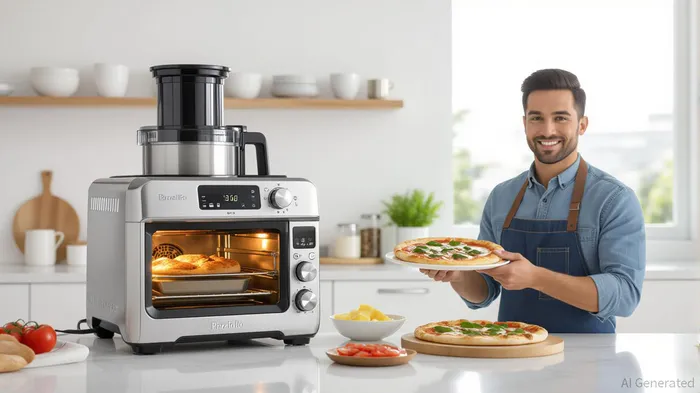
The Breville Group (ASX:BRG) has long been a poster child for premium pricing in the kitchen appliance sector, leveraging engineering innovation and brand equity to command margins that often outpace earnings growth. While the company's stock has historically outperformed broader market indices, the question remains: Can Breville's recent product launches, such as the Paradice series and Pizzaiolo oven, sustain investor enthusiasm in an era where consumers increasingly demand both functionality and value?
Engineering as a Differentiator: Precision and Premium Pricing
Breville's latest innovations underscore its commitment to niche markets willing to pay a premium for specialized tools. The Paradice series, for instance, redefines food processing with its precision dicing capabilities. The Paradice 9 ($399) and Paradice 16 ($699) models offer users programmable cube sizes (0.5-inch, 5/8-inch, and 5/16-inch) and app integration via the Breville+ platform, which provides step-by-step recipe guidance[1]. These features cater to a segment of home cooks and professional chefs who prioritize efficiency and consistency, even at a high price point.
The Pizzaiolo oven, meanwhile, exemplifies Breville's focus on hyper-specific use cases. Designed for pizza enthusiasts, it combines a pizza stone baking surface with advanced temperature controls and modes like “Air Fryer” and “Dehydrator”[3]. While user feedback highlights occasional reliability issues—such as the “three blinking lights” error and cleaning challenges[2]—the product's ability to deliver restaurant-quality results in a home kitchen reinforces Breville's reputation for engineering excellence.
Brand Equity: A Double-Edged Sword
Breville's brand equity is built on a duality: sophistication and utility. The company markets its appliances as tools for “precision cooking,” appealing to consumers who view kitchen gadgets as investments rather than disposables[1]. This positioning is evident in the Paradice series' emphasis on durability (e.g., a 30-year motor warranty) and the Pizzaiolo's aesthetic appeal, with models like the Brass Accents Range blending seamlessly into high-end kitchens[1].
However, brand equity also comes with risks. The Paradice series' reliance on proprietary accessories—such as $250 compatibility kits for retrofitting older models—has drawn criticism for inflating total ownership costs[1]. Similarly, the Pizzaiolo's maintenance challenges, including fragile pizza stones and out-of-warranty repair expenses, could erode trust in the brand's reliability[2]. These issues highlight a tension between Breville's premium pricing strategy and the expectations of value-conscious buyers.
Innovation vs. Earnings: The Investor Paradox
The disconnect between Breville's stock performance and its earnings growth is a recurring theme. While the company's 2023–2025 financial reports remain undisclosed in the provided sources, the broader market's reaction to Breville's product launches suggests that investors are betting on future innovation rather than current margins. The Paradice series and Pizzaiolo oven, for example, reflect a strategic pivot toward high-margin, low-volume products that cater to passionate niches. This approach aligns with the “experience economy,” where consumers pay premiums for tools that enhance lifestyle and convenience[1].
Yet, sustaining this outperformance requires more than one-off innovations. Breville must address recurring reliability concerns, particularly with the Pizzaiolo, to maintain its premium brand image. The company's ability to balance engineering complexity with user-friendly design—such as the Breville+ app's integration with the Paradice 9—will be critical in retaining customer loyalty[1].
The Road Ahead: Can Breville Keep the Magic Alive?
For Breville to justify its stock's premium valuation, it must demonstrate that its innovations are not just novel but also scalable and sustainable. The Paradice series' success hinges on whether its specialized dicing features can become a standard in home kitchens, while the Pizzaiolo's longevity depends on resolving its maintenance issues. Analysts will likely scrutinize the company's ability to expand its ecosystem of accessories and digital tools (e.g., app content) to deepen customer engagement[1].
Conclusion
Breville's stock outperformance is rooted in its ability to marry engineering innovation with brand storytelling. The Paradice series and Pizzaiolo oven exemplify this strategy, offering premium solutions for niche markets. However, the company's long-term success will depend on its capacity to address reliability concerns and justify its pricing through consistent value delivery. For investors, the key takeaway is that Breville's magic lies not in its earnings alone but in its ability to redefine what consumers are willing to pay for—a recipe that, if executed well, could sustain outperformance for years to come.







Comentarios
Aún no hay comentarios