
Brent Crude Oil's Potential 7-Month Low in 2026: A Convergence of Macroeconomic Shifts, Supply Glut Risks, and OPEC+ Dynamics
The global oil market in 2026 is poised for a dramatic recalibration, with Brent crude prices facing downward pressure from a perfect storm of macroeconomic headwinds, a surging supply overhang, and the evolving calculus of OPEC+ policy. As the year unfolds, the interplay of these forces could push prices toward a 7-month low, testing the resilience of energy markets and challenging long-held assumptions about oil's role in the global economy.
Macroeconomic Headwinds: Demand Destruction and Inventory Overhang
The foundation of this bearish outlook lies in the weakening global demand for oil. According to the U.S. Energy Information Administration, global oil demand growth is expected to slow significantly in 2026, with average Brent prices projected to fall to $52 per barrel due to a combination of inventory builds and structural demand shifts. This aligns with the World Bank's forecast of a decline from $68 in 2025 to $60 in 2026, marking a five-year low.
The slowdown is driven by a confluence of factors: a decelerating Chinese economy, which accounts for nearly 30% of global oil demand, and a broader global economic malaise exacerbated by high interest rates and inflation according to EIA data. Central banks' aggressive monetary tightening has dampened industrial activity and transportation demand, while the transition to renewable energy sources continues to erode long-term oil consumption trends.
Supply Glut: A Structural Overhang Beyond OPEC+ Control
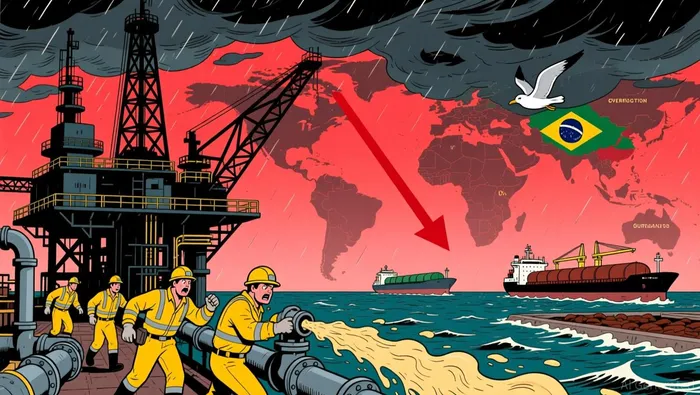 While demand has faltered, supply has surged, creating a stark imbalance. The International Energy Agency estimates a global supply overhang of 4 million barrels per day in 2026, driven by non-OPEC producers such as the United States, Brazil, and Guyana. U.S. shale production, in particular, has rebounded sharply, with output nearing 13 million barrels per day, while emerging producers in the Atlantic basin have added incremental capacity.
This surge in supply has outpaced OPEC+'s ability to manage the market. Despite the cartel's earlier decision to unwind supply cuts at a faster pace, the resulting surplus of over 2 million barrels per day has kept prices in check. Wall Street analysts have echoed this bearish sentiment, with JPMorgan forecasting $58 per barrel and Goldman Sachs predicting $56 according to market analysis. These projections reflect a market increasingly dominated by non-OPEC+ dynamics, where OPEC+'s influence is waning.
OPEC+'s Strategic Pause: A Temporary Balm for a Deepening Problem
In response to the oversupply crisis, OPEC+ has adopted a "strategic pause" in its production strategy, maintaining current output levels through Q1 2026 to stabilize prices. This decision, announced in early 2026, temporarily extended supply discipline, pushing Brent crude prices back to the low-$60s range. However, this pause is a short-term fix for a structural issue.
The cartel's ability to curb production is constrained by internal fissures and external pressures. Saudi Arabia, the de facto leader of OPEC+, has signaled a shift toward a more market-driven approach, prioritizing fiscal breakeven targets over price manipulation. Meanwhile, Russia and other members have resisted deeper cuts, fearing revenue losses amid Western sanctions. These divergent priorities have weakened OPEC+'s cohesion, limiting its capacity to counter the supply glut.
The Path to a 7-Month Low: Interconnected Risks and Investor Implications
However, the bearish outlook is not without upside risks. A surprise OPEC+ production cut, a sharper-than-expected slowdown in U.S. shale output, or a rebound in Chinese demand could provide short-term relief. Yet, these scenarios remain speculative, and the structural forces driving the oversupply are unlikely to abate without a fundamental shift in global energy policy or economic conditions.
Conclusion: A Market in Transition
Brent crude's potential 7-month low in 2026 is not merely a function of cyclical factors but a symptom of a deeper transformation in the global energy landscape. As macroeconomic shifts, supply glut risks, and OPEC+ dynamics converge, the oil market is entering a new era of volatility and uncertainty. For investors, the key takeaway is clear: hedging against downside risk and prioritizing flexibility will be critical in navigating this turbulent period.







Comentarios
Aún no hay comentarios