
Breaking the Paycheck-to-Paycheck Cycle: How Retained Income Strategies Counteract Debt-Driven Wealth Erosion
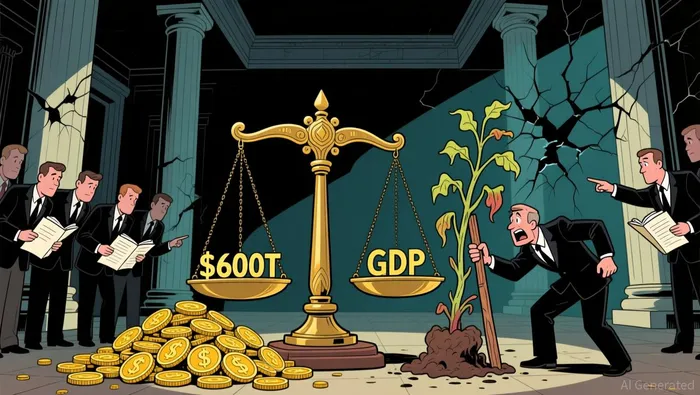
The global financial landscape is at a crossroads. Over the past five years, the world's balance sheet has ballooned to $600 trillion, outpacing GDP growth and concentrating wealth in the hands of the top 1%. This imbalance, driven by asset price inflation and rising debt, has created a fragile system where a single shock-be it a sustained inflationary spike or a balance sheet reset-could erase up to $95,000 of real wealth per capita in the U.S. by 2033 according to analysis. Meanwhile, individuals are increasingly trapped in a paycheck-to-paycheck cycle, with 69% of Americans reporting this financial reality in 2025-a four-year high as data shows. This dual crisis of macroeconomic instability and personal financial fragility demands a rethinking of how wealth is built and preserved.
The Macroeconomic Imbalance: Debt as a Double-Edged Sword
Debt has long been a tool for economic growth, but its role has shifted from a catalyst to a liability. The Congressional Budget Office (CBO) projects that U.S. federal deficits will exceed $20 trillion from 2025 to 2034, with annual deficits climbing from $1.5 trillion to $2.6 trillion according to projections. This trajectory is fueled by rising interest costs, which will surpass defense spending in 2025 and reach 3.9% of GDP by 2034 as research indicates. The implications are stark: a growing debt-to-GDP ratio, projected to hit 166% by 2054, threatens to crowd out investment in productivity and innovation, the engines of sustainable growth according to analysis.
At the individual level, the consequences are equally dire. Middle-class households, constrained by stagnant income growth and rising costs, increasingly rely on high-interest debt to meet basic needs. Credit card debt and unsecured loans have become lifelines, yet these tools deepen financial fragility. A 2025 study notes that middle-class families with high-interest debt are four times more likely to experience work-related distractions due to financial stress compared to those with emergency savings according to Vanguard research. This cycle not only erodes personal wealth but also undermines broader economic stability by reducing consumer spending power and investment capacity.
The Power of Retained Income: A Counterforce to Erosion
Amid this backdrop, retained income strategies emerge as a critical antidote. These strategies-rooted in disciplined budgeting, emergency savings, and long-term investment-offer a path to wealth accumulation that is less susceptible to macroeconomic volatility. For instance, Vanguard's research underscores that individuals with at least $2,000 in emergency savings report 21% higher financial well-being, with stress levels dropping from 51% to 15% according to findings. This buffer enables households to avoid high-interest debt during crises, preserving capital for growth-oriented investments.
On the investment front, retained income strategies are gaining traction among institutional and individual investors alike. BlackRock's 2025 Fall Investment Directions highlights the appeal of fixed-income strategies in the 3- to 7-year yield curve segment, which offers attractive returns with limited duration risk according to analysis. These strategies align with the broader shift toward uncorrelated returns, particularly through liquid alternatives and digital assets, to diversify portfolios in an era of diminishing traditional diversification benefits as research shows. For individuals, this means prioritizing income-generating assets that compound over time, rather than relying on debt-fueled consumption.
Breaking the Paycheck-to-Paycheck Cycle: A Long-Term Perspective
The paycheck-to-paycheck cycle is not merely a personal finance issue; it is a structural challenge with long-term implications. Goldman SachsGS-- Asset Management's 2025 Retirement Survey reveals that 42% of younger workers (Gen Z, Millennials, and Gen X) live paycheck to paycheck, with 74% struggling to save for retirement according to survey data. A ten-year delay in starting retirement savings could reduce total savings by 38%, while eight years out of the workforce could lead to a 27% decline as analysis shows. These figures highlight the compounding costs of short-term financial decisions, which disproportionately affect women and other groups with non-linear career paths according to research.
Retained income strategies offer a way to disrupt this cycle. Early savings, even modest ones, can have outsized effects. For example, saving $500 annually from ages 1 to 20 can increase final retirement savings by 14% according to Goldman Sachs analysis. Similarly, personalized retirement planning and guaranteed income strategies, such as annuities, can address longevity risk and improve outcomes as research indicates. These approaches emphasize the importance of time in wealth accumulation-a principle often overlooked in debt-driven cycles that prioritize immediate needs over long-term security.
The Path Forward: Productivity, Policy, and Personal Discipline
Addressing debt-driven wealth erosion and fostering retained income strategies require a multi-pronged approach. At the macro level, productivity acceleration is essential to restore balance between asset growth and economic output according to McKinsey analysis. Policies that incentivize innovation, education, and infrastructure investment can create the conditions for sustainable wealth creation. At the individual level, financial literacy and access to employer-sponsored retirement plans (e.g., 401(k)s) are critical. The Sightlines Project notes that Americans, particularly younger generations, are increasingly unprepared for retirement due to stagnant savings rates and rising debt burdens according to a special report. Expanding access to financial education and automating savings mechanisms can help bridge this gap.
For investors, the message is clear: retained income strategies are not a panacea but a necessary component of a resilient portfolio. As Fitch Ratings and Moody's signal growing concerns over U.S. debt sustainability according to analysis, the risks of debt-driven wealth erosion become more acute. By prioritizing income retention, diversification, and long-term planning, individuals and institutions can navigate the fragility of the current system and build a foundation for enduring prosperity.
Conclusion
The interplay between debt-driven wealth erosion and retained income strategies defines a pivotal moment in global finance. While macroeconomic imbalances threaten to erode decades of progress, individual and institutional adoption of disciplined, forward-looking strategies offers a path to stability. Breaking the paycheck-to-paycheck cycle requires both personal discipline and systemic change-a dual commitment to preserving capital and fostering productivity. In a world where fragility is the norm, the power of retained income stands as a beacon of resilience.







Comentarios
Aún no hay comentarios