
Bread Financial's Resilient Credit Performance Amid Trade Policy Uncertainty: Strategic Risk Management and Forward-Looking Credit Resilience in a Volatile Macroeconomic Environment
In a macroeconomic climate marked by trade policy uncertainties and inflationary pressures, Bread FinancialBFH-- has emerged as a case study in strategic risk management and credit resilience. As global markets grapple with the ripple effects of shifting tariffs and geopolitical tensions, the company's disciplined approach to capital allocation, credit underwriting, and balance sheet optimization has positioned it to navigate volatility while safeguarding long-term value.
Disciplined Capital Allocation and Credit Tightening
Bread Financial's proactive risk management strategies have been central to its recent performance. According to a report by Investing.com, the company executed a $400 million subordinated notes offering in Q1 2025 and completed a $150 million share repurchase program, directly addressing balance sheet concerns amid macroeconomic headwinds. These moves were part of a broader strategy to strengthen liquidity and optimize capital structure, ensuring the firm remains agile in the face of potential downturns.
The company's credit tightening measures have also played a pivotal role. By refining underwriting standards and leveraging advanced credit loss modeling, Bread Financial has mitigated exposure to high-risk borrowers. As stated by executives during the Q1 2025 earnings call, these actions reflect a “proactive approach to managing credit risk in an environment of evolving consumer behavior and economic uncertainty”.
Improved Credit Metrics Signal Resilience
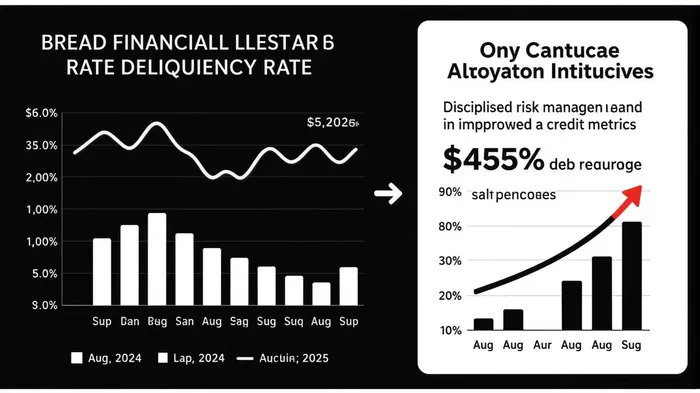
The efficacy of these strategies is evident in Bread Financial's recent credit performance. Data from GlobeNewswire reveals that the company's net loss rate declined to 7.6% in August 2025, down from 7.8% in the same period in 2024. Similarly, the delinquency rate—measuring accounts 30 days or more past due—dropped to 5.8% as of August 31, 2025, from 6.2% a year earlier. These improvements underscore the company's ability to maintain credit quality despite macroeconomic turbulence.
Notably, Bread Financial's reserve rate—a key indicator of its preparedness for economic downturns—remains at 12.2%, as highlighted in a Market Insights Report. This conservative buffer, combined with its focus on technological modernization and customer service enhancements, further bolsters its resilience.
Forward-Looking Strategy: Balancing Growth and Prudence
Looking ahead, Bread Financial's management anticipates Federal Reserve rate cuts in the latter half of 2025, which could alleviate borrowing costs and stimulate consumer spending. The company is already positioning itself to capitalize on this shift while maintaining its risk-averse posture. For instance, its $200 million share repurchase plan, authorized in Q2 2025, signals confidence in its capital position and commitment to shareholder returns.
Moreover, Bread Financial's debt reduction initiatives—such as the successful tendering of senior and subordinated notes—demonstrate its focus on long-term stability. These actions not only reduce refinancing risks but also free up capital for strategic investments in digital innovation and market expansion.
Conclusion: A Model for Navigating Uncertainty
Bread Financial's performance in 2025 highlights the importance of adaptive risk management in volatile environments. By combining credit discipline, capital prudence, and forward-looking strategies, the company has not only stabilized its credit metrics but also positioned itself to thrive amid macroeconomic shifts. For investors, this resilience offers a compelling case for long-term confidence, particularly as trade policy uncertainties and inflationary pressures continue to shape the financial landscape.





Comentarios
Aún no hay comentarios