
BRD Stablecoin: Brazil's High-Interest Economy and DeFi's Gateway to Emerging Markets
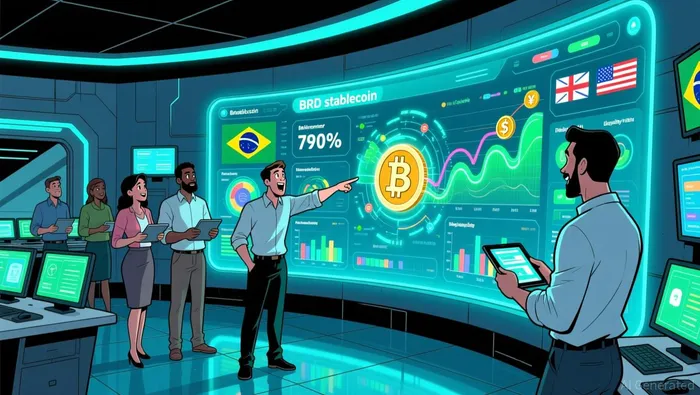
Brazil has emerged as a pivotal player in the global crypto and stablecoin ecosystem, driven by a confluence of economic pressures, regulatory innovation, and a rapidly digitizing population. As the fifth-ranked country in the 2025 Global Crypto Adoption Index, Brazil's stablecoin market now accounts for 30% of on-chain crypto transaction volume, with 90% of virtual asset transfers involving stablecoins according to Chainalysis. This surge is not accidental but a response to inflation, remittance demands, and a regulatory environment that is increasingly aligning with global standards. At the heart of this transformation lies the BRD stablecoin-a Brazilian Real (BRL)-pegged digital asset that is redefining how DeFi protocols exploit Brazil's high-interest economy and serve as a gateway for emerging markets.
Brazil's High-Interest Environment: A Magnet for DeFi Innovation
Brazil's economic landscape in 2025 is characterized by double-digit government bond yields (reaching 14% as of 2025) and a 5% inflation rate, creating a fertile ground for stablecoin-based DeFi strategies. The BRD stablecoin, backed by government bonds and fully collateralized, offers a unique proposition: it allows global investors to access Brazil's attractive yields while mitigating currency volatility as TradingView reports. This is particularly appealing in a world where traditional fixed-income markets are starved of high returns.
DeFi protocols in Brazil are leveraging this dynamic by integrating BRD into yield farming and lending platforms. For instance, Renda Fixa Digital (RFD), a blockchain-based fixed-income product, has distributed $325 million in 2025 alone, offering returns exceeding Brazil's risk-free benchmark rate according to CoinDesk. These platforms enable users to lock BRD into liquidity pools or tokenized bonds, earning yields that outperform traditional savings accounts. The appeal is amplified by Brazil's Gen Z demographic, which now accounts for 56% year-over-year growth in crypto participation, with many using stablecoins as a low-volatility entry point into digital assets as CoinDesk reports.
Regulatory Clarity: A Catalyst for BRD's Expansion
Brazil's Central Bank (BCB) has played a critical role in legitimizing stablecoins by classifying them as foreign exchange (FX) operations under Resolutions 519, 520, and 521 according to Chainalysis. This regulatory shift, effective in February 2026, treats stablecoin transactions like traditional forex transfers, requiring compliance with anti-money laundering (AML) protocols and transaction monitoring. While this introduces compliance costs-such as capital thresholds of R$10.8 million to R$37.2 million for VirtualVIRTUAL-- Asset Service Providers (VASPs)-it also enhances transparency and reduces the risk of illicit activity as Notabene notes.
The BCB's approach has attracted institutional players and fintechs. Platforms like Mercado Pago have launched dollar-backed stablecoins (e.g., Meli Dolar), while B3 is developing a tokenization platform to bridge traditional assets with blockchain-based solutions as CryptoForInnovation reports. These developments underscore Brazil's ambition to become a testbed for crypto integration, setting a precedent for other Latin American markets.
Cross-Border Utility: BRD as a Gateway for Emerging Markets
Beyond Brazil's borders, the BRD stablecoin is gaining traction as a cost-effective solution for cross-border remittances and trade. With 90% of Brazil's crypto flows linked to stablecoins for outbound remittances, BRD offers faster and cheaper alternatives to traditional wire transfers, which often incur fees exceeding 6% according to Plasma. For example, fintechs like Lumx and BlindPay have reduced cross-border payment costs from ~1.5% to ~0.1% by leveraging stablecoins as RebelFi reports.
This utility extends to B2B transactions, where exporters and importers use BRD to hedge against foreign exchange risks. The BRL1 stablecoin, developed by a consortium including Mercado BitcoinBTC-- and Foxbit, has already hit $906 million in H1 2025, demonstrating strong local adoption according to Plasma. As Brazil's regulatory framework matures, it is likely to attract DeFi protocols from other emerging markets, such as Nigeria and Indonesia, where stablecoins similarly address currency instability as Cornell Business reports.
Challenges and Opportunities Ahead
While BRD's potential is vast, challenges remain. The BCB's capital requirements could lead to market consolidation, favoring larger institutions over smaller innovators as Notabene notes. Additionally, the government is considering extending the financial transaction tax (IOF) to stablecoin-based cross-border payments, which may impact liquidity according to Reuters. However, these hurdles also create opportunities for well-capitalized players to dominate the space.
For investors, the key lies in DeFi protocols that bridge Brazil's high-interest environment with global liquidity. Platforms enabling BRD yield farming, tokenized bonds, and cross-border remittances are poised to benefit from Brazil's regulatory clarity and economic fundamentals. As Chainalysis notes, Brazil's DeFi ecosystem is maturing, with institutional-sized transactions driving growth according to Chainalysis.
Conclusion: BRD as a Strategic Asset for Emerging Markets
The BRD stablecoin is more than a hedge against inflation-it is a strategic asset for DeFi protocols seeking to exploit Brazil's high-interest economy and expand into emerging markets. By combining regulatory innovation, fintech adoption, and cross-border utility, BRD is positioning Brazil as a global leader in stablecoin integration. For investors, this represents a unique opportunity to capitalize on a market where DeFi and traditional finance are converging, driven by a population hungry for financial inclusion and innovation.






Comentarios
Aún no hay comentarios