
Brazil's Trade Resilience: Strategic Opportunities Amid U.S. Tariff Volatility and Diversified Export Growth
Brazil's trade landscape in 2025 is defined by a delicate balancing act: navigating the turbulence of U.S. tariff policies while accelerating efforts to diversify its export portfolio. For investors, this duality presents both risks and opportunities. The country's ability to mitigate geopolitical exposure through strategic trade realignment, coupled with its growing influence in critical sectors like renewable energy and mineral resources, underscores its potential as a resilient emerging market play.
The U.S. Tariff Challenge and Economic Implications
The Trump administration's imposition of 50% tariffs on a broad range of Brazilian goods has disrupted supply chains and forced a recalibration of export strategies. According to a report by the Policy Center, these tariffs-exempting only a handful of products such as air transport equipment and iron ore-have already led to a measurable decline in Brazilian exports to the U.S., which accounts for 12% of the country's total exports. The economic fallout is quantifiable: a 10-percentage-point tariff hike could reduce Brazil's GDP by 0.2% to 0.3%, according to estimates, prompting the Central Bank to revise its growth projections downward.
However, Brazil's response has been pragmatic. The government has invoked its Economic Reciprocity Law to justify countermeasures, signaling a willingness to engage in tit-for-tat trade tactics. This assertiveness, while politically charged, reflects a broader strategy to protect domestic industries and maintain leverage in negotiations.
Diversification as a Geopolitical Shield
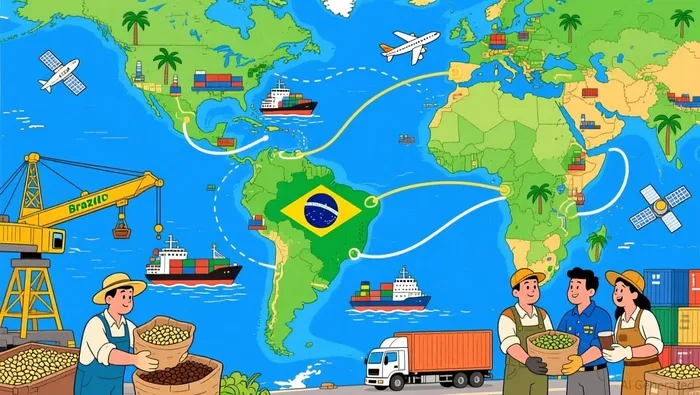 To insulate its economy from U.S. volatility, Brazil has aggressively pursued trade diversification. Data from the Atlantic Council highlights that China remains its largest export market, absorbing 29% of total exports in 2025. This relationship, driven by demand for commodities like soybeans and iron ore, provides a critical buffer against U.S. policy shifts.
Simultaneously, Brazil is expanding into emerging markets. The Belfer Center notes that the country is deepening trade ties with Vietnam, Mexico, Argentina, and the European Union. These partnerships are not merely transactional; they reflect a calculated effort to reduce overreliance on any single market. For instance, Brazil's agricultural exports-coffee, meat, and soybeans-are increasingly directed toward China and Southeast Asia, where tariffs remain more favorable.
Strategic Assets: Critical Minerals and Renewable Energy
Beyond diversification, Brazil's long-term trade resilience is anchored in its natural and industrial assets. The country is a major supplier of critical minerals such as lithium and rare earth elements, which are indispensable for green technologies. As global demand for clean energy infrastructure surges, Brazil's mineral reserves position it as a strategic partner for nations seeking to decouple from Chinese-dominated supply chains.
Moreover, Brazil's renewable energy sector-particularly its expertise in biofuels and hydropower-is gaining international traction. These capabilities enhance its trade leverage, offering value-added exports that transcend raw commodities. For example, Brazilian ethanol exports to the EU and Asia have grown steadily in 2025, capitalizing on stricter carbon regulations in developed markets.
Investment Implications and Long-Term Outlook
For investors, Brazil's trade dynamics highlight a paradox: short-term headwinds from U.S. tariffs coexist with long-term tailwinds from diversification and strategic assets. The immediate risks are clear-tariff-driven export slumps could pressure corporate earnings and currency stability. Yet, the country's proactive trade policies and resource endowments suggest a path to sustained growth.
The European Union and Southeast Asia, in particular, represent underpenetrated markets where Brazil's agricultural and industrial exports could gain share. Additionally, its critical mineral reserves and renewable energy infrastructure offer exposure to global decarbonization trends, aligning with ESG-focused investment strategies.
In conclusion, Brazil's trade resilience is not a product of luck but of deliberate strategy. By mitigating U.S. tariff risks through diversification and leveraging its natural and industrial strengths, the country is positioning itself as a cornerstone of emerging market growth. For investors willing to navigate near-term volatility, Brazil's trade story is one of cautious optimism-and significant long-term potential.







Comentarios
Aún no hay comentarios