
Brazil's Supreme Court Finalizes 27-Year Sentence for Bolsonaro, Spurring Political Uncertainty
Brazil's Supreme Court and Jair Bolsonaro's Legal Case
Brazil's Supreme Court has officially closed the case against Jair Bolsonaro for orchestrating a coup plot, allowing for the start of his 27-year prison sentence. The decision was made after the court rejected his final appeal earlier in November. Details on when Bolsonaro will begin serving his sentence remain unclear, but the legal process is now in motion.
Bolsonaro was placed in pre-trial detention on Saturday after federal police claimed he tampered with his electronic ankle monitor according to reports. The arrest followed concerns that he was attempting to evade justice as his sentence loomed. 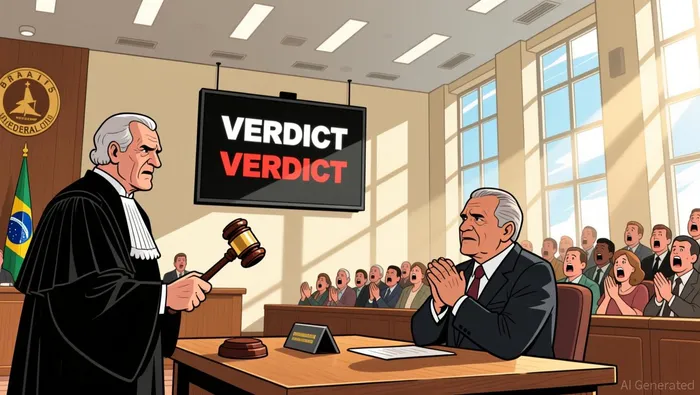 The Supreme Court confirmed the move was a precaution to ensure compliance with the law and public safety.
The arrest came amid heightened political tensions in Brazil and international scrutiny. Bolsonaro's legal team has repeatedly requested that he serve his sentence at home due to health concerns, but the Supreme Court has dismissed those appeals. The figure remains a polarizing figure, with polls suggesting he could still be a strong contender in the 2026 election if eligible to run.
Political and Legal Implications
Bolsonaro's conviction stems from his alleged role in the January 2023 insurrection, where thousands of his supporters stormed government buildings in Brasilia according to court records. The events drew comparisons to the January 6, 2021, U.S. Capitol attack, further complicating diplomatic relations with the United States. The charges were found guilty of leading a criminal organization and attempting to overthrow democracy, charges he has consistently denied.
The ruling has political ramifications for Brazil's 2026 election. With Bolsonaro's prison sentence now pending, his ability to influence the right-wing segment of the electorate is uncertain. His eldest son, Eduardo Bolsonaro, is already facing obstruction charges, which may further fragment the party base according to legal analysts.
International Reactions and U.
S. Ties
The case has also strained U.S.-Brazil relations, particularly under Donald Trump. Trump had previously labeled the trial a "witch-hunt" and imposed 50% tariffs on Brazilian exports in an effort to pressure the Brazilian government. However, Trump recently removed most of those tariffs after a meeting with current Brazilian President Luiz Inácio Lula da Silva at the ASEAN summit. The shift suggests Trump is prioritizing trade negotiations over political alliances, highlighting the limits of his influence on foreign policy.
The U.S. administration's reversal may signal broader diplomatic normalization, as Lula expressed optimism about resolving trade disputes during their meeting. For now, Bolsonaro's arrest underscores the growing strength of Brazil's judiciary in upholding democratic institutions, despite political pressure from abroad.
Legal and Health Challenges
Bolsonaro's legal team has continued to argue that his health conditions make incarceration impractical. They cited medical reports showing the need for regular monitoring of his heart and blood pressure, as well as surgical history including a recent bowel obstruction. The Supreme Court has so far rejected these arguments, but legal experts suggest the debate is not over.
The detention center in Brasilia where Bolsonaro may serve his sentence has also come under scrutiny. Inspections have noted poor conditions, raising concerns about whether the facility can accommodate his medical needs. These issues may lead to further legal challenges or delays in the implementation of the sentence.
Bolsonaro's arrest marks a pivotal moment in Brazil's political and judicial landscape. It sends a message that no individual, regardless of former power, is above the law. As the country moves forward, the case will continue to shape the political discourse and the role of the judiciary in maintaining democratic order.







Comentarios
Aún no hay comentarios