
Brazil's Strategic Crypto Regulatory Tightening and Tax Revenue Potential
Regulatory Overhaul: DeCripto and Global Alignment
In 2025, Brazil implemented Normative Instruction 2.291/2025, overhauling its crypto regulatory framework to align with the OECD's CARF. This update mandates stricter anti-money laundering (AML) and know-your-customer (KYC) procedures for crypto service providers, requiring them to identify users, verify counterparties, and track cross-border transactions in standardized formats. The redesigned DeCripto reporting system, set to become mandatory in July 2026, expands reporting obligations for both domestic and foreign exchanges serving Brazilian users. For instance, individuals must now report transactions exceeding R$35,000 on non-Brazilian platforms.
These changes position Brazil as a regional regulatory benchmark, reflecting its broader pivot toward formalizing the digital-asset economy. By treating crypto-fiat and stablecoin transactions as foreign-exchange (FX) operations, the Central Bank has signaled a commitment to integrating crypto into the formal financial system. For investors, this alignment with global standards could enhance transparency and attract institutional capital, but it also raises compliance costs for platforms and users.
IOF Tax Reforms: Closing Loopholes and Revenue Projections
A parallel regulatory shift involves extending Brazil's IOF tax to cross-border crypto transactions, particularly stablecoins. The Finance Ministry is reviewing proposals to classify stablecoin transfers as FX operations, subjecting them to the same tax framework as traditional currency exchanges. This move aims to address an estimated $30 billion annual revenue shortfall caused by unregulated crypto flows according to financial sources. For example, importers have exploited loopholes by under-invoicing goods and transferring remaining funds via stablecoins to avoid IOF and import duties according to Reuters.
The Central Bank's recent classification of stablecoin transactions as FX operations-effective February 2026-sets the stage for tax implementation according to market reports. If finalized, the IOF extension could increase compliance costs for crypto exchanges and fintechs, potentially reducing the appeal of stablecoins for informal remittances and currency trading according to industry analysis. However, analysts argue that the reform could curb illicit financial flows and enhance consumer protection by integrating the crypto sector into the formal economy according to financial reports.
Market Dynamics: Growth, Risks, and Revenue Potential
Brazil's crypto market has surged by 20% year-over-year, driven by stablecoins and a growing base of retail and institutional investors. The government's push to formalize the sector aligns with global trends, such as the OECD's CARF, but introduces new challenges. For instance, the IOF tax could disincentivize cross-border transactions, reducing the utility of stablecoins like USDT for international payments.
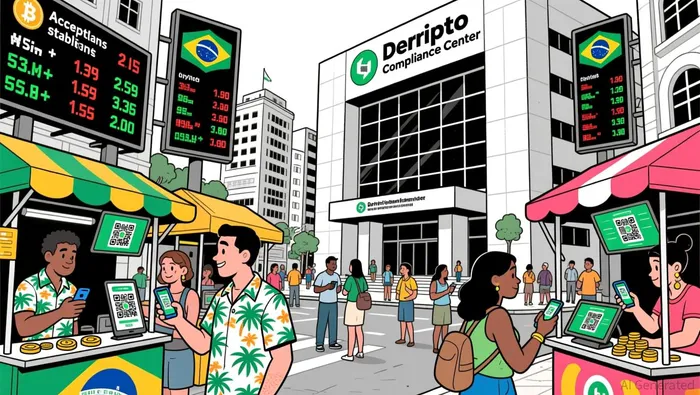
Revenue projections for the IOF extension are ambitious. By taxing stablecoin transfers, the government aims to recover $30 billion in lost revenue annually according to financial sources. However, the success of this policy hinges on enforcement. As noted by a Federal Police official, the current system lacks mechanisms to track under-invoicing schemes involving crypto according to Reuters. If the tax is poorly enforced, it may fail to meet revenue targets while stifling innovation.
Investment Risks and Opportunities
Opportunities:
1. Regulatory Clarity: Brazil's alignment with global standards could attract foreign investors seeking jurisdictions with robust AML/KYC frameworks. Platforms that adapt to DeCripto's reporting requirements may gain a competitive edge.
2. Formalization of the Market: The IOF tax and FX classification could reduce regulatory arbitrage, creating a more stable environment for long-term investments.
3. Institutional Adoption: As crypto transactions become subject to formal financial rules, institutional players may enter the market, driving liquidity and innovation.
Risks:
1. Increased Compliance Costs: Stricter reporting and tax obligations could burden small exchanges and fintechs, potentially fragmenting the market.
2. Reduced Stablecoin Utility: The IOF tax may deter users from adopting stablecoins for cross-border transactions, shifting demand to traditional FX channels.
3. Market Volatility: Regulatory uncertainty-such as delays in finalizing IOF guidance-could trigger short-term volatility in crypto prices and investor sentiment according to market analysis.
Conclusion
Brazil's strategic regulatory tightening and tax reforms reflect a dual objective: enhancing transparency and recovering lost revenue. While these measures risk increasing compliance costs and reducing the appeal of stablecoins, they also create a more formalized, globally aligned market. For investors, the key lies in balancing the short-term challenges of regulatory adaptation with the long-term potential of a matured crypto ecosystem. As Brazil navigates this transition, the success of DeCripto and IOF reforms will depend on effective enforcement and the ability to foster innovation within a structured framework.







Comentarios
Aún no hay comentarios