
Brazil's Strategic Bitcoin Adoption: A Catalyst for Institutional Globalization and Long-Term Value
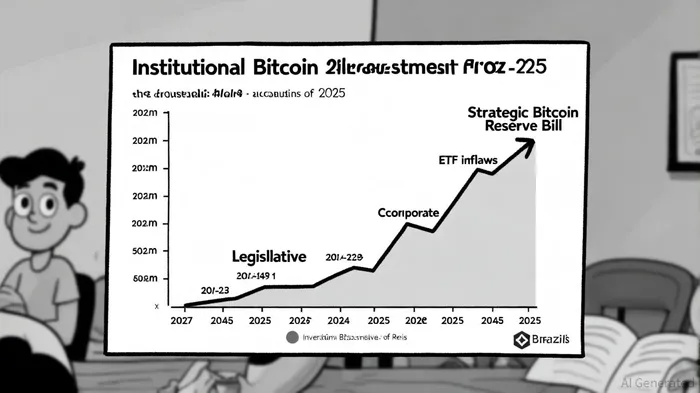
Brazil is emerging as a pivotal player in the global BitcoinBTC-- adoption narrative, with institutional investors, policymakers, and corporate entities aligning to position the country at the forefront of digital asset integration. The Strategic Bitcoin Reserve Bill (RESBiT), which proposes allocating up to 5% of Brazil's $344 billion foreign exchange reserves to Bitcoin, represents a bold institutional leap that could redefine how emerging markets approach digital assets. This move, coupled with a 260% surge in institutional investment in Hashdex's Bitcoin ETFs in 2024 (reaching R$540 million) [1], underscores a strategic shift toward treating Bitcoin as a legitimate reserve asset alongside gold.
Institutional Momentum and Regulatory Clarity
Institutional adoption in Brazil has been fueled by a combination of regulatory clarity and market demand. The Virtual Assets Law (Law No. 14,478/22) has provided a legal framework for cryptocurrency transactions, reducing uncertainty for investors [2]. Meanwhile, institutional trading volume on Mercado Bitcoin now accounts for 70% of the exchange's total activity [1], reflecting a maturation of the market from speculative retail-driven dynamics to institutional-grade infrastructure. This shift is further amplified by global trends, such as the U.S. approval of Bitcoin spot ETFs and Japan's corporate accumulation of Bitcoin as a hedging tool [3].
The RESBiT bill, currently under review by Brazil's Economic Development Committee, includes safeguards like cold storage, biannual audits, and AI monitoring systems to mitigate volatility risks [4]. While critics, including the Central Bank of Brazil, argue that Bitcoin's price swings could destabilize reserves during crises [4], proponents counter that diversification into non-correlated assets is essential in an era of geopolitical and monetary uncertainty. Vice President Geraldo Alckmin's chief of staff, Pedro Giocondo Guerra, has explicitly endorsed the initiative, framing it as a strategic move to “future-proof” Brazil's economic resilience [4].
Global Context and Market Implications
Brazil's institutional Bitcoin journey is part of a broader global trend. Over $11 billion has flowed into Bitcoin spot ETFs in the past three months alone, with 59% of institutional portfolios now including digital assets [3]. The U.S. has further accelerated this trend by allowing Bitcoin investments in 401(k) retirement accounts, unlocking an $8.9 trillion capital pool [3]. Meanwhile, corporate treasuries and sovereign wealth funds—particularly in Asia—are increasingly allocating Bitcoin as a hedge against inflation and currency devaluation [3].
For Bitcoin, Brazil's institutional adoption could act as a multiplier effect. By legitimizing Bitcoin as a reserve asset in a country with the ninth-largest economy globally, the asset gains credibility in markets where regulatory skepticism has historically been high. This could catalyze similar moves in Latin America and other emerging economies, expanding Bitcoin's liquidity base and reducing its perceived risk profile.
Price Projections and Long-Term Value
The implications for Bitcoin's valuation are profound. Institutional demand, particularly from Brazil and Asia, is driving a structural shift in market dynamics. According to Tiger Research's 2025 Q3 valuation report, sustained institutional buying and regulatory tailwinds could propel Bitcoin to $190,000 by year-end [5]. This projection hinges on continued ETF inflows, corporate adoption, and policy innovations like RESBiT, which signal a transition from speculative interest to institutional-grade utility.
Moreover, Bitcoin's role as a hedge against currency debasement becomes increasingly relevant in Brazil, where inflation has historically been a concern. By allocating reserves to Bitcoin, the country could reduce reliance on traditional fiat currencies and diversify its exposure to global monetary policies. This aligns with broader macroeconomic trends, as central banks worldwide grapple with the limitations of conventional monetary tools in a post-pandemic, AI-driven economy.
Conclusion: A New Era for Bitcoin
Brazil's institutional Bitcoin adoption is not an isolated phenomenon but a harbinger of a larger shift. As the RESBiT bill advances toward a Senate vote, the world watches to see whether Brazil will cement its status as a digital asset pioneer. If successful, the initiative could normalize Bitcoin as a reserve asset, accelerating its integration into traditional financial systems and reshaping its long-term value proposition. For investors, this represents a critical inflection point: Bitcoin is no longer a speculative asset but a strategic tool for institutional portfolios, corporate treasuries, and sovereign wealth strategies.






Comentarios
Aún no hay comentarios