
Brazil's Offshore Renaissance: Why Petrobras' $5.1 Billion Fleet Expansion is a Long-Term Growth Catalyst for Shipbuilders and Support Firms
The convergence of Brazil's energy ambitions, regulatory tailwinds, and the global shift toward sustainable offshore operations is creating a once-in-a-generation opportunity for investors. At the heart of this transformation is Petrobras' $5.1 billion offshore support vessel (OSV) commissioning program—a strategic move that promises to reindustrialize Brazil's shipbuilding sector while fueling offshore production growth. For investors seeking exposure to a high-growth, underappreciated market, the time to act is now.
The Petrobras Play: A Strategic Bet on Brazil's Energy Future
Petrobras' fleet expansion—targeting 12 new Platform Supply Vessels (PSVs) by 2028—marks a pivotal step in its ambition to sustain offshore production growth, particularly at the Búzios field, which aims to hit 2 million barrels per day (bpd) by 2030. These vessels, equipped with hybrid propulsion systems combining electric motors, batteries, and biodiesel generators, are not just logistical tools but also emblems of Petrobras' commitment to decarbonization. The program's scale is staggering: over $860 million of the $5.1 billion investment is allocated directly to Brazilian shipyards, with contracts awarded to Santa Catarina-based firms Bram Offshore and Starnav Serviços Marítimos.
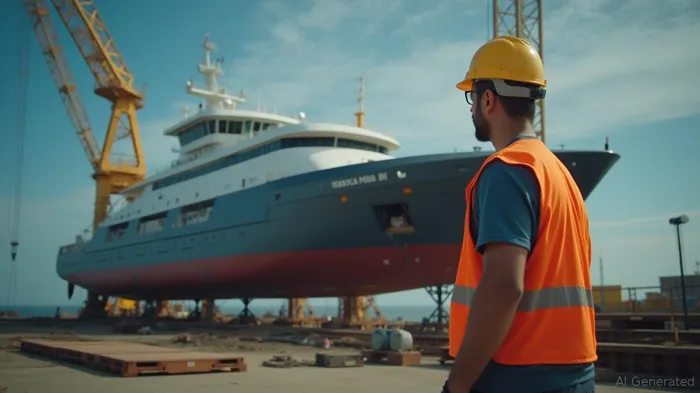
The PSVs' advanced technology aligns with Petrobras' goal to reduce greenhouse gas emissions by 25% by 2030, while their operational lifespan—up to 16 years—ensures long-term revenue streams for contractors. This initiative is just one component of Petrobras' $111 billion Business Plan 2025–2029, which prioritizes low-carbon energy transition projects and reinforces Brazil's role as a global energy powerhouse.
The Local Content Mandate: A Tailwind for Domestic Industry
Brazil's Law 15,075/2024 has fundamentally reshaped the oil and gas sector, mandating that 40% of vessel construction costs be sourced domestically—a threshold PetrobrasPBR-- aims to exceed. The law's flexibility, allowing surplus local content credits to be transferred between projects, ensures that Brazilian shipyards and suppliers remain central to Petrobras' supply chain. For firms like Bram Offshore and Starnav, this creates a guaranteed revenue pipeline, while the requirement to source materials locally drives job creation (an estimated 11,000 direct and indirect roles) and strengthens Brazil's industrial capabilities.
The ripple effects are profound. Shipbuilders are upgrading facilities to meet international standards, while local suppliers of engines, automation systems, and composites are benefiting from sustained demand. This reindustrialization is not merely about vessel construction—it is a catalyst for Brazil's broader maritime sector, positioning it to compete in emerging markets like offshore wind, where hybrid vessels could find new applications.
Rising Offshore Production: The Búzios Field as a Catalyst
The Búzios field, Brazil's most prolific pre-salt discovery, is the linchpin of Petrobras' production growth. With output set to double over the next decade, the field's expansion demands a robust fleet of OSVs for supply logistics, subsea maintenance, and exploration. Petrobras' fleet modernization program directly supports this goal, ensuring that its vessels are equipped to handle deepwater operations safely and efficiently.
The field's success also underscores a broader trend: Brazil's pre-salt reserves, accounting for over 90% of its oil production, are underpinned by a regulatory environment that rewards local content compliance. This creates a “virtuous cycle” where Petrobras' investments in domestic shipbuilders and suppliers directly enhance its ability to exploit these reserves cost-effectively.
Addressing Risks: Navigating Labor Shortages and Tax Uncertainty
No investment is without risks. Brazil's shipbuilding sector faces labor shortages exacerbated by the industry's rapid expansion. While Petrobras has partnered with vocational schools to train workers, bottlenecks could delay project timelines. Similarly, proposed tax reforms—such as changes to the ICMS state tax—could impact input costs.
However, Petrobras' close ties to Brazil's government, coupled with the strategic national interest in energy self-sufficiency, suggest these risks are manageable. The long-term nature of vessel contracts (12-year operational terms) also buffers investors against short-term volatility.
Why Investors Should Take Note: Long-Term Opportunities in Brazilian Shipbuilders
The confluence of factors—Petrobras' capital spending, local content mandates, and rising offshore production—creates a compelling case for long-term exposure to Brazilian shipbuilders and support firms. Key beneficiaries include:
- Bram Offshore and Starnav Serviços Marítimos: Direct contractors for the PSV program, positioned to capitalize on Petrobras' multiyear spending.
- Suppliers of hybrid propulsion systems: Firms like Wärtsilä and local partners will benefit from the shift to sustainable technology.
- Offshore wind players: As Brazil explores renewable energy, hybrid vessels could transition to support offshore wind farms, extending their utility beyond oil and gas.
For investors, this is not just a play on Petrobras—it is a bet on Brazil's industrial renaissance. With a government eager to reduce import dependency and a private sector hungry for modernization, the OSV sector is a gateway to a broader transformation.
Conclusion: A Decade of Growth, a Strategic Entry Point
Petrobras' $5.1 billion OSV program is more than a fleet upgrade—it is a cornerstone of Brazil's energy strategy. By leveraging local content mandates, the company is rebuilding its domestic supply chain while positioning itself to meet rising global demand for low-carbon energy. For investors, the opportunity is clear: allocate to Brazilian shipbuilders and support firms now, and ride the wave of Brazil's offshore renaissance for years to come.
The time to act is here. The next decade's energy landscape will be shaped by those who bet on Brazil's revival—and the vessels that will power it.





Comentarios
Aún no hay comentarios