
Brazil's Coffee Harvest: A Tug-of-War Between Supply Abundance and Geopolitical Tensions
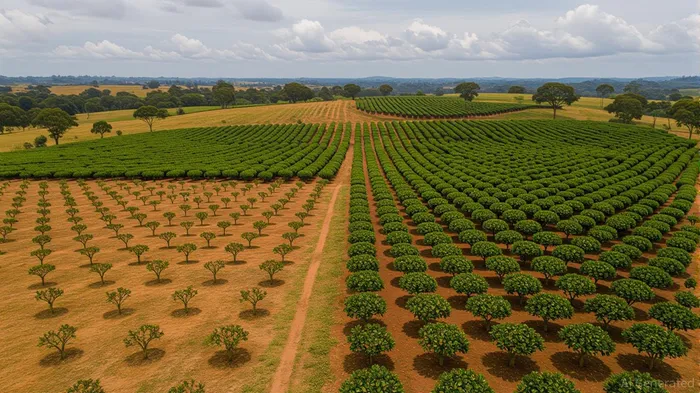
Brazil's 2025 coffee harvest is unfolding under a unique confluence of climatic and geopolitical forces, creating both volatility and opportunity for investors in coffee commodities. As the world's largest producer and exporter of coffee, Brazil's output has a direct bearing on global prices and supply chains. This year's crop, projected at 65 million 60kg bags, reflects a modest 0.5% increase over the previous year but masks a stark divergence between robusta and arabica dynamics. Robusta production is expected to hit a record 24.1 million bags (+15%), while arabica output declines by 13.6% to 40.9 million bags. These trends, coupled with the looming threat of U.S. tariffs and retaliatory measures from Brazil, are reshaping the risk-reward calculus for coffee investors.
Weather-Driven Supply Dynamics: A Tale of Two Beans
The 2025 harvest is being driven by uneven weather patterns. In the Cerrado Mineiro region, early reports indicate 4% of the crop has been collected, with bean size improving to favorable levels for 60kg bag filling. However, arabica productivity is lagging forecasts, with 20%–30% of the crop expected to consist of defective or lower-quality beans due to drought-induced stress and early cherry drop. Conversely, robusta regions like Espírito Santo and Bahia are thriving, supported by consistent rainfall and irrigation.
Normalized Difference Vegetation Index (NDVI) data reveals a mixed picture: Minas Gerais and Espírito Santo show above-average crop health, while São Paulo and Rondônia face localized productivity challenges. Producers are adopting adaptation strategies like intercropping and heat-tolerant cultivars, but these measures may not fully offset the biennial off-year pattern for arabica.
Geopolitical Risks: Tariffs and Retaliatory Measures
The most immediate threat to Brazil's coffee export dominance is the U.S. government's 50% tariff on Brazilian imports, effective August 1, 2025. This move, framed as retaliation against Brazil's judicial actions against former President Jair Bolsonaro, targets a sector where Brazil holds 16% of U.S. coffee imports. The U.S. is also imposing tariffs on Indonesian and Vietnamese coffee, signaling a broader shift in sourcing dynamics.
Brazil has responded by enacting its Economic Reciprocity Law, granting it authority to impose retaliatory tariffs on U.S. goods, including technology and pharmaceuticals. While no concrete measures have been announced yet, the legal framework is in place, and the government has formed an interministerial committee to coordinate responses. This tit-for-tat escalation risks further market volatility, particularly for small-scale Brazilian producers who account for two-thirds of the country's coffee output.
Investment Implications: Navigating the Volatility
For investors, the current environment presents a duality of risks and opportunities:
1. Short-Term Volatility in Futures Markets: The combination of a robusta surplus and arabica shortages has already driven down arabica prices by 25% since January 2025, while robusta prices have fallen by 47%. However, geopolitical uncertainty could trigger sharp price swings. Hedging strategies, such as shorting arabica futures or long positions in robusta, may appeal to risk-tolerant traders.
2. Supply Chain Diversification Plays: As U.S. buyers seek alternatives to Brazilian coffee, opportunities may emerge in Vietnam, Indonesia, and Colombia. Investors could explore exposure to these markets via ETFs or commodity-linked equities.
3. Structural Resilience in Brazil's Coffee Sector: Despite challenges, Brazil's coffee industry remains resilient. The country is projected to maintain its leadership in green and soluble coffee exports, with record revenues expected in 2025. Companies like Cooxupe and Expocacer are diversifying export markets and enhancing logistics to mitigate U.S. tariff risks.
Strategic Recommendations
- For Commodity Traders: Consider a balanced portfolio of arabica and robusta futures, with a bias toward robusta as its oversupply-driven price corrections may bottom out sooner.
- For Long-Term Investors: Focus on Brazilian coffee cooperatives and logistics providers adapting to trade tensions. These entities are better positioned to navigate supply chain shifts and regulatory changes.
- For Risk-Averse Portfolios: Diversify exposure across coffee-producing regions and monitor NDVI data for early signals of supply disruptions.
In conclusion, Brazil's 2025 coffee harvest and the associated geopolitical risks are creating a volatile but fertile ground for strategic investment. Weather-driven supply dynamics and trade policy tensions are not just catalysts for near-term price swings—they are shaping the long-term structure of global coffee markets. Investors who can navigate this complexity will be well-positioned to capitalize on both the risks and opportunities ahead.







Comentarios
Aún no hay comentarios