
Brazil's $5.6 Billion Exporter Support Plan: A Blueprint for Resilience in a Fractured Global Trade Landscape
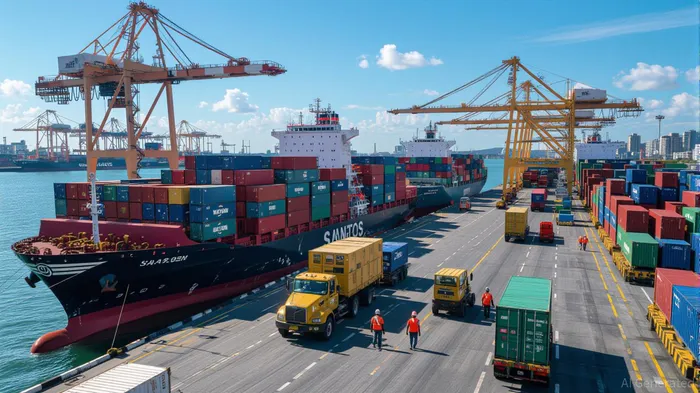
In an era of escalating trade wars and geopolitical fragmentation, Brazil's $5.6 billion exporter support plan—unveiled in response to U.S. tariffs hiking duties on selected goods from 10% to 50%—offers a masterclass in strategic resilience. The plan, funded by the Brazilian Development Bank (BNDES) and Banco do Brasil, combines immediate financial relief, tax exemptions, and job preservation measures to shield its export sector. But beyond the numbers lies a deeper story: how a nation with a diversified trade profile and a history of navigating external shocks is positioning itself as a linchpin in the new global trade order.
The Anatomy of the Support Plan
The Brazilian government's response is both pragmatic and targeted. By leveraging BNDES's $30 billion (30 billion reais) reserves, the plan provides low-interest credit lines to exporters, ensuring liquidity for firms facing margin compression from tariffs. The “drawback” program, which suspends taxes on imported inputs for export-oriented manufacturing, further reduces costs. Crucially, the initiative extends to micro, small, and medium-sized enterprises (MSMEs), which account for a significant portion of Brazil's export base. São Paulo's state-level measures—such as the Giro Exportador credit line with interest rates as low as 0.27% per month—add another layer of support, demonstrating a coordinated federal-state approach.
This is not just a short-term fix. The government is also modernizing the Export Guarantee Fund (FGE), expanding eligibility for export credit insurance to firms with up to $4 million in annual exports. These reforms signal a long-term commitment to building a competitive export ecosystem, even as Brazil navigates the turbulence of U.S. protectionism.
Strategic Resilience: Diversification as a Shield
Brazil's ability to absorb the shock of U.S. tariffs hinges on two pillars: trade diversification and commodity flexibility. The U.S. accounts for just 12% of Brazil's exports, compared to 28% for China. This asymmetry allows Brazil to redirect commodities like soybeans, beef, and coffee to markets in Asia, Europe, and Mercosur. Goldman SachsGS-- estimates that the U.S. tariff will reduce Brazil's GDP by a mere 0.15% in 2025, a figure that shrinks further when considering the 36% of exports exempted from the levy (e.g., aircraft, energy, and orange juice).
The resilience of Brazil's trade finance sector is also underpinned by its low trade openness (36% of GDP) and the fungibility of its commodity exports. For instance, beef and coffee can be rerouted to China or the EU with minimal price discounts, mitigating the impact of U.S. tariffs. This adaptability has kept Brazil's GDP growth forecast at 2.3% for 2025, outperforming many emerging markets.
Investor Confidence: A Market at a Discount
Despite the challenges, Brazilian equities have staged a modest rebound in 2025. The MSCIMSCI-- Brazil Index, which fell 30% in 2024, is now trading at a forward P/E of 6–8x—well below its long-term average. The Ibovespa index has rallied 13.9% year-to-date, driven by financials (e.g., Itau Unibanco) and energy firms (e.g., Petrobras), which benefit from Brazil's energy exports being largely tariff-exempt.
The Brazilian real (BRL) is another tailwind. Undervalued relative to its long-term equilibrium, the currency offers a 15–20% upside potential, according to analysts. This, combined with the expectation of rate cuts in Q1 2026 (as 60% of corporate debt is linked to the Selic rate), could trigger a rotation into equities.
Opportunities in the New Trade Order
For investors, Brazil's strategy highlights three key opportunities:
1. Commodity Exports: As global supply chains shift away from high-tariff regions, Brazil's role as a supplier of soybeans, iron ore, and meat will grow.
2. Trade Finance Innovations: The modernization of the FGE and BNDES's credit programs could create a more efficient export finance ecosystem, benefiting MSMEs.
3. Currency Arbitrage: The BRL's undervaluation and Brazil's status as a rate-cutting outlier in 2026 present a compelling case for currency and equity exposure.
The Road Ahead
While Brazil's plan is robust, risks remain. The Northeast region, reliant on low-value-added goods like textiles and fresh fruit, faces disproportionate impacts. Additionally, political uncertainty ahead of the 2026 elections could delay reforms. However, the government's proactive stance—coupled with Brazil's structural advantages—suggests that the country is well-positioned to thrive in a fragmented global trade environment.
For investors, the message is clear: Brazil's exporter support plan is not just a defense mechanism but a catalyst for long-term growth. In a world where trade barriers are the new norm, Brazil's blend of strategic resilience and market adaptability offers a rare combination of risk mitigation and upside potential.
Investment Advice: Consider overweighting Brazilian equities in sectors like agriculture, energy, and financials. The BRL's undervaluation and expected rate cuts in 2026 make it an attractive currency play. For trade finance, monitor BNDES's credit disbursement data and the FGE's eligibility criteria for MSMEs—early indicators of the plan's success.
In the end, Brazil's story is one of adaptation. As the world grapples with the new reality of trade wars, Brazil's playbook offers a blueprint for resilience—and a reminder that even in the face of protectionism, opportunity can be found in the margins.







Comentarios
Aún no hay comentarios