
Why Brazil's 43% Crypto Surge Signals a Strategic Entry Point for Global Investors
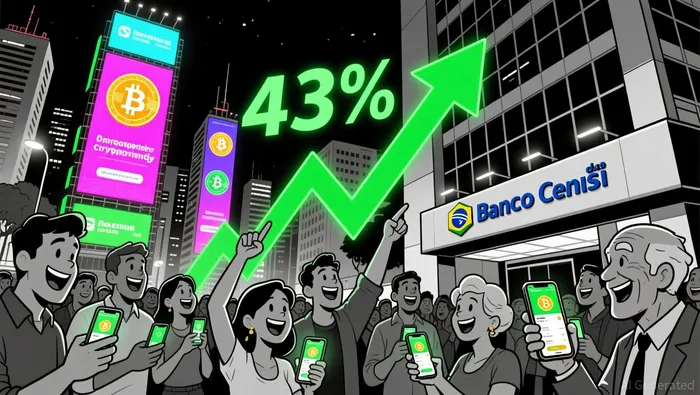
The cryptocurrency market in Brazil has surged by 43% in 2025, marking a pivotal inflection point for global investors seeking exposure to emerging markets. This growth is not a fleeting trend but a structural shift driven by regulatory clarity, institutional adoption, and a diversification of investment strategies. As Brazil solidifies its position as the largest crypto market in Latin America and ranks fifth globally in crypto inflow, the country's maturing ecosystem offers a compelling case for strategic entry.
Regulatory Maturation: A Foundation for Sustainable Growth
Brazil's regulatory framework has evolved into one of the most comprehensive in the world, creating a fertile ground for crypto adoption. The Banco Central do Brasil (BCB) introduced licensing mandates for virtual asset service providers (VASPs) under Resolutions 519, 520, and 521, requiring firms to obtain authorization as Sociedades Prestadoras de Serviços de Ativos Virtuais (SPSAVs) by February 2026. These rules include capital requirements ranging from R$10.8 million to R$37.2 million, depending on risk profiles, extending anti-money laundering and cybersecurity obligations to VASPs. By aligning with global standards like the EU's Markets in Crypto-Assets (MiCA) regulation, Brazil has signaled its commitment to balancing innovation with investor protection.
This regulatory clarity has attracted institutional capital, with Brazil's institutional-sized crypto transactions surging in 2025. The BCB's oversight of stablecoin transactions-now classified as foreign exchange operations-has further legitimized the asset class, driving a tripling in stablecoin volume. For global investors, this structured environment reduces counterparty risk and enhances transparency, making Brazil a safer harbor compared to less regulated emerging markets.
Diversification and Retail Adoption: A Dual-Engine Growth Model
Brazil's crypto surge is underpinned by a diversification of investment strategies. Nearly 18% of investors now hold multiple crypto assets, including BitcoinBTC--, EtherETH--, and SolanaSOL--, reflecting a shift from speculative trading to portfolio diversification. This trend mirrors broader emerging market patterns, where crypto is increasingly viewed as a hedge against inflation and currency devaluation. In 2025, the Asia-Pacific region saw a 69% year-over-year increase in on-chain transaction volume, driven by similar diversification strategies. Brazil's adoption of stablecoins for remittances and local transactions-akin to the Philippines and Indonesia-further underscores its role as a functional financial alternative.
Retail adoption has also accelerated, with Brazil's Gen Z population driving demand for income-generating tokens and decentralized finance (DeFi) platforms. This demographic shift aligns with global trends, where younger investors prioritize liquidity and yield optimization. For institutional investors, Brazil's retail-driven growth creates a scalable user base and long-term network effects, making it a strategic asset in a diversified portfolio.
Global Context: Brazil as a Macro-Driven Opportunity
Brazil's crypto growth must be viewed through the lens of broader macroeconomic forces. Emerging markets like India, Pakistan, and Vietnam have led grassroots adoption in 2025, but Brazil's regulatory progress and institutional infrastructure position it as a unique opportunity. Unlike less mature markets, Brazil's framework includes a 9-month grace period for compliance, allowing firms to adapt without stifling innovation. This balance between oversight and flexibility is critical for global investors seeking to avoid regulatory black swans, such as the Bybit hack in early 2025, which exposed gaps in unregulated ecosystems.
Moreover, Brazil's integration into global crypto networks-such as its participation in the Blockchain Brazil Network (RBB) and regulatory sandboxes-positions it as a bridge between traditional finance and decentralized systems. As the U.S. and EU refine their crypto frameworks, Brazil's proactive approach ensures it remains competitive in attracting cross-border capital.
Strategic Entry Point: Why Now?
For global investors, Brazil's 43% surge represents a strategic entry point for three reasons:
1. Regulatory Tailwinds: The BCB's structured licensing model reduces systemic risks, making Brazil a safer bet than less regulated peers.
2. Diversification Potential: With 18% of investors holding multiple crypto assets, Brazil's market offers exposure to a diversified basket of digital assets.
3. Macro-Driven Demand: Economic volatility in Latin America and the global shift toward stablecoins for remittances create tailwinds for sustained adoption.
As Brazil's crypto market matures, early entry allows investors to capitalize on undervalued assets before institutional inflows drive valuations higher. The country's fifth-place ranking in global crypto inflow and its leadership in Latin America further reinforce its strategic importance.
Conclusion
Brazil's 43% crypto surge is not an isolated event but a symptom of structural maturation in emerging markets. By combining regulatory clarity, institutional adoption, and retail-driven diversification, Brazil has positioned itself as a linchpin in the global crypto ecosystem. For investors seeking to hedge against macroeconomic uncertainty and tap into the next wave of digital finance, Brazil's market offers a rare combination of growth potential and risk mitigation.






Comentarios
Aún no hay comentarios