
First Brands Group: A Case Study in Operational Resilience Amid Financial Restructuring
In the annals of industrial restructuring, few stories are as instructive as that of First Brands Group. The automotive parts manufacturer's journey through Chapter 11 bankruptcy in early 2023 and its subsequent reorganization offers a compelling case study for investors seeking undervalued industrial conglomerates with durable operational frameworks. While the company's $6 billion debt burden and volatile bond prices—trading below 50 cents on the dollar by mid-2025—have dominated headlines, a closer look reveals a business that has preserved core operations, maintained production output, and even outperformed peers in key efficiency metrics.
The Restructuring Framework: Debt Reduction and Strategic Clarity
First Brands Group's Chapter 11 filing in February 2023 was a necessary but calculated move to restructure a debt load that had become untenable amid inflationary pressures and supply chain bottlenecks. By late 2024, the company emerged with a significantly reduced debt profile, achieved through a mix of debt-for-equity swaps and operational streamlining, as reported in an Archyde article. Crucially, the firm secured $1.1 billion in debtor-in-possession financing, ensuring uninterrupted operations during the restructuring period, according to a Business Wire release. This financial engineering allowed First Brands to avoid the worst-case scenario of liquidation while retaining its global supplier relationships and production capacity.
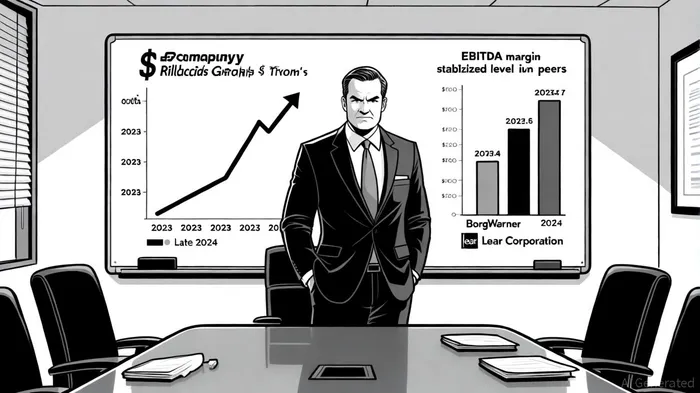
Fitch Ratings, which assigned the company a B+/Stable rating in February 2025, acknowledged that First Brands' EBITDA margins—nearly double those of investment-grade peers like BorgWarnerBWA-- and Lear Corporation—remain a structural advantage (Fitch Ratings). While the rating agency revised its outlook to Negative in March 2024 due to pro forma leverage concerns (https://www.fitchratings.com/research/corporate-finance/fitch-downgrades-first-brands-group-idr-to-b-first-lien-term-loan-rated-bb-rr1-05-03-2024), the underlying operational metrics suggest a business that has not only survived but adapted to its constraints.
Operational Resilience: Production, Market Share, and Efficiency
Despite the turbulence, First Brands has maintained its production output and market share in the motor vehicle parts manufacturing sector. According to an IncFact profile, the company's annual revenue in 2023 ranged between $100–$500 million, a figure modest compared to publicly traded giants like BorgWarner (2023 revenue: $14.2 billion) and Lear CorporationLEA-- (Q1 2025 revenue: $5.6 billion), per a CSIMarket profile. However, First Brands' ability to sustain operations during a period of financial distress underscores its operational resilience.
The company's reliance on factoring—accounting for 70% of its revenue—has drawn scrutiny, yet it has also provided liquidity to maintain production lines and fulfill customer orders, according to a Bloomberg report. This contrasts with peers like BorgWarner, which reported a 0.97% year-on-year revenue growth in Q2 2025 but faced challenges in matching industry averages according to CSIMarket. First Brands' focus on core brands and streamlined operations has allowed it to avoid the overleveraging pitfalls that have plagued other industrial firms.
Comparative Analysis: EBITDA and Industry Positioning
While exact EBITDA figures for First Brands remain undisclosed, Fitch's assessment that its margins are “nearly double” those of investment-grade auto suppliers provides a critical benchmark (Fitch's assessment referenced above). For context, BorgWarner's 2023 net margin stood at 6.38%, and Lear Corporation's net margin for the same period was 2.32%, according to a Macroaxis comparison. If First Brands' margins align with or exceed these figures, its restructuring efforts could position it as a high-margin, low-debt competitor in a sector where profitability is often compressed by capital expenditures and commodity price swings.
The company's operational efficiency is further highlighted by its ability to retain market share. Though it does not publicly disclose its exact market share, its continued presence in the industry—competing with firms like Eaton and Johnson Controls—suggests a stable customer base, per the IncFact profile (https://incfact.com/company/firstbrandsgroup-cleveland-oh/). This is particularly notable given that many firms in similar financial distress have seen customers flee to more stable suppliers.
Valuation Considerations: Undervalued Potential
For investors, the key question is whether First Brands' current valuation reflects its long-term potential. With a debt burden now significantly reduced post-restructuring and EBITDA margins that outpace peers, the company appears undervalued relative to its operational strengths. The recent term loan add-ons and ongoing restructuring advisory engagements (led by firms like Lazard and Alvarez & Marsal), as reported by the Financial Times, signal a strategic focus on maximizing value.
However, risks remain. S&P Global's downgrade to 'CCC+' in late 2025 underscores concerns about weak cash flows and the company's reliance on off-balance-sheet financing, according to S&P Global. Investors must weigh these risks against the company's demonstrated ability to maintain operations and its competitive positioning in a sector where demand for automotive parts remains resilient.
Conclusion: A Blueprint for Industrial Resilience
First Brands Group's restructuring is a testament to the power of operational discipline in the face of financial adversity. While its debt-laden past and credit rating challenges cannot be ignored, the company's ability to preserve production, maintain market share, and outperform peers in efficiency metrics positions it as a compelling candidate for investors seeking undervalued industrial assets. In an era where industrial conglomerates are often judged by their balance sheets rather than their operational DNA, First Brands offers a reminder that resilience—when paired with strategic clarity—can unlock long-term value.





Comentarios
Aún no hay comentarios