
BP's North Sea Oil Expansion and Its Implications for Energy Transition Stocks
The energy transition has long been framed as a binary conflict between traditional hydrocarbon producers and renewable energy innovators. Yet BP's 2025 strategic pivot-centered on its North Sea Oil Expansion-exposes the growing complexity of this landscape. While the company's decision to prioritize oil and gas production over renewables has drawn sharp criticism, it also reflects a recalibration of ESG (environmental, social, and governance) priorities in response to market realities. This analysis examines how BP's strategy aligns with-or diverges from-emerging ESG investing trends and what this means for energy transition stocks.
Strategic Realignment: From Ambition to Pragmatism
BP's 2025 strategy marks a stark departure from its earlier climate commitments. The company has abandoned its 2030 target to reduce fossil fuel production by 25% and instead aims to boost oil and gas output to 2.3–2.5 million barrels of oil equivalent per day by 2030, according to an ESG News report. This shift is epitomized by the Murlach field in the UK North Sea, a project expected to add 15,000 boed to BP's portfolio, as noted in an OilPrice article. Such moves are part of a broader industry trend, as peers like ShellSHEL-- and TotalEnergiesTTE-- also scale back renewable investments to focus on core hydrocarbon operations, according to an AgreenerLife analysis.
The rationale is clear: BP's net profit plummeted by 97% in 2024, according to a Fortune report, prompting CEO Murray Auchincloss to prioritize cost discipline and profitability. By redirecting $10 billion annually to upstream oil and gas projects and slashing renewable investments by $5 billion, BPBP-- said in a BP press release it seeks to generate $20 billion in annual free cash flow by 2027, according to an Energy Connects article. This pivot mirrors activist investor demands, particularly from Elliott Investment Management, which holds a 5% stake and advocates for a return to "core" fossil fuel operations, according to a Klean Industries analysis.
ESG Tensions: Net-Zero Promises vs. Short-Term Realities
BP's long-term goal of achieving net-zero emissions by 2050 remains unchanged, per BP's investor ESG page, but its 2025 strategy has strained credibility. The company now plans to reduce Scope 1 and 2 emissions by 20–50% by 2030 and cut methane intensity to 0.20%, according to a CNBC report. However, these targets are overshadowed by the scale of its new oil and gas projects. For instance, the Kaskida development in the Gulf of Mexico alone is projected to produce 80,000 boed starting in 2029 (as reported earlier), raising questions about how such output aligns with global decarbonization goals.
Investor reactions have been mixed. While ESG funds like Legal & General's Climate Action Global Equity fund continue to hold BP shares, citing relative performance metrics, according to a Responsible Investor article, others, including Nest and Sampension, have condemned the strategy as a "step backward," according to Wren Sterling commentary. Over 60 ESG funds have increased their stakes in BP since the announcement, reflecting the tension between short-term financial returns and long-term sustainability (per Energy Connects). This divergence underscores a broader challenge: ESG fund managers must balance decarbonization mandates with the reality that energy markets remain heavily reliant on hydrocarbons.
Peer Comparisons: Lessons from Shell and TotalEnergies
BP's struggles contrast sharply with the strategies of Shell and TotalEnergies. Shell, for example, has maintained a balanced approach by preserving its hydrocarbon core while selectively investing in renewables. Its 2025 Q1 profits of $9.2 billion were highlighted in a CorpDev report, reflecting the financial benefits of this strategy, as does its 12% ROACE in traditional energy versus BP's 8% (noted by industry analysts). Similarly, TotalEnergies has allocated 29% of its capital expenditures to renewables, outpacing BP's revised 25% target and demonstrating a more credible path to decarbonization.
BP's share price decline of 25% over five years, compared to Shell's 12% gain and Exxon's 70% surge, further illustrates the risks of overcommitting to ESG goals without financial discipline. The company's recent divestments-such as 50% of its Lightsource solar operations-signal a partial retreat from its earlier "Beyond Petroleum" identity, prioritizing core energy operations over speculative renewables.
Implications for Energy Transition Stocks
BP's 2025 strategy highlights a critical inflection point for energy transition stocks. While the company's North Sea expansion may bolster short-term profitability, it risks alienating ESG-focused investors who prioritize long-term climate alignment. This tension is evident in the mixed reactions from ESG funds and the shareholder revolt at BP's 2025 AGM, where major institutional investors opposed the re-election of outgoing chair Helge Lund (as reported by CNBC).
For energy transition stocks, the lesson is clear: investors are increasingly sophisticated in assessing companies' transition plans. BP's experience suggests that a one-size-fits-all approach to ESG is no longer viable. Instead, firms must demonstrate both financial resilience and credible decarbonization pathways. This dual focus will likely define the next phase of the energy transition, as companies like Shell and TotalEnergies show.
Conclusion
BP's North Sea Oil Expansion exemplifies the fraught intersection of traditional energy and ESG investing. While the company's 2025 strategy prioritizes profitability and operational efficiency, it risks undermining its climate credibility. For energy transition stocks, the key takeaway is the need for strategic nuance: aligning with ESG trends requires not just ambitious goals but also financial prudence and adaptability. As the energy sector evolves, investors will increasingly demand companies like BP to prove that their hydrocarbon projects can coexist with-and even accelerate-the global transition to net-zero.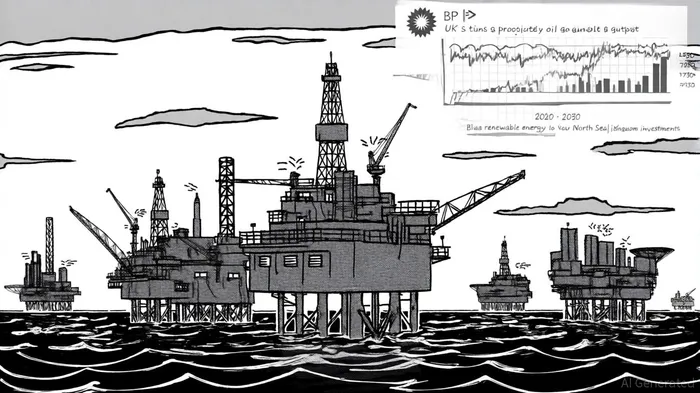







Comentarios
Aún no hay comentarios