
Boustead Singapore's Attractive Dividend-Driven Returns and Strategic Growth Catalysts
Boustead Singapore (SGX: F9D) has emerged as a compelling investment opportunity in 2026, driven by its robust dividend growth, improving capital efficiency, and strategic initiatives to unlock long-term shareholder value. While the company's recent financial performance has shown mixed results, a closer examination of its fundamentals, return on capital employed (ROCE), and asset optimization plans reveals a strong case for both income and growth-oriented investors.
Fundamentals: Earnings Growth and Margin Resilience
Despite a 31% year-on-year revenue decline in FY2025 to S$527.1 million, Boustead Singapore demonstrated impressive cost discipline and margin management. Core net profit rose by 8% to S$68.6 million, driven by a 3% increase in gross profit to S$233.3 million. This resilience underscores the company's ability to navigate a challenging order book while maintaining profitability.
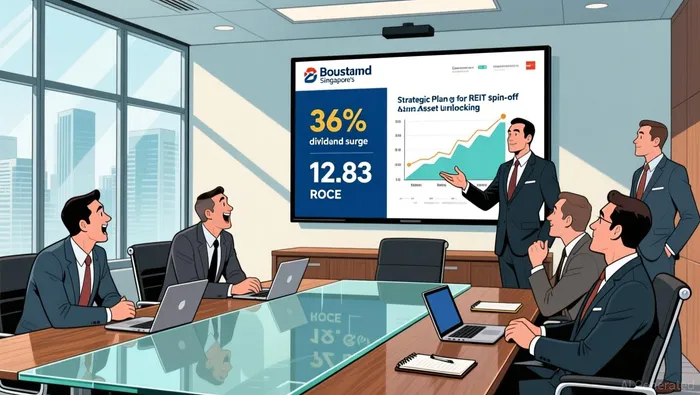 The dividend story is equally compelling. For FY2025, the company declared a total dividend of S$0.075 per share, up from S$0.055 in FY2024-a 36% increase according to financial reports. This aligns with Boustead's commitment to returning capital to shareholders, even amid operational headwinds. The interim dividend for 1H FY2026 remained unchanged at 1.5 cents per share, signaling stability in its payout policy.
ROCE: A Barometer of Capital Efficiency
While Boustead Singapore's ROCE for FY2025 is not explicitly disclosed in public reports, a calculated estimate using available data provides insight into its capital efficiency. Based on an EBIT of S$85.442 million and capital employed of S$665.673 million (as reported in the FY2025 annual report), the ROCE stands at approximately 12.83%. This figure, though not directly comparable to prior years, suggests a healthy return relative to the company's asset base.
The upward trajectory in earnings per share (EPS)-from S$0.094 in FY2023 to S$0.20 in FY2025 according to market data-further reinforces the notion of improving capital utilization. Investors should note that ROCE trends are best assessed over multiple years, and Boustead's strategic focus on high-margin divisions, such as geospatial services which saw a 10% revenue increase in 1H FY2026, could drive further efficiency gains.
Strategic Catalysts: REIT Spin-Off and Asset Unlocking
Boustead Singapore's most significant growth catalyst lies in its plan to list UI Boustead REIT, a move designed to monetize its real estate assets and redirect capital toward higher-growth opportunities. The REIT listing, coupled with the divestment of logistics and industrial assets, aims to enhance the group's net liquid position, which stood at S$210.3 million as of September 30, 2025.
This strategic repositioning is critical for long-term value creation. By spinning off non-core assets, Boustead can reduce capital intensity and focus on its core competencies in energy engineering, healthcare, and geospatial services. For instance, the geospatial division's 10% revenue growth in 1H FY2026 highlights its potential to become a key driver of future earnings.
Risks and Considerations
Investors must remain mindful of near-term challenges, including the 24% revenue decline in the healthcare division due to the absence of a one-off contract. Additionally, the 0.4% year-on-year revenue contraction in 1H FY2026 underscores the need for continued operational agility. However, the company's strong cash reserves and disciplined capital allocation practices mitigate these risks.
Conclusion: A Dual-Engine Investment
Boustead Singapore's combination of attractive dividend yields, improving ROCE, and strategic asset optimization positions it as a dual-engine investment for 2026. With a forward-looking approach that balances income generation and capital appreciation, the stock offers a rare blend of stability and growth potential. As the REIT listing progresses and asset divestments materialize, shareholders are likely to benefit from enhanced returns and a more streamlined business model.







Comentarios
Aún no hay comentarios