
Why Boston Omaha Corporation (BOC) is a High-Risk Holding in the Communication Services Sector
Quantitative Risk Metrics: A Mixed Picture
BOC's debt-to-equity ratio of 0.32 as of September 30, 2025, suggests a relatively conservative capital structure compared to the Communication Services sector's average of 1.27 in Q2 2025 according to industry data. This lower leverage, calculated by dividing $170 million in long-term debt by $550 million in shareholders' equity according to financial data, positions BOC as less exposed to interest rate risks than its peers. However, this metric alone obscures deeper vulnerabilities.
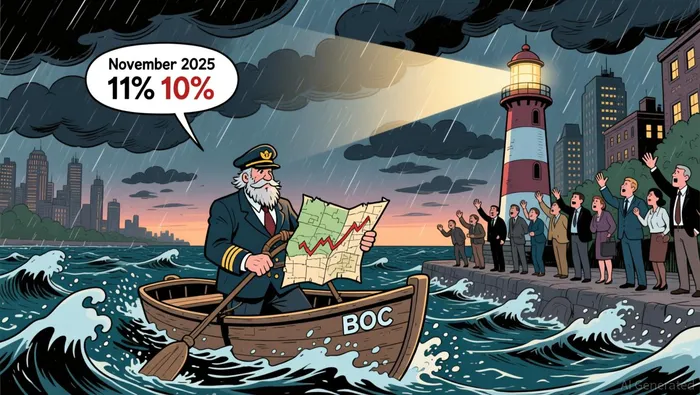
The company reported a net loss of $2.6 million in Q3 2025, a 62% increase in losses compared to the same period in 2024. This decline, attributed to a $1.5 million unrealized loss on its Sky Harbour warrants and broader operational challenges, signals fragility in earnings. Meanwhile, BOC's stock has swung wildly: a 11% surge following the announcement of a $30 million share repurchase program in November 2025 according to market analysis, yet a 10% year-to-date decline according to market analysis. Such volatility, while not quantified by beta, underscores exposure to market sentiment and liquidity risks.
Sector Benchmarking: A Sector on Shaky Ground
The Communication Services sector itself is a high-risk environment. As of 2025, the sector carries a "Marketperform" rating from the Schwab Center for Financial Research, indicating expectations of in-line performance with the S&P 500 over the next 12 months. However, this rating masks underlying weaknesses: the sector scores negative in value, growth, and quality metrics according to sector analysis, and its debt-to-equity ratio ranks poorly at #72 out of 100 industries according to industry data. For capital-intensive subsectors like telecommunications, high leverage is typical, but BOC's recent losses and declining book value per share ($16.80 as of September 2025, down from $16.99 in 2024 according to financial results) suggest it may struggle to weather a downturn.
Strategic Risks: Share Buybacks and Liquidity Constraints
BOC's $30 million share repurchase program, set to run through 2026 according to market analysis, is a double-edged sword. While it aims to boost shareholder value, the program's success hinges on the company's ability to maintain liquidity. With $56 million in unrestricted cash and investments as of September 2025 according to financial data, BOC has room to execute the buyback, but its net losses and the absence of a clear path to profitability raise questions about long-term sustainability. The reliance on a Rule 10b5-1 trading plan to automate repurchases also highlights management's limited flexibility to respond to market shifts according to market analysis.
Conclusion: A High-Risk Proposition
Despite BOC's lower leverage, its financial performance, stock volatility, and sector dynamics collectively paint a high-risk profile. The company's recent losses, coupled with the Communication Services sector's dependence on economic cycles, expose it to significant downside if growth slows. While the share repurchase program offers short-term optimism, it does not address structural weaknesses in earnings or operational resilience. Investors must weigh these risks against the sector's speculative allure, recognizing that BOC's current strategy may not insulate it from broader market turbulence.





Comentarios
Aún no hay comentarios