
Borussia Dortmund's Financial Prudence and Structural Growth in Football's Evolving Market
In an era where global sports valuations are surging, Borussia Dortmund stands as a compelling case study in balancing financial discipline with strategic growth. While the club faces headwinds from volatile transfer markets and intense competition from financial powerhouses like Bayern Munich and Manchester City, its focus on core revenue pillars, debt management, and long-term sustainability positions it as a resilient player in football's evolving economic landscape.
Revenue Resilience Amid Transfer Volatility
Borussia Dortmund's 2024/2025 fiscal year saw consolidated revenue rise by 3.3% to €526.02 million, driven by robust growth in TV marketing(+10.3% to €227.20 million), advertising(+4.8% to €153.56 million), and match operations(+5.0% to €55.22 million) according to financial reports. However, profitability was severely dented by a 61.3% decline in transfer earnings to €37.84 million, dragging net profit down by 85.3% to €6.50 million. This volatility underscores the club's reliance on transfer markets-a double-edged sword in football finance. Yet, Dortmund's ability to maintain stable personnel expenses (€268.3 million) and boost operating cash flow by 22.3% to €57.71 million highlights its operational discipline. 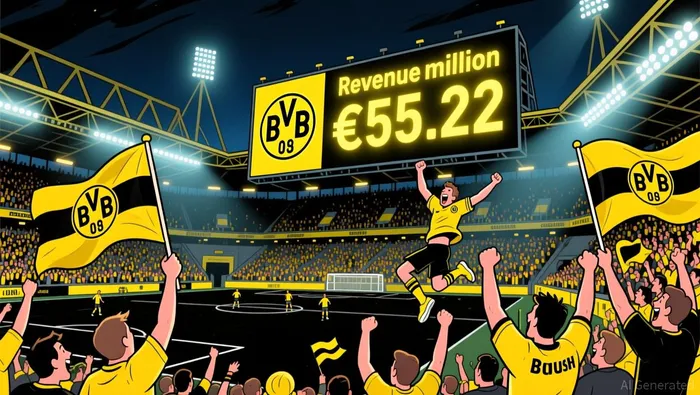 .
.
Debt Management and Liquidity Strength
Despite an average annual debt growth of 39.4% from 2021 to 2025 according to annual reports, Dortmund has fortified its liquidity position. Cash and cash equivalents surged 373% to €20.63 million, and the club resumed dividend payments in 2024/2025, distributing €6.62 million. This fiscal prudence contrasts with the aggressive debt-fueled expansion of peers like Manchester City, whose Etihad Stadium North Stand project-a £300 million investment-aims to generate £50 million annually in new revenue according to Forbes analysis. Dortmund's approach prioritizes stability over short-term leverage, a strategy that mitigates risks in an industry prone to cyclical downturns.
Structural Growth: Core Operations and Global Ambitions
Dortmund's financial strategy hinges on three pillars: TV marketing, advertising, and matchday revenue. These segments accounted for 73% of total revenue in 2024/2025, reflecting a deliberate shift away from transfer-dependent models. The club's global brand expansion further bolsters this strategy. In the Asia-Pacific region, Dortmund has deepened its footprint through football academies, a Shanghai office, and increased social media engagement, with plans to expand staffing in Singapore and Shanghai according to Chinese news reports. Such initiatives align with the global football market's projected 6% CAGR through 2032, reaching $70 billion.
Competitive Positioning Against Peers
While Dortmund trails Bayern Munich (€765 million revenue in 2023/24) and Manchester City (€838 million) according to Deloitte analysis, its valuation of $2.05 billion according to Forbes reflects a more balanced approach. Bayern's brand value of €1.3 billion according to Brand Finance and Manchester City's stadium-driven revenue growth underscore the gap, but Dortmund's focus on cost control and fan-centric operations offers a differentiator. The club's SIGNAL IDUNA PARK stadium, with its 81,365 capacity, remains a cash cow, generating €55.22 million in matchday revenue in 2024/2025. Unlike rivals pursuing large-scale expansions, Dortmund prioritizes optimizing existing assets, a model that reduces capital expenditure risks.
Sustainability and Long-Term Vision
Dortmund's commitment to environmental sustainability adds another layer of appeal. The club aims to cut Scope 1 and 2 emissions by 50% by 2030 and Scope 3 emissions by 12.5% according to preliminary figures, supported by initiatives like a photovoltaic system on the stadium roof. This aligns with global ESG trends, enhancing its attractiveness to socially conscious investors. Financially, the club's 2025–2030 strategy emphasizes "responsible development," balancing sporting ambitions with fiscal prudence.
Investment Appeal: Balancing Risks and Rewards
Dortmund's financial profile presents a nuanced investment case. While transfer earnings remain a wildcard, its diversified revenue streams, liquidity strength, and global brand expansion mitigate risks. The club's enterprise value of $2.05 billion according to Forbes lags behind Bayern and Manchester City but offers a more conservative valuation, potentially undervaluing its long-term growth potential. For investors seeking exposure to football's next phase of globalization, Dortmund's disciplined approach-coupled with its strong fan base and sustainability focus-makes it a compelling, if not dominant, contender.







Comentarios
Aún no hay comentarios