
Bone Price Surges Amid DeFi Security Concerns: A Post-Shibarium Flash Loan Exploit Analysis
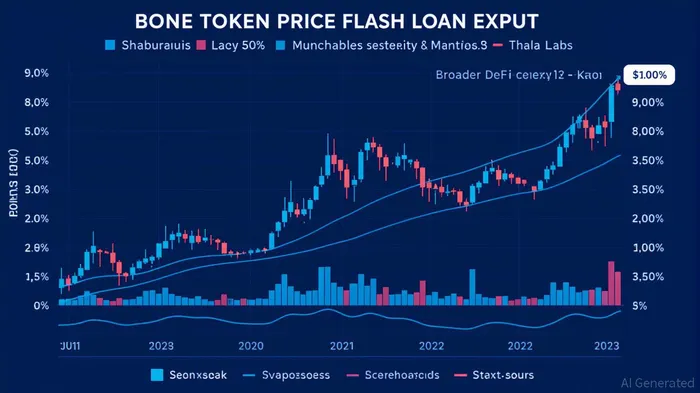
The Shiba InuSHIB-- (SHIB) ecosystem's recent turbulence, triggered by the Shibarium flash loan exploit in late 2023, offers a compelling case study in how decentralized finance (DeFi) security vulnerabilities can ripple through token valuations. While the BONE token initially plummeted by 15% in the 24 hours following the exploit [5], its subsequent recovery and recent price surge highlight the complex interplay between technical resilience, investor sentiment, and market dynamics. This analysis examines the Shibarium incident alongside broader DeFi security trends to assess how such vulnerabilities shape token valuations and investor behavior.
The Shibarium Flash Loan Exploit: Immediate Fallout and BONE's Response
The Shibarium exploit, which involved a malicious actor leveraging flash loans to overwhelm the network and trigger a fail-safe pause, exposed critical weaknesses in the platform's infrastructure. According to a report by Cointelegraph, the incident led to millions of dollars being trapped on the bridge, causing a 10% drop in SHIB's price and a 15% decline in BONE's value [5]. The rapid sell-off reflected heightened fear, uncertainty, and doubt (FUD) among investors, as large holders offloaded tokens to mitigate perceived risks.
However, the Shiba Inu development team's swift response—including scaling infrastructure upgrades, rate limitations, and automatic server resets—helped stabilize the network within days [2]. These measures not only restored block production but also signaled a commitment to long-term security, which likely contributed to BONE's gradual recovery. By mid-2024, BONE's price had rebounded, buoyed by renewed confidence in Shibarium's governance model and its role in supporting decentralized applications and the metaverse [2].
Broader DeFi Security Trends: A Comparative Lens
The Shibarium incident is part of a larger pattern of DeFi vulnerabilities that have repeatedly shaken investor confidence. In 2023 alone, the industry lost $1.95 billion to exploits, with Ethereum-based projects accounting for $1.35 billion of those losses [4]. For example, the March 2024 Munchables attack exploited a proxy contract vulnerability to drain $62.5 million, causing its total value locked (TVL) to collapse from $91.56 million to zero in three days [1]. Similarly, the November 2024 Thala Labs breach—where $25.5 million was siphoned from liquidity pools—resulted in a 30% market cap drop for the project [1].
These cases underscore a recurring theme: security breaches often trigger immediate liquidity crises and erode trust, but projects that implement robust fixes and transparent communication can regain ground. The key differentiator appears to be the speed and efficacy of post-incident responses. Shibarium's introduction of safety features like rate limitations aligns with best practices observed in successful recovery efforts [2].
Investor Sentiment and the Path to Recovery
Investor sentiment plays a pivotal role in translating technical vulnerabilities into valuation shifts. Post-Shibarium, BONE's price trajectory mirrored broader market trends but remained uniquely tied to the ecosystem's reputation. A 2024 audit by AuditOne noted that DeFi projects with proactive incident response plans and community engagement saw faster recovery rates compared to those that delayed transparency [1]. Shibarium's public relaunch and wallet growth to 100,000 users [3] further demonstrated its ability to rebuild trust, a factor that likely contributed to BONE's recent surge.
Conclusion: Balancing Risk and Resilience in DeFi
The BONE token's journey post-Shibarium illustrates the dual-edged nature of DeFi security: vulnerabilities can cause sharp declines, but well-executed mitigation strategies can restore—and even enhance—valuation. For investors, the lesson is clear: while security risks are inherent in DeFi, projects that prioritize transparency, rapid response, and community communication are better positioned to weather crises. As the ecosystem evolves, the interplay between technical robustness and investor psychology will remain a defining factor in token valuations.






Comentarios
Aún no hay comentarios