
Bonds as a Recession Hedge in a Trump-Driven Policy Climate
In the shadow of Trump-era macroeconomic turbulence, U.S. Treasury bonds have oscillated between their traditional role as a recession hedge and a source of volatility. The interplay of expansive fiscal policies, trade wars, and unpredictable tariff regimes has redefined how investors approach strategic asset allocation. As the 2020 recession and the 2025 tariff escalations demonstrate, the Treasury market’s structural fragilities—exacerbated by leveraged funds and reduced dealer liquidity—have created a landscape where even “risk-free” assets demand nuanced strategies.
The Trump-Era Paradox: Bonds as Both Shelter and Storm
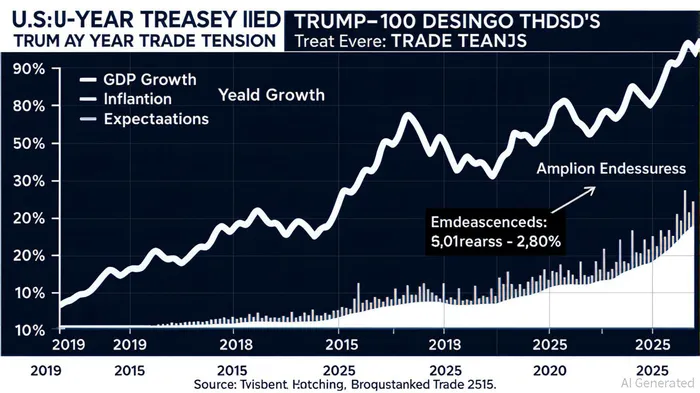
During the 2020 recession, U.S. Treasuries initially served as a safe haven, with yields plummeting as investors fled equities amid economic uncertainty [1]. However, this dynamic reversed in April 2025 when President Trump’s tariff announcements triggered a sharp rise in long-term Treasury yields. The 10-year yield surged from below 4% to 4.5% within days, while the 30-year yield breached 5%—a stark departure from historical patterns where yields typically fall during crises [4]. This volatility underscored a critical shift: Treasury bonds were no longer insulated from the very trade policies they were meant to hedge against.
The root cause lay in the decoupling of fiscal deficits from traditional economic indicators. Since 2008, U.S. government debt has ballooned under Trump-era fiscal policies, even as unemployment rates remained low [1]. Rising interest rates have amplified borrowing costs, creating a fiscal drag that investors now price into long-term bonds. The result is a market where Treasury yields reflect not just recession fears but also inflationary risks tied to trade policy uncertainty.
Structural Fragilities and the Erosion of the “Convenience Yield”
The Treasury market’s liquidity challenges have further complicated its role as a safe haven. Dealer intermediaries, constrained by regulatory limits and risk aversion during volatility, have reduced their capacity to absorb large trades [3]. This has led to wider bid-ask spreads and sharper price swings, particularly during events like the 2025 tariff announcements.
A key metric—the “convenience yield” of U.S. Treasuries, representing the liquidity premium investors demand—has shown signs of erosion [1]. As global investors reassess the dollar’s dominance and U.S. fiscal credibility, this premium may no longer provide the same cushion. For example, the 90-day tariff delay in April 2025 briefly restored confidence, but the yield curve remained steeper than pre-tariff levels, signaling lingering doubts [4].
Strategic Asset Allocation: Navigating Duration, Diversification, and Yield
Investors navigating this environment must adopt dynamic strategies. J.P. Morgan’s Global Investment Strategy Team emphasized the need for shorter bond durations to mitigate interest rate risks during periods of tariff-driven volatility [1]. For instance, the 50-basis-point spike in 10-year yields in early April 2025 highlighted the perils of long-duration portfolios. By contrast, shorter-term Treasuries or inflation-linked bonds (TIPS) offer more flexibility to rebalance as policy shifts unfold.
Diversification has also become critical. The U.S. Treasury’s strong auction results in April 2025 demonstrated residual demand for safe assets, but investors cannot rely solely on domestic bonds. Allocating to non-U.S. government bonds or high-quality corporate debt—particularly in sectors less exposed to trade wars—can reduce overconcentration risks. UBSUBS-- noted that companies are beginning to pass tariff costs to consumers, signaling nascent inflation pressures that could further strain traditional fixed-income allocations [2].
Yield strategies must balance income generation with risk management. Structured notes and floating-rate instruments have gained traction as tools to capture yield without exposing portfolios to prolonged rate hikes. For example, during the 2025 turmoil, leveraged hedge funds faced funding pressures that temporarily drove yields higher—a reminder that liquidity constraints can turn even high-credit-quality bonds into volatile assets [4].
Conclusion: A New Normal for Recession Hedges
The Trump-era policy climate has exposed the limitations of treating U.S. Treasuries as a static hedge. While they remain a cornerstone of diversified portfolios, their performance is now inextricably linked to the volatility of trade policy and fiscal sustainability. Investors must prioritize agility, adjusting duration, diversification, and yield strategies in real time to account for the unpredictable nature of Trump-driven macroeconomic shocks.
As the 2025 experience illustrates, the Treasury market’s resilience is not guaranteed. In a world where tariffs and fiscal deficits can rapidly reshape risk profiles, the key to preserving capital lies in anticipating policy-driven turbulence and adapting asset allocations accordingly.
**Source:[1] Unstoppable government debt - consequences for investors, [https://www.berenberg.de/en/news/capital-markets-focus/unstoppable-government-debt-consequences-for-investors/][2] POTUS 47: Quick takes on Trump 2.0, [https://www.ubs.com/us/en/wealth-management/insights/investment-research/potus-47/articles/quick-takes-on-the-second-trump-administration.html][3] What's going on in the US Treasury market, and why does it matter?, [https://www.brookings.edu/articles/whats-going-on-in-the-us-treasury-market-and-why-does-it-matter/][4] What's going on in the US Treasury market, and why does it matter?, [https://www.brookings.edu/articles/whats-going-on-in-the-us-treasury-market-and-why-does-it-matter/]







Comentarios
Aún no hay comentarios