
Bombardier Defense's Strategic Bet: A 10-Year SNC Pact and the Road to Aerospace Dominance
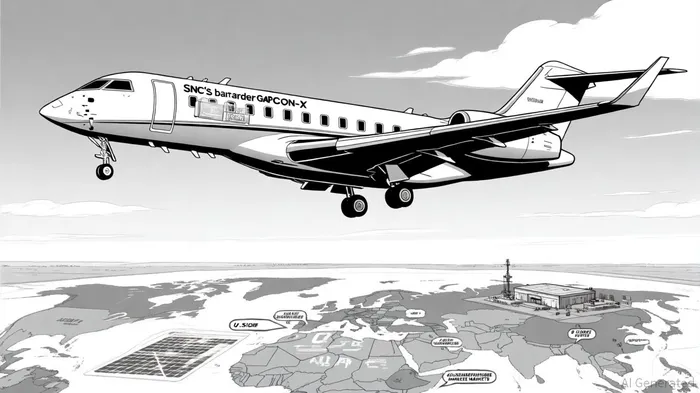
Here's the deal: Bombardier Defense is making a bold move to cement its position in the global aerospace services market with a 10-year service agreement with Sierra Nevada Corporation (SNC) for two Global 6500 aircraft equipped with SNC's RAPCON-X technology. This isn't just another contract-it's a calculated play to lock in long-term revenue, reduce operational risks for clients, and position itself as a critical player in the U.S. military's modernization push. Let's break down why this matters for investors and how it fits into Bombardier's broader strategy.
The Strategic Partnership: A Win-Win for Defense and Commercial Markets
The 10-year pact with SNC is part of Bombardier's Smart Services Defense program, which offers a "cost-per-flight-hour" model to shield operators from unpredictable maintenance expenses. By covering logistical support, spare parts, and 24/7 technical assistance, Bombardier is essentially guaranteeing predictable costs for SNC, which operates the two COCO (contractor-owned, contractor-operated) aircraft for a U.S. military customer, in Bombardier's announcement. This model is a game-changer for high-utilization missions, where traditional maintenance costs can spiral out of control.
What's more, the Global 6500 isn't just a workhorse-it's a platform for specialized missions. With its 18-hour endurance and ability to fly at high altitudes, it's being configured for the U.S. Army's HADES program as a next-generation ISR (intelligence, surveillance, and reconnaissance) platform, according to The Aviationist. SNC's RAPCON-X technology, which allows rapid reconfiguration for SIGINT, EO reconnaissance, and other missions, is a key enabler here. This partnership isn't just about selling planes; it's about embedding Bombardier into the U.S. military's critical infrastructure.
Financial Implications: Stability and Scalability
While the exact contract value isn't disclosed, the 10-year horizon provides Bombardier with a steady revenue stream. This is crucial in a sector where defense contracts often come with unpredictable delays or budget shifts. By locking in SNC as a long-term partner, Bombardier reduces exposure to short-term volatility and gains a recurring revenue model that's attractive to investors.
The financial benefits extend beyond this single deal. Bombardier's broader defense segment is on a growth trajectory. The company aims to triple its defense-related revenues to over $1 billion by the end of the decade, according to Bombardier's 2025 update. This SNC contract aligns with that goal, especially as the U.S. military accelerates its shift from legacy turboprop aircraft to high-performance platforms like the Global 6500.
Competitive Positioning: Outmaneuvering the Giants
In a market dominated by primes like Lockheed MartinLMT-- and Northrop GrummanNOC--, Bombardier's focus on niche, high-margin services is a smart differentiator. While its rivals are jockeying for hypersonic systems and next-gen fighter jets, Bombardier is carving out a niche in specialized mission aircraft and after-market services.
The company's Smart Services Defense program is a standout. By offering transparent, fixed-cost support, Bombardier is appealing to defense clients looking to mitigate financial risks. This is a contrast to traditional MRO (maintenance, repair, and overhaul) models, where costs can balloon unexpectedly. According to a 2025 Deloitte report, the aerospace and defense industry is increasingly prioritizing cost predictability and digital transformation-areas where Bombardier is already ahead of the curve.
Market Tailwinds: A $1.4 Trillion Industry Awaits
The global aerospace and defense market is projected to hit $1.4 trillion by 2033, driven by rising defense budgets and geopolitical tensions, according to Business Research Insights. Bombardier's dual focus on commercial and defense markets positions it to ride this wave. The company's recent debt reduction ($4.5 billion since 2020) and free cash flow generation ($900 million annually by 2025) further strengthen its balance sheet, giving it flexibility to invest in growth or return value to shareholders.
The Takeaway for Investors
Bombardier's SNC deal is more than a line item-it's a strategic pivot toward long-term, high-margin contracts that align with the U.S. military's modernization needs. By leveraging its Smart Services model and the Global 6500's versatility, Bombardier is positioning itself as a critical player in both commercial and defense markets. For investors, this represents a compelling mix of stability and growth potential, especially as the industry shifts toward cost-efficient, tech-driven solutions.
The question isn't whether Bombardier can win this contract-it's whether it can replicate this model with other defense clients and expand its Smart Services footprint globally. If the company can do that, its $1 billion defense revenue target by 2028 might just be the beginning.





Comentarios
Aún no hay comentarios