
Bolsonaro's Political Dynasty and the 2026 Brazilian Election Outlook: Assessing the Financial and Political Risks and Opportunities of a Bolsonarista-Led Comeback
Brazil's 2026 presidential election is shaping up as a defining moment for the country's political and economic trajectory. At the heart of this contest lies the question of whether the Bolsonarista movement, despite its current fractures and legal challenges, can mount a credible comeback. The dynasty of former President Jair Bolsonaro, once a dominant force in Brazilian politics, now faces a complex landscape of internal divisions, external pressures, and shifting investor sentiment. This analysis examines the financial and political risks and opportunities associated with a potential Bolsonarista-led government, drawing on recent developments and expert insights.
The Bolsonarista Dynasty: Fractures and Foreign Leverage
The Bolsonaro political dynasty, anchored by Jair Bolsonaro's sons, has seen its influence tested by both domestic and international dynamics. Eduardo Bolsonaro, a prominent figure in the family's political strategy, has been instrumental in lobbying U.S. President Donald Trump for retaliatory measures against Brazil's judiciary. His efforts, however, have had unintended consequences: Trump's imposition of 50% tariffs on Brazilian goods, framed as a response to judicial "persecution" of Jair Bolsonaro, has instead accelerated the former president's legal downfall and shifted public opinion in favor of the Supreme Court. This miscalculation underscores the risks of leveraging foreign alliances in domestic political battles.
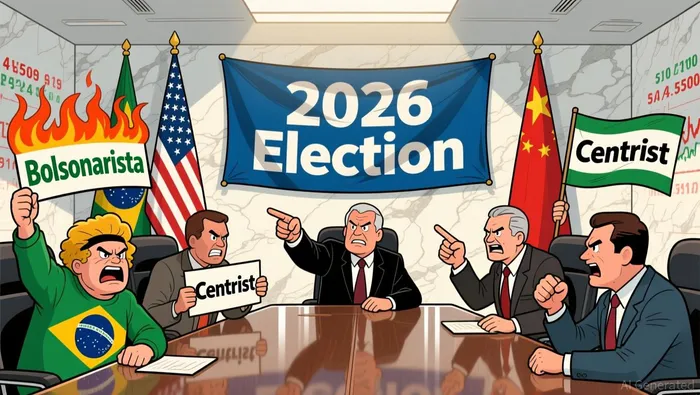 Meanwhile, Carlos Bolsonaro, mayor of Rio de Janeiro, has exacerbated internal tensions within the right-wing coalition by attacking fellow conservative leaders like Governor Romeu Zema (Minas Gerais) and Ronaldo Caiado (Goiás). His accusations of opportunism and disloyalty highlight a growing ideological rift between hardline Bolsonaristas and moderate conservatives pursuing distinct policy agendas. These divisions weaken the movement's ability to present a unified front, complicating efforts to coalesce around a single presidential candidate.
Economic Implications: Fiscal Challenges and Sectoral Opportunities
The financial risks of a Bolsonarista-led government are intertwined with Brazil's broader fiscal challenges. According to Goldman Sachs, Brazil's public debt-to-GDP ratio reached 78.1% in September 2025, necessitating a fiscal adjustment of approximately 3% of GDP to stabilize the trajectory. A return to Bolsonarista economic policies-prioritizing deregulation, fiscal discipline, and support for agribusiness-could attract sectors focused on raw materials and infrastructure. However, the high-interest-rate environment (Selic at 15%) and inflation (5.5–6%) pose significant hurdles, particularly for inflation-sensitive industries.
Agriculture and mining remain critical to Brazil's economic outlook. Record soy and corn harvests have bolstered growth, but U.S. tariffs on Brazilian agricultural goods have introduced volatility. Analysts note that while these tariffs affect only 60% of exports (with exemptions for energy and agricultural products), their political symbolism has amplified tensions and diverted attention from domestic fiscal sustainability. A Bolsonarista administration might seek to mitigate these risks by diversifying trade relationships, potentially balancing ties with the U.S. and China.
Investor Sentiment: Uncertainty and Asymmetric Opportunities
Investor sentiment ahead of the 2026 election is cautiously optimistic but clouded by political uncertainty. The iShares MSCI Brazil Capped ETF (EWZ) has risen 48% year-to-date in 2025, reflecting a generally upbeat outlook despite the polarized political environment. The MSCI Brazil index, trading at a price-to-earnings ratio of 9.3, remains undervalued compared to global emerging markets, presenting potential upside if a pro-market candidate wins.
However, the Bolsonarista movement's reliance on a "persecution" narrative has lost momentum following evidence of Jair Bolsonaro's attempt to tamper with his ankle monitor. This has eroded trust among moderate voters, who may instead gravitate toward technocratic figures like São Paulo Governor Tarcísio de Freitas. De Freitas, while positioning himself as a centrist alternative, faces criticism from both conservatives and the establishment, with Eduardo Bolsonaro branding him a "system candidate" (https://www.intellinews.com/brazil-s-right-wing-fractures-as-2026-election-takes-shape-amid-judicial-tensions-403636/). His ability to unify the right will depend on navigating these tensions and delivering on security and economic reforms.
Geopolitical and Fiscal Risks
A Bolsonarista-led government would need to address Brazil's constrained fiscal environment, where 92% of the federal budget is already allocated to mandatory expenses. While fiscal discipline could stabilize investor confidence, the polarized political climate risks creating turbulence during the transition, particularly if Lula's supporters perceive electoral irregularities. Additionally, the movement's reliance on external actors like Trump has exposed it to geopolitical risks, as seen in the tariff debacle.
Conclusion: A High-Stakes Election for Brazil's Future
The 2026 election will determine whether Brazil continues its expansionary fiscal policies under Lula or shifts to a more conservative approach under a Bolsonarista-aligned leader. For investors, the key variables will be the movement's ability to unify its fractured base, navigate fiscal constraints, and mitigate external shocks. While a Bolsonarista comeback could offer opportunities in sectors like agriculture and mining, the risks of political instability and policy missteps remain significant. As the election approaches, the interplay between domestic governance and global markets will be critical to Brazil's economic trajectory.







Comentarios
Aún no hay comentarios