
Bolsonaro's Coup Trial and Its Implications for Brazil's Political and Economic Stability
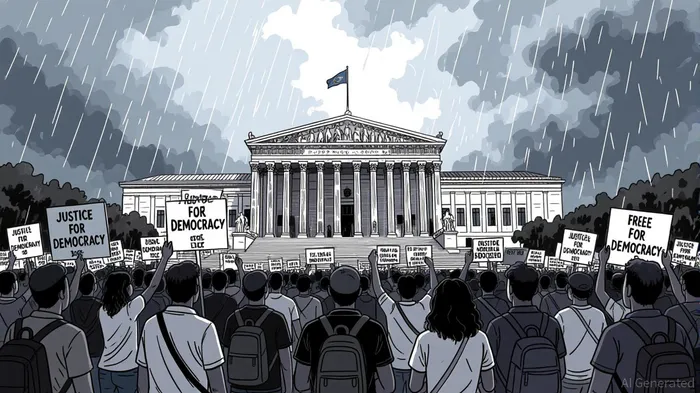
The trial of former Brazilian President Jair Bolsonaro for alleged coup plotting has become a defining moment for Brazil's democracy and its economic trajectory. As the Supreme Court prepares to deliver its verdict, the political and economic stakes are immense. This analysis examines how the trial's outcome could reshape Brazil's 2026 election landscape, influence investor confidence, and test the resilience of democratic institutions in a polarized society.
Political Fragmentation and the 2026 Election
Bolsonaro's trial is not merely a legal proceeding but a political earthquake. If convicted, he could face up to 43 years in prison, effectively ending his political career and forcing his far-right movement to seek a successor. According to a Bloomberg report, this scenario could lead to a fragmented right-wing bloc, with potential candidates like São Paulo Governor Tarcísio de Freitas or Bolsonaro's son Eduardo vying for leadership. However, a conviction might also consolidate support for President Luiz Inácio Lula da Silva's coalition, which has struggled to maintain unity amid declining approval ratings.
Conversely, an acquittal would embolden Bolsonaro's base, potentially deepening polarization. His legal team has already framed the trial as a “witch hunt,” a narrative that resonates with his supporters and could galvanize them ahead of the 2026 election. A free Bolsonaro might leverage his remaining influence to delay the formation of a cohesive right-wing alternative, prolonging political uncertainty.
Investor Confidence and Economic Stability
The trial's economic implications are equally critical. U.S. tariffs on Brazilian goods—escalated to 50% under President Trump—have already strained trade relations and raised concerns about Brazil's export-dependent sectors. A conviction could stabilize investor sentiment by signaling judicial independence, a key factor for foreign capital. Deloitte's 2025 economic outlook notes that Brazil's services sector and resilient labor market provide some buffer, but trade tensions remain a risk.
However, a conviction might also trigger short-term volatility. If Bolsonaro's movement fractures, it could lead to political instability, deterring investment. Conversely, an acquittal might reinforce perceptions of institutional weakness, eroding trust in Brazil's democratic governance. The International Monetary Fund has warned that geopolitical tensions could dampen global economic confidence, indirectly affecting Brazil's growth prospects.
Geopolitical Risks and U.S. Influence
Trump's geopolitical intervention—sanctioning Justice Alexandre de Moraes and framing the trial as a “violation of sovereignty”—has added another layer of complexity. While this aligns with Bolsonaro's base, it risks ceding influence to China and the EU, which have deepened economic ties with Brazil. The U.S. tariffs, justified under the Global Magnitsky Act, are seen as politically motivated, with analysts arguing they prioritize Trump's alliance with Bolsonaro over economic logic.
Brazil's response, including the Economic Reciprocity Law, signals a shift toward assertive diplomacy. Yet, this approach could escalate trade wars, further destabilizing investor confidence. The trial's outcome will likely determine whether Brazil can balance its sovereignty with the need to maintain stable international relations.
Conclusion
Bolsonaro's trial is a litmus test for Brazil's democratic institutions and its economic resilience. A conviction could weaken the far-right's grip, stabilize the political landscape, and restore investor confidence—but only if the judiciary's independence is perceived as credible. An acquittal, meanwhile, risks entrenching polarization and undermining trust in democratic norms. For investors, the key variables will be the trial's outcome, the emergence of a unified right-wing alternative, and the trajectory of U.S.-Brazil relations. As the world watches, Brazil's ability to navigate these challenges will shape its political and economic future for years to come.







Comentarios
Aún no hay comentarios