
BOK Maintains Policy Rate Amidst Persistent Financial Risks and Growth Moderation
This hold comes despite a notable divergence in lending rates. Corporate loan costs have eased significantly, declining for five consecutive months to reach 3.96%. This ongoing drop supports business financing and economic activity. Conversely, household loan rates increased by 0.07 percentage points to 4.24%, directly linked to stricter mortgage lending regulations. This split trend reflects the BOK's targeted approach: stimulating the corporate sector while containing risks in the residential property market.
Deposit rates also saw a second consecutive monthly rise, contributing to a narrowing lending-deposit spread. 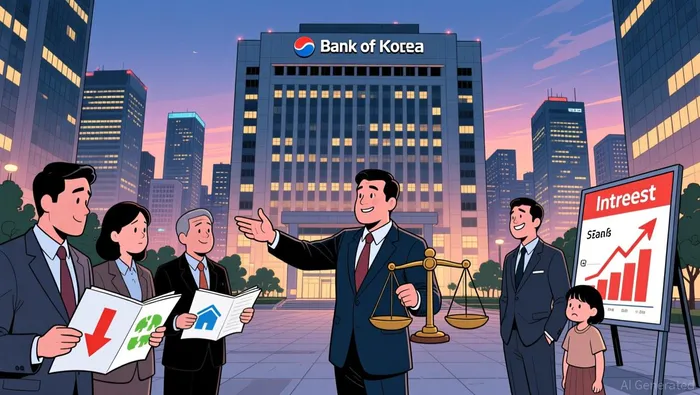 The spread between what banks charge for loans and pay on deposits now stands at 2.18 percentage points. This contraction in the spread, occurring alongside the corporate rate decline, signals the ongoing impact of the BOK's easing cycle that began in late 2024. The central bank maintains an accommodative monetary stance overall, using rate stability as a tool to navigate the complex interplay between supporting growth and safeguarding financial system resilience.
Growth Moderation Signals Underlying Fragility
The IMF's 0.9% 2025 GDP growth projection highlights mounting headwinds for South Korea's economy, driven by global trade slowdowns and domestic political uncertainty. This cautious outlook comes even as the Bank of Korea maintains its accommodative monetary stance to support recovery. However, authorities simultaneously implement macroprudential measures targeting housing market risks and non-bank financial vulnerabilities.
Household lending activity now reflects these tensions. In July 2025, total household loans grew by just KRW2.2 trillion-the slowest pace since March-as tightened debt management rules and stricter debt-service ratio requirements directly curbed borrowing. The deceleration was especially pronounced in non-mortgage lending, which actually declined by KRW1.9 trillion. While mortgage loans still expanded modestly at KRW4.1 trillion, their growth rate slowed significantly.
These financial trends signal growing fragility in South Korea's consumption-driven growth model. The IMF's weak growth forecast and the credit crunch reinforce each other: reduced consumer borrowing weakens domestic demand, which the IMF already expects to struggle amid trade and political headwinds. Authorities acknowledge stable housing prices but warn of potential overheating risks, suggesting they may further tighten lending standards. This creates a dangerous cycle where growth remains hampered by policy constraints while external factors continue to weigh on the economy.
Liquidity Pressures Mount in Banking Sector
Banks face growing profit pressure as deposit rates rise for a second month while lending rates struggle to keep pace, compressing the critical lending-deposit spread to just 2.18 percentage points. This squeeze comes despite the Bank of Korea holding its policy rate steady at 2.5% through November 2025, prioritizing financial stability amid household debt concerns. The narrowing spread directly erodes banks' core revenue stream, forcing them to find alternative income sources while maintaining profitability.
Corporate credit continues deteriorating, with loan rates falling for the fifth consecutive month to 3.96%, signaling weak demand and pricing pressure. Simultaneously, household borrowing stalled in July 2025 with new loans growing just KRW2.2 trillion – the slowest pace since March – as regulators aggressively implement debt curbs. Mortgage lending slowed to KRW4.1 trillion while non-mortgage loans actually declined by KRW1.9 trillion. This dual credit contraction, against rising funding costs, creates dangerous balance sheet pressures for lenders.
While authorities view the household lending slowdown as necessary for financial stability, the rapid credit contraction now threatens broader economic momentum. Banks face the difficult choice of either absorbing squeezed margins or passing higher costs to struggling borrowers, potentially triggering loan quality issues. The combination of narrowing spreads and weakening loan growth creates a liquidity strain that could force banks to tap into capital buffers or seek alternative funding, especially if the current monetary stance persists through 2026.
Regulatory Uncertainty Compounds Policy Risks
Beyond economic fundamentals, Korea's business landscape faces heightened policy turbulence. Political instability, including the presidential impeachment process, creates unpredictable legislative momentum and enforcement priorities. Simultaneously, evolving U.S. trade policies under the new administration introduce cross-border compliance complexities, forcing multinationals to rapidly adapt export strategies and supply chain structures. Financial institutions now face dual pressures: navigating domestic political volatility while hedging against shifting international trade barriers.
Korea's regulatory reform efforts, while ongoing, lack the depth needed for stable long-term planning. Enhanced consultation mechanisms like the People's Idea Box provide some stakeholder input. However, critical gaps persist in evaluating proposed laws. Regulatory Impact Assessments (RIAs) remain limited to executive branch initiatives, excluding most legislation originating in the National Assembly. Efforts to expand RIA requirements to parliamentary laws have stalled, meaning a significant portion of new regulations lack rigorous analysis of their economic consequences or cumulative burden on businesses.
This combination of political flux and incomplete regulatory reform creates substantial planning headaches for financial players. Banks and asset managers must now build contingency buffers against sudden regulatory shifts without clear signals on policy direction. The absence of comprehensive impact assessments for parliamentary bills means unexpected costs or operational frictions can emerge with little warning. Consequently, capital allocation becomes riskier, with institutions likely demanding higher risk premiums or scaling back sensitive activities until the political and regulatory environment stabilizes.







Comentarios
Aún no hay comentarios