
The BoJ's Hawkish Pivot: A Strategic Case for Yen-Linked Assets
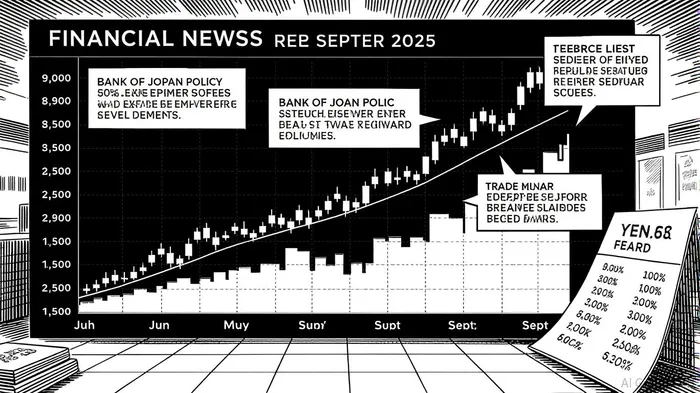
The Bank of Japan's (BoJ) recent policy shift has sent ripples through global markets, signaling a departure from years of ultra-dovish monetary easing. In September 2025, the BoJ maintained its short-term interest rate at 0.5% but revised its core inflation forecast upward to 2.7% for the current fiscal year, a stark contrast to the 2.2% projection just three months prior[1]. This adjustment, coupled with a more balanced assessment of inflation risks, marks a pivotal moment in Japan's monetary policy trajectory. For investors, the implications are clear: yen-linked assets are emerging as a compelling strategic play, driven by evolving currency options positioning and a re-rating of Japan's macroeconomic fundamentals.
A Hawkish Pivot Anchored in Economic Resilience
The BoJ's cautious optimism is rooted in Japan's economic resilience. A trade deal with the U.S. has alleviated concerns over tariff-related headwinds, while wage-price dynamics and robust household consumption have underpinned growth. Japan's Q2 2025 GDP expanded by 0.5% quarter-on-quarter, exceeding expectations of 0.3% and translating to an annualized rate of 2.2%[2]. This outperformance has emboldened the BoJ to recalibrate its inflation outlook, now viewing risks as balanced rather than skewed to the downside—a critical threshold for policy normalization.
Governor Kazuo Ueda's post-meeting remarks further fueled speculation about near-term tightening. While the BoJ refrained from immediate rate hikes, derivatives markets priced in a 49% probability of a hike by October 2025, up from 39% before the trade deal's finalization[1]. This divergence from the Federal Reserve's dovish stance—where rate cuts are anticipated—has created a widening yield differential, a tailwind for the yen. As one analyst noted, “The BoJ is no longer the outlier in the G10; it's now part of the tightening club”[4].
Currency Options Positioning: A Barometer of Confidence
The yen's positioning in currency options markets underscores growing confidence in its near-term strength. Traders have extended net-long exposure for a third consecutive week, with the USD/JPY pair trading near 146.50–146.80, close to its range lows[1]. This shift reflects a re-rating of Japan's economic prospects and the BoJ's tightening trajectory.
Forex strategists project further downward pressure on USD/JPY, with the pair potentially falling to 146.00 by Q3 2025 and 144.00 by year-end[4]. Such a move would align with the BoJ's gradual normalization path, where rate hikes—albeit modest—narrow the yield gap with the U.S. and Europe. Meanwhile, the yen's relative strength against the euro and British pound suggests a broader repositioning in carry trades, as investors rotate into higher-yielding assets[1].
Macroeconomic Re-Rating: Inflation Differentials and Structural Tailwinds
Japan's inflation differentials versus major economies are reshaping global macroeconomic narratives. While the U.S. faces a potential inflation uptick to 3.8% by mid-2026[4], and the Eurozone targets 2% via fiscal stimulus, Japan's core inflation is projected to stabilize at 2.1% in fiscal 2025[4]. This divergence is not merely cyclical but structural: wage growth and a tightening labor market are embedding inflation into Japan's economy, a stark contrast to the disinflationary pressures in the West.
These dynamics are re-rating Japan's macroeconomic profile. A trade deficit of 117.55 billion yen in July 2025, though a decline from prior years, coexists with falling electricity and education costs, which have tempered headline inflation[2]. Yet, food prices—particularly rice—surged 90.7% year-on-year, illustrating the stickiness of domestic inflation. For the BoJ, this means a delicate balancing act: tightening enough to anchor inflation expectations without derailing growth.
Strategic Implications for Investors
For investors, the BoJ's hawkish pivot and the yen's re-rating present a multi-faceted opportunity. Currency options with yen exposure, particularly those with short-dated maturities, could benefit from volatility as the BoJ navigates its tightening path. Additionally, yen-linked equities and bonds are gaining appeal, supported by Japan's improving fiscal position and corporate earnings growth.
However, risks remain. Political uncertainty, including Prime Minister Shigeru Ishiba's recent resignation, could delay policy normalization[3]. Moreover, global trade dynamics—particularly U.S. tariffs—remain a wildcard. Yet, for those with a medium-term horizon, the case for yen-linked assets is compelling. As one market participant put it, “The yen is no longer a proxy for risk-off; it's becoming a proxy for risk-on”[2].
In conclusion, the BoJ's pivot—from dovish outlier to cautious hawk—has redefined Japan's role in global markets. For investors, the yen is no longer a currency to avoid but a strategic asset to embrace.







Comentarios
Aún no hay comentarios