
The BOJ ETF Sell-Off: A Liquidity Crossroads for Global Markets
The Bank of Japan's (BOJ) planned gradual ETF sell-off, expected to begin between 2026 and 2027 at an annual pace of 600 billion to 1 trillion yen, marks a pivotal shift in global financial markets. This move, aimed at unwinding a decade of unprecedented monetary stimulus, will test the resilience of Japanese equities, bond markets, and cross-border capital flows. For investors, the sell-off presents a complex landscape of risks and opportunities, particularly in liquidity dynamics, equity valuation adjustments, and cross-asset correlations.
The Liquidity Crunch: A Hidden Catalyst for Volatility
The BOJ's ETF purchases—part of its yield curve control policy—have been a lifeline for Japanese equities, injecting liquidity into markets and supporting prices. Since 2010, the BOJ has accumulated ETFs worth 37 trillion yen (at book value), now valued at 70 trillion yen. 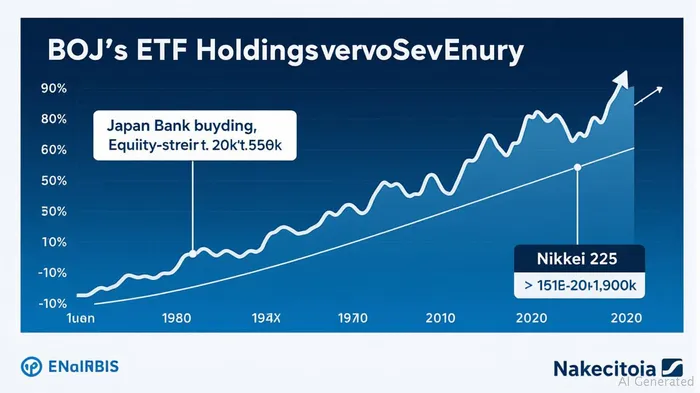 . As sales begin, this liquidity source will reverse, potentially creating a vacuum that foreign investors may struggle to fill.
. The withdrawal of BOJ support could amplify volatility, particularly in sectors like technology and healthcare, which have relied on central bank inflows. Investors should monitor the yen's liquidity metrics, such as the bid-ask spread in USD/JPY futures, for early signs of stress.
Equity Valuations: A Stress Test for Overhang Pricing
The sell-off will force markets to reassess equity valuations without central bank backstops. Japanese equities, particularly large-cap stocks in the TOPIX index, have traded at a premium due to BOJ demand. A gradual exit may not trigger a crash, but it will pressure valuations as private investors demand higher returns for risk.
. Sectors such as retail and real estate, which have benefited from low rates and BOJ buying, could face the sharpest revaluation. Conversely, export-driven sectors like automotive and machinery may gain if yen weakness persists, as a weaker yen boosts overseas profits.
Investors should consider underweighting cyclicals and overweighting defensive sectors such as utilities, which are less sensitive to liquidity shifts. Alternatively, hedged ETFs like the WisdomTreeWT-- Japan Hedged Equity Fund (DXJ) could mitigate currency risks while maintaining equity exposure.
Cross-Asset Correlations: Bond Yields and USD/JPY Dynamics
The BOJ's ETF sell-off is intertwined with its broader quantitative tightening (QT) strategy, including reduced purchases of Japanese Government Bonds (JGBs). A reveals how QT has already nudged yields upward. As ETF sales begin, the dual reduction in JGB and ETF buying could amplify upward pressure on bond yields, potentially destabilizing the yen.
Higher JGB yields would weaken the yen against the U.S. dollar, benefiting Japanese exporters but complicating the BOJ's inflation target. . Investors should brace for increased cross-asset volatility, as yen weakness could spill into global bond markets, altering traditional correlations between equities, bonds, and commodities.
Hedging Strategies and Sector Opportunities
- Currency Hedging: Use inverse yen ETFs like the ProShares UltraShort Yen (YCS) to offset yen depreciation risks.
- Sector Rotation: Favor export-oriented sectors (e.g., semiconductor equipment, machinery) while avoiding domestic consumer discretionary stocks.
- Liquid Alternatives: Invest in short-duration JGB ETFs (e.g., iShares JGB Short-Term Bond) to capitalize on yield increases without duration risk.
- Diversification: Allocate to Asian markets (e.g., South Korea, Taiwan) with stronger growth profiles to reduce Japan-specific exposure.
Conclusion: Navigating the BOJ's New Normal
The BOJ's ETF sell-off is not merely a technical adjustment but a seismic shift in market architecture. For global investors, the risks lie in liquidity dislocations and valuation resets, while opportunities emerge in sectors insulated from central bank withdrawal. As the BOJ charts its exit strategy, the mantra for investors should be caution in exposure and precision in hedging—ensuring portfolios are ready for a world where liquidity is no longer free.
. The path forward is clear: adapt to the new liquidity regime or risk being swept aside by its currents.







Comentarios
Aún no hay comentarios