
Boeing's Strategic Turnaround: A Post-Contract Win Growth Opportunity
Defense Sector Dominance: A Catalyst for Re-Rating
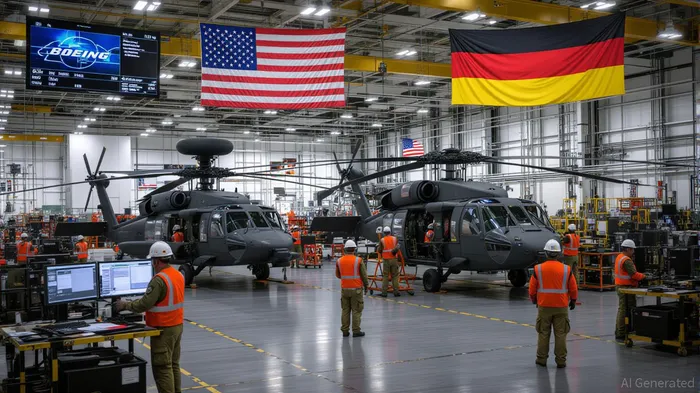 Boeing's recent defense contract wins underscore its renewed strength in the national security space. The company secured a with the U.S. Army, alongside a , including a according to Reuters. These awards, coupled with a for Lot 12 production aircraft and a , highlight Boeing's ability to capitalize on global modernization demands.
Such contracts not only provide immediate revenue tailwinds but also reinforce Boeing's role in critical defense programs. With a as of Q3 2025-20% of which is international-Boeing is well-positioned to sustain growth through 2026. This contrasts sharply with Airbus's recent struggles, where fuselage quality issues and a software recall affecting 6,000 A320 jets have disrupted operations and eroded customer confidence. Boeing's defense segment, meanwhile, , driven by its ability to execute large-scale, high-margin programs.
Commercial Aviation Recovery: Stabilizing Production and Delivery Metrics
Boeing's commercial aviation recovery has gained momentum in 2025, with production and delivery metrics aligning with long-term goals. The 737 MAX program, capped at by the FAA earlier this year, stabilized at that rate in Q3 2025, with plans to ramp up to and according to FlightGlobal. This gradual increase reflects Boeing's disciplined approach to quality control, which has year-on-year.
Delivery performance has also improved markedly. Boeing reported , the highest quarterly total since 2018, according to Simple Flying. The 737 MAX family accounted for 246 of these deliveries, , according to S&P Global. This progress contrasts with Airbus's narrowbody struggles, where production bottlenecks and quality issues have limited its ability to match Boeing's delivery cadence according to Simple Flying.
Institutional Investor Confidence: A Signal of Strategic Buy-In
Institutional investors have taken notice of Boeing's turnaround. FMR LLC and UBS, two of the largest holders, increased their stakes in Q3 2025 by , respectively, adding to their portfolios according to Boeing's Q3 results. This surge in institutional interest reflects confidence in Boeing's ability to convert its $4.7 billion in undelivered aircraft inventory into revenue and free cash flow-a critical step for restoring investor trust according to Yahoo Finance.
Despite recent share price volatility-a 19% drop over the past month-analysts remain cautiously optimistic, with a moderate buy consensus and an average target price of . This optimism is supported by Boeing's $23 billion in cash and marketable securities, according to Boeing's Q3 results.
Sector Dynamics: Defense Spending and Market Share Shifts
The aerospace sector's trajectory in 2025-2026 is shaped by two key trends: defense spending growth and market share reallocation. Global defense budgets rose nearly 10% in 2024-the fastest growth in four decades-and Boeing is poised to benefit from this trend. Its defense contracts, including a $2.8 billion deal for the U.S. Space Force's Evolved Strategic Satellite Communications program, highlight its alignment with national security priorities.
In the commercial space, Airbus has maintained a narrowbody delivery lead, with 67 aircraft delivered in July 2025 compared to Boeing's 48 according to FlightPlan. However, Boeing's focus on scaling the 737 MAX and optimizing production facilities-such as repurposing the Everett plant for the 737 MAX 10-positions it to close this gap. Meanwhile, Airbus's A320neo production challenges and supply chain bottlenecks could create opportunities for Boeing to regain market share in 2026 according to SafeFly.
Strategic Initiatives: AI, Sustainability, and Supply Chain Resilience
Boeing's long-term earnings potential is further bolstered by its strategic investments in AI, sustainability, and . The company has allocated $1 billion to its South Carolina facilities, creating 500 jobs and enhancing infrastructure to support full production cycles according to Pestel Analysis. AI and IoT integration into manufacturing processes is expected to reduce energy consumption and improve efficiency, while Boeing's commitment to sourcing 39% of its operational energy from renewables in 2023 underscores its alignment with ESG trends according to Pestel Analysis.
In the defense sector, Boeing is advancing its (Next Generation Air Dominance) program and refining its KC-46A Tanker operations, ensuring its relevance in an era of heightened geopolitical tensions. These initiatives, combined with a stable outlook from Fitch Ratings and a projected return to positive free cash flow in 2026, reinforce Boeing's strategic resilience.
Conclusion: A Strategic Buy-In at an Inflection Point
Boeing's strategic turnaround is no longer speculative-it is being driven by concrete contract wins, operational improvements, and institutional confidence. With defense spending surging, Airbus grappling with production challenges, and Boeing's commercial recovery gaining momentum, the company is at an inflection point where value-driven re-rating is not only plausible but increasingly probable. For investors, the combination of a $76 billion defense backlog, a disciplined production ramp-up, and a stable financial outlook makes Boeing a compelling long-term opportunity.





Comentarios
Aún no hay comentarios