
Boeing's Strategic Turnaround and 2026 Growth Catalysts: Fleet Modernization, Order Strength, and Profitability Potential
Boeing's 2026 trajectory appears increasingly promising as the aerospace giant navigates a strategic revival marked by robust order intake, accelerated fleet modernization, and a recalibration of long-term profitability. After years of production bottlenecks and regulatory scrutiny, the company is now capitalizing on pent-up demand, technological innovation, and a disciplined approach to cost management. For investors, the convergence of these factors positions BoeingBA-- to reclaim its competitive edge in a market still dominated by Airbus.
Order Strength: A Foundation for Growth
Boeing's order performance in late 2025 underscores its ability to attract demand amid a competitive landscape. Through November 30, 2025, the company secured 1,000 gross orders, outpacing Airbus and driven largely by widebody aircraft such as the 777X and 787 Dreamliner according to defense reports. December 2025 added further momentum, with 64 commercial aircraft deliveries, including 44 737 MAX narrowbodies and 14 787s as production data shows. A landmark transaction with Alaska Airlines-a $2.73 billion order for 105 737 MAX 10s and five 787s-exemplifies the growing confidence in Boeing's product lineup according to flight industry analysis. These orders, with deliveries extending through 2035, provide a stable revenue pipeline and validate the company's focus on fuel-efficient, high-capacity models.
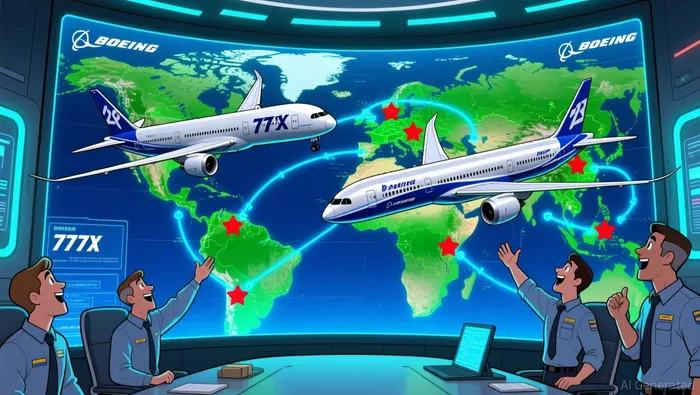
Fleet Modernization: Scaling Production and Innovation
Central to Boeing's 2026 growth is its fleet modernization strategy, which hinges on scaling production rates and integrating advanced technologies. The company plans to increase 737 MAX output to 47 units per month by late 2025 or early 2026, pending FAA approval, while raising 787 production to 10 units monthly as part of its growth strategy. These adjustments aim to align with surging demand for narrowbody and widebody aircraft, particularly in transcontinental and long-haul markets. The 777X program, though delayed, remains a cornerstone, with its first delivery expected in 2026 according to strategic analysis.
Efficiency gains are also evident in Boeing's production processes. In December 2025, the company achieved a compressed lead time of 24 days for narrowbody aircraft deliveries, reflecting streamlined operations and improved quality control as production data indicates. Such improvements are critical to restoring customer trust and reducing costs, which have historically plagued Boeing's manufacturing divisions.
Profitability Potential: From Cash Burn to Positive Flow
Boeing's financial trajectory is set to reverse in 2026, with the company projecting positive cash flow after burning $2 billion in 2025 according to financial analysis. This shift is driven by higher delivery volumes-2025 saw 590 aircraft handed over, a 69% increase from 2024 as industry reports show-and a more stable production environment. Capital expenditures of approximately $3 billion in 2025 and 2026 further underscore Boeing's commitment to long-term profitability, with investments targeting production capabilities, digital tools, and workforce development according to rating analysis.
The company's cost management efforts are equally pivotal. By leveraging artificial intelligence (AI), additive manufacturing, and the "Internet of Military Things," Boeing is optimizing supply chains, reducing waste, and enhancing situational awareness in both commercial and defense operations as technology trends indicate. These technologies not only cut costs but also align with global trends toward sustainability and operational efficiency.
R&D and Strategic Positioning
Boeing's $3 billion R&D investment in 2025–2026 reflects its ambition to lead in next-generation aviation according to financial analysis. Innovations in hydrogen-powered propulsion, electric systems, and autonomous flight are being explored to meet evolving environmental regulations and customer preferences. Meanwhile, the company's expansion of manufacturing facilities in South Carolina and St. Louis highlights its focus on domestic supply chain resilience and workforce training as company reports state.
Conclusion: A Cautious Optimism
While Boeing still trails Airbus in 2025 deliveries (590 vs. 793 aircraft) according to industry data, its order strength, production scalability, and technological investments position it for a strong 2026. The Alaska Airlines deal and 787 program momentum, coupled with a disciplined approach to profitability, suggest the company is emerging from its recent turbulence. For investors, Boeing's strategic turnaround hinges on executing these plans without repeating past missteps-a challenge, but one that appears increasingly within reach.







Comentarios
Aún no hay comentarios