
Boeing's Strategic Rebalancing: Restoring Long-Term Value in the Narrow-Body Aircraft Market
The BoeingBA-- Company stands at a pivotal juncture in its history, navigating the dual challenges of restoring trust in its 737 MAX program while preparing for a generational shift in narrow-body aircraft design. For patient capital, the question is whether Boeing can transform its current struggles into a sustainable competitive advantage. This analysis examines Boeing's strategic recalibration, its implications for the narrow-body market, and the risks and opportunities for long-term investors.
The 737 MAX: Incremental Progress Amid Lingering Risks
Boeing's 737 MAX has been a symbol of both engineering ambition and corporate missteps. As of September 2025, the Federal Aviation Administration (FAA) has restored limited certification authority to Boeing for the 737 MAX and 787, allowing the company to issue airworthiness certificates on alternating weeks with FAA inspectors. This arrangement reflects a cautious trust-building effort, with embedded FAA oversight ensuring quality control in production. However, the MAX 7 and MAX 10 variants remain delayed until 2026 due to unresolved issues with the engine anti-ice system, which risks overheating and structural damage.
Production rates have increased to 38 aircraft per month, with a near-term goal of 42 and a long-term target of 47. While this progress eases delivery bottlenecks, Boeing must still prove it can maintain safety standards while scaling output. The January 2024 Alaska Airlines door plug incident has further intensified regulatory scrutiny, underscoring systemic risks in production quality. For investors, the 737 MAX's revival hinges on Boeing's ability to balance efficiency with safety-a test of its renewed corporate discipline.
A New Era: The 797 and the Middle-of-the-Market Opportunity
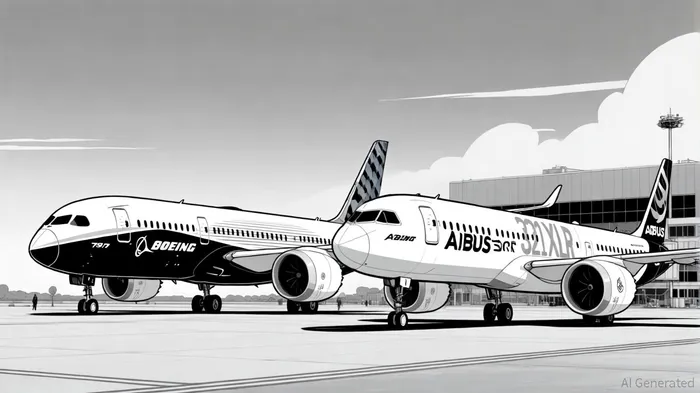
Boeing's long-term competitiveness depends on its next-generation narrow-body aircraft, tentatively dubbed the 797 or New Midsize Aircraft (NMA). In early 2025, the company began exploratory studies for a clean-sheet design targeting the middle-of-the-market (MOM) segment, a space currently dominated by Airbus's A321XLR. The 797 is envisioned as a single-aisle aircraft with seating for 225–275 passengers and a range of 4,500–5,000 nautical miles, according to Q2 2025 earnings highlights. This positioning would directly challenge the A321XLR's 4,700-nautical-mile range while offering faster boarding and deboarding compared to traditional narrow-body aircraft.
Technological differentiation is critical. The 797's design incorporates thermoplastic composites to reduce weight, advanced avionics akin to the 787, and next-generation engines from partners like Rolls-Royce and GE. Fuel efficiency improvements of 15–20% are projected, aligning with industry demands for sustainability. However, Airbus is not idle: its A320neo successor, expected to enter service in the mid-2030s, will likely integrate hybrid-electric propulsion and sustainable materials. Boeing's ability to innovate at scale-and deliver the 797 by the mid-2030s-will determine its dominance in a market, according to a narrow-body market analysis, projected to grow at 4.5% CAGR through 2035.
Financial Resilience and Risk Mitigation: A Test of Leadership
Boeing's financial health remains precarious. In Q2 2025, the company reported $22.7 billion in revenue-a 35% increase year-over-year-and achieved 150 commercial deliveries, the highest since 2018. Yet, its debt balance of $53.3 billion and a net loss of $11.82 billion in 2024 highlight ongoing vulnerabilities. To stabilize its balance sheet, Boeing has raised $25 billion in debt and credit, with plans to divest non-core units. The 737 MAX's backlog of 4,600 orders offers a path to cash positivity, but supply chain disruptions and FAA production caps remain obstacles.
Risk management has also been overhauled. Leadership changes, including a new CFO and realigned divisions, aim to restore operational discipline. The acquisition of Spirit AeroSystems and reinforced quality protocols signal a commitment to addressing past safety culture failures. However, as former Boeing 737 Program Manager Ed Pierson noted, internal production issues and regulatory skepticism persist. For long-term investors, Boeing's success will depend on its ability to execute these reforms without repeating past mistakes.
Investment Implications: Balancing Patience and Prudence
For patient capital, Boeing presents a high-risk, high-reward proposition. The narrow-body market's projected expansion to $193.8 billion by 2033 offers growth potential, particularly in Asia-Pacific and North America. However, Boeing's path to competitiveness requires navigating:
1. Regulatory and Reputational Risks: The FAA's alternating certification model and ongoing scrutiny of Boeing's safety processes could delay timelines.
2. Technological Uncertainty: The 797's clean-sheet design demands significant R&D investment, with no guarantees of cost overruns or technical hurdles.
3. Competitive Pressures: Airbus's A321XLR and upcoming A320 successor threaten to capture market share, particularly in the MOM segment.
Despite these challenges, Boeing's strategic rebalancing-focusing on efficiency, innovation, and financial discipline-aligns with long-term industry trends. Investors should monitor Q2 2025 earnings, production ramp-ups, and progress on the 797. A successful execution could position Boeing to reclaim its leadership in narrow-body aviation, but patience will be essential.
Conclusion
Boeing's journey from crisis to renewal is far from complete. The 737 MAX's gradual recovery, the 797's aspirational design, and the company's financial restructuring collectively signal a strategic pivot toward long-term value creation. Yet, the stakes are high: regulatory trust, technological execution, and market dynamics will determine whether this rebalancing succeeds. For patient capital, the key is to balance optimism with vigilance, recognizing that Boeing's revival will require not just innovation, but a sustained commitment to safety and transparency.





Comentarios
Aún no hay comentarios