
Boeing's Strategic Momentum: Korean Air Deal and China Hopes Signal a Turnaround for the Aviation Giant
Boeing’s recent $50 billion order from Korean Air, coupled with its ambitious negotiations in the Chinese market, marks a pivotal shift in the aerospace giant’s post-pandemic recovery. These moves not only address immediate operational needs but also position BoeingBA-- to navigate complex geopolitical and economic dynamics in a rapidly evolving aviation landscape.
Korean Air Deal: A Catalyst for Fleet Modernization and U.S. Job Growth
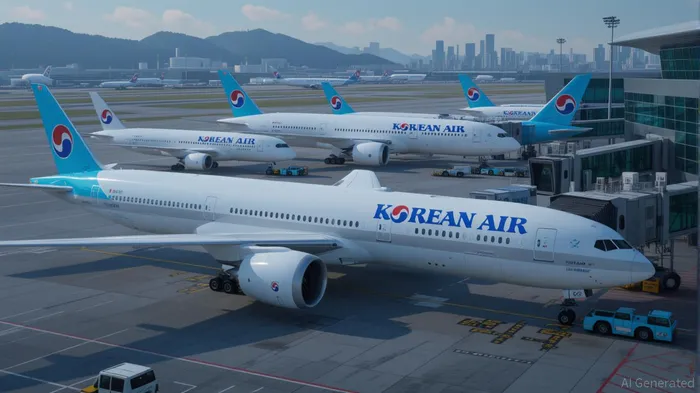
Korean Air’s record $50 billion order for 103 Boeing aircraft—including 50 737-10s, 25 787-10s, 20 777-9s, and eight 777-8F freighters—represents a strategic bet on modernization and efficiency [1]. The deal, announced during the Korea-U.S. Business Roundtable, underscores Korean Air’s intent to integrate with Asiana Airlines and reduce fuel costs while meeting global sustainability targets [2]. By phasing deliveries through 2030, the airline is aligning its fleet with long-term demand projections, particularly in Asia, where air travel is expected to account for over 40% of global aircraft demand by 2030 [3].
The order also reinforces U.S. aerospace manufacturing, supporting 135,000 jobs and signaling a broader geopolitical alignment between Washington and Seoul [4]. For Boeing, this deal stabilizes its order backlog and restores credibility in Asia, a market it has struggled to retain amid production delays and competition from Airbus [5].
China Hopes: A High-Stakes Geopolitical Gambit
While the Korean Air deal provides immediate momentum, Boeing’s long-term recovery hinges on its ability to re-enter the Chinese market. Negotiations for a potential $37 billion order of up to 500 aircraft—focused on the 737 Max series—could reclaim lost ground in a market that accounts for 10% of Boeing’s current backlog [6]. China’s projected demand for 9,755 commercial aircraft by 2045 makes it a critical growth driver, yet the deal faces hurdles, including unresolved U.S.-China tariffs and leadership shifts in China’s aviation sector [7].
The trade war has already forced Chinese airlines to reject Boeing deliveries, redirecting them to India and Southeast Asia [8]. While this diversification offers Boeing new opportunities, it also highlights the fragility of its China strategy. Success in Beijing would not only boost Boeing’s financials but also ease broader U.S.-China trade tensions, making it a geopolitical as well as commercial priority [9].
Strategic Implications: Balancing Risk and Opportunity
Boeing’s dual focus on Korean Air and China reflects a calculated approach to post-pandemic recovery. The Korean Air deal provides a stable revenue stream and reinforces U.S. manufacturing, while the China negotiations offer a high-reward, high-risk path to market dominance. However, both strategies are intertwined with geopolitical currents: U.S.-South Korea alignment and U.S.-China tensions.
For investors, the key question is whether Boeing can leverage these deals to outpace Airbus and address production bottlenecks. The inclusion of a 20-year GE engine maintenance contract with Korean Air, for instance, signals a shift toward lifecycle cost management—a critical factor in an era of volatile fuel prices and regulatory pressures [10].
Conclusion
Boeing’s strategic momentum is built on two pillars: immediate fleet modernization with Korean Air and the long-term potential of the Chinese market. While the former provides a clear path to stabilizing its order book, the latter remains a high-stakes gamble. As the aviation industry rebounds, Boeing’s ability to navigate geopolitical risks and production challenges will determine whether these deals translate into sustained profitability. For now, the $50 billion Korean Air order and the $37 billion China hope represent a compelling case for optimism in an otherwise turbulent sector.
Source:
[1] Korean Air makes airline's biggest-ever Boeing jet order [https://www.reuters.com/business/aerospace-defense/korean-air-makes-airlines-biggest-ever-boeing-jet-order-amid-trump-lee-summit-2025-08-26/]
[2] Korean Air orders 103 Boeing jets in record deal [https://charlestonbusiness.com/korean-air-orders-103-boeing-jets-dreamliners/]
[3] Korean Air Seals $50B Boeing Deal for 100 Aircraft Upgrade [https://www.webpronews.com/korean-air-seals-50b-boeing-deal-for-100-aircraft-upgrade/]
[4] Korean Air Commits to Record Purchase of 103 Boeing Jets [https://investors.boeing.com/investors/news/press-release-details/2025/Korean-Air-Commits-to-Record-Purchase-of-103-Boeing-Jets-to-Modernize-Fleet/default.aspx]
[5] Boeing's Strategic Win with Korean Air [https://www.ainvest.com/news/boeing-strategic-win-korean-air-catalyst-aerospace-manufacturing-post-pandemic-era-2508/]
[6] Boeing's China Gambit: A Strategic Bet on Market Access [https://www.ainvest.com/news/boeing-china-gambit-strategic-bet-market-access-geopolitical-harmony-2508]
[7] Boeing's $37 Billion China Deal [https://www.ainvest.com/news/boeing-37-billion-china-deal-strategic-reassessment-aerospace-geopolitical-risks-2508]
[8] Boeing Jets Back from China [https://safefly.aero/boeing-jets-back-from-china-how-trade-war-opens-doors-for-global-airlines/]
[9] Korean Air Seals $50B Boeing Deal for 103 Jets [https://www.webpronews.com/korean-air-seals-50b-boeing-deal-for-103-jets-and-maintenance/]
[10] Korean Air Seals $50B Boeing Deal for 100 Aircraft Upgrade [https://www.webpronews.com/korean-air-seals-50b-boeing-deal-for-100-aircraft-upgrade/]





Comentarios
Aún no hay comentarios