
Boeing's Strategic Alliances in Defense Aviation: Capitalizing on the Global Advanced Military Trainer Market
Resolving Operational Challenges to Meet Demand
Boeing's recent resolution of a 101-day strike at its St. Louis defense facilities marks a critical turning point. The labor agreement, which includes a 24% wage increase over five years and a $6,000 ratification bonus, ensures the resumption of production for the F-15 fighter jet and the T-7A Red Hawk trainer according to Reuters and CNBC. This stabilization is vital for maintaining delivery schedules to the U.S. Air Force and supporting global orders. According to CNBC, the defense unit, which contributed 30% of Boeing's $65.5 billion revenue in the first nine months of 2025, is now positioned to scale operations.
Strategic Alliances Drive Global Expansion
Boeing's partnerships are central to its strategy for capturing emerging markets. In the U.S., the company has teamed with Leonardo to modernize Army aviation training through the Flight School Next program, utilizing Leonardo's AW119T helicopter. This collaboration combines Boeing's expertise in Army aviation with Leonardo's proven aircraft, offering a cost-effective, proficiency-based training system. The Army plans to evaluate proposals in 2026, with implementation expected by fiscal 2027 according to Boeing.
In the Asia-Pacific region, Boeing's alliance with Singapore-based ST Engineering reflects its focus on asset optimization and fleet flexibility. A recent transaction involving Titan Aviation Leasing-partially owned by Bain Capital and Atlas Air Worldwide-delivered two Boeing 737-800SF aircraft to ST Engineering, underscoring Boeing's role in supporting regional defense and cargo needs.
International Partnerships and the T-7A Red Hawk
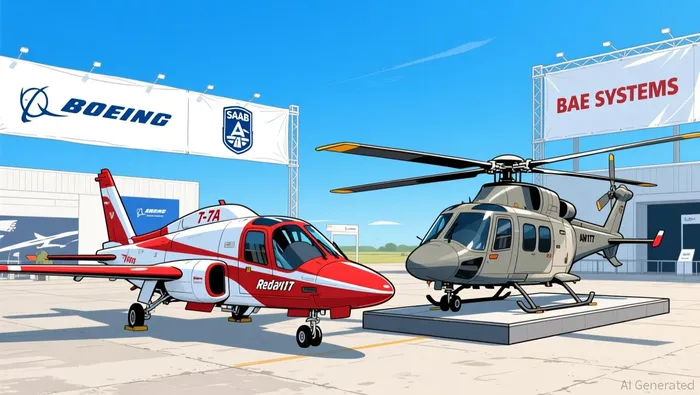
Boeing's international ambitions for the T-7A Red Hawk are gaining momentum. The company has partnered with Sweden's Saab for the U.S. Air Force program and is in advanced discussions with BAE Systems to potentially replace the UK's aging Hawk fleet according to Seeking Alpha. These alliances highlight Boeing's ability to adapt its platforms to diverse markets. With the UK seeking a modern trainer to meet evolving combat requirements, a partnership with BAE could unlock significant contracts according to Seeking Alpha.
The Asia-Pacific region, expected to be the fastest-growing market due to defense spending in China and India, is another focal point. Boeing executives have indicated that a formal cooperation announcement for the T-7A's international expansion is imminent. This aligns with the global trend of adopting advanced trainers to prepare pilots for 4th- and 5th-generation aircraft according to Coherent Market Insights.
Long-Term Growth and Competitive Positioning
Boeing's strategic alliances are not limited to aircraft production. The company's collaboration with Leonardo on synthetic training systems and its focus on simulation technologies further enhance its value proposition. These innovations address cost concerns while improving training efficiency-a critical factor for budget-conscious militaries.
Moreover, Boeing's recent labor agreement mitigates risks of production delays, ensuring it can meet the U.S. military's demands and compete with rivals like Lockheed Martin and Airbus. The defense sector's shift toward partnerships-evidenced by Leonardo's alliance with Airbus and Thales in the space industry-underscores the importance of collaborative ecosystems in maintaining competitive advantage.
Conclusion
As the global advanced military trainer market expands, Boeing's strategic alliances and operational stability position it as a key beneficiary. By leveraging partnerships in the U.S., Europe, and Asia-Pacific, and integrating advanced training solutions, Boeing is well-equipped to capitalize on long-term growth. Investors should monitor the company's progress in securing international contracts for the T-7A and its ability to maintain production efficiency post-strike.





Comentarios
Aún no hay comentarios