
Boeing's Strategic AI Adoption in Defense and Space Manufacturing: Operational Efficiency and Competitive Relevance in a High-Stakes Sector
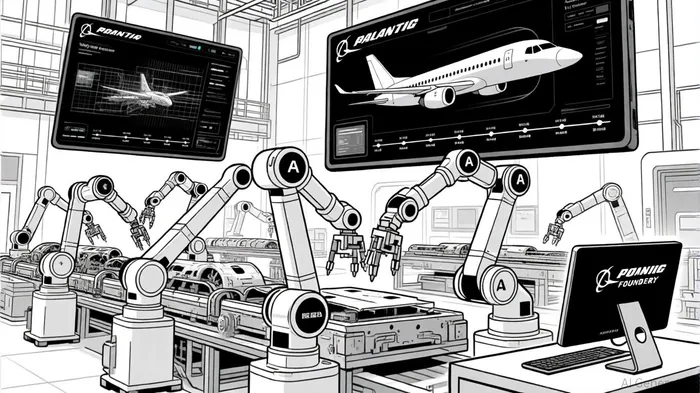
In an era where artificial intelligence (AI) is reshaping the aerospace and defense landscape, Boeing's recent strategic pivot toward AI-driven manufacturing has positioned the company at a critical inflection point. With defense budgets surging globally and the Pentagon prioritizing AI for military modernization, Boeing's collaboration with PalantirPLTR-- Technologies to integrate AI systems across its Defense, Space & Security (BDS) division represents a calculated move to enhance operational efficiency and secure its competitive edge. This analysis examines Boeing's AI initiatives, their measurable impact on production timelines and cost structures, and how they stack up against rivals like Lockheed MartinLMT-- and Northrop GrummanNOC-- in a sector defined by high stakes and technological disruption.
AI as a Catalyst for Operational Efficiency
Boeing's partnership with Palantir, announced in September 2025, leverages the Foundry platform to unify data analytics across its geographically dispersed defense manufacturing facilities. By standardizing data workflows, the system enables real-time decision-making, reducing production planning cycles from weeks to hours[1]. This is particularly critical for complex programs like military aircraft, satellites, and missile systems, where delays and cost overruns have historically plagued the industry. Steve Parker, CEO of BDS, emphasized that the integration accelerates supply chain responsiveness and allows for dynamic adjustments to production bottlenecks[2].
Beyond Palantir, BoeingBA-- has embedded AI into its manufacturing toolkit. For instance, the company's Flexible Robotic Drilling Systems (FRDS) automate precision drilling and fastening, cutting assembly time by up to 50% in commercial and defense aircraft production[3]. AI-powered machine vision systems further enhance quality control, detecting microscopic defects in composite materials and reducing rework costs by identifying flaws in real time[3]. These technologies are not just incremental improvements—they represent a fundamental shift toward predictive, data-driven manufacturing.
Competitive Positioning: Boeing vs. Rivals
While Boeing's AI initiatives are robust, its competitors are also advancing their own strategies. LockheedLMT-- Martin, for example, has focused on AI for autonomous systems and predictive maintenance. Its VISTA X-62A training plane, equipped with AI operating systems, demonstrated autonomous flight for 17 hours in 2023, signaling progress in AI-enabled combat aircraft development[4]. Additionally, Lockheed's Predictive Maintenance Model uses machine learning to preemptively identify system failures, reducing downtime and maintenance costs[5].
Northrop Grumman, meanwhile, has automated F-35 center fuselage production using robotic assembly lines, achieving a production interval of just 1.25 days[6]. This automotive-style automation, combined with digital twin technology, has streamlined multi-variant manufacturing and reduced engineering rework to less than 1% in recent projects[6]. Northrop's additive manufacturing advancements further cut lead times by up to 90% for certain components, offering a stark contrast to traditional methods[7].
Despite these strides, Boeing's integration of AI across its entire value chain—from design to supply chain—sets it apart. The company's 30% improvement in design accuracy and 25% increase in manufacturing efficiency in the aerospace sector[8] underscore its ability to scale AI applications beyond isolated use cases. Moreover, Boeing's collaboration with Palantir extends to classified military projects, aligning with the Pentagon's push for AI-driven capabilities in sensitive operations[1].
Strategic Implications for Investors
The defense sector's AI arms race is intensifying, with smaller tech firms like Anduril and Kratos challenging traditional primes with agile, AI-first solutions[9]. However, Boeing's industrial base and long-term contracts with the U.S. government provide a buffer against such disruption. Its investments in AI are not merely defensive but proactive, aiming to secure a leadership role in next-generation programs like the B-21 Raider and Collaborative Combat Aircraft (CCA) initiatives[10].
For investors, Boeing's AI adoption represents a dual opportunity: cost optimization in the short term and a platform for innovation in the long term. While competitors like Lockheed and Northrop excel in niche AI applications, Boeing's holistic approach—combining automation, data analytics, and strategic partnerships—positions it to navigate the sector's volatility. The company's ability to translate AI into measurable efficiency gains (e.g., 50% faster drilling, 30% higher design accuracy) provides a tangible edge in a market where margins are razor-thin and geopolitical risks are high.
Conclusion
Boeing's strategic embrace of AI is a masterclass in industrial transformation. By integrating Palantir's Foundry platform, automating manufacturing workflows, and leveraging digital twins, the company is addressing long-standing inefficiencies while aligning with Pentagon priorities. While rivals like Lockheed and Northrop Grumman are making strides in autonomous systems and additive manufacturing, Boeing's end-to-end AI strategy offers a broader, more scalable solution. For investors, this positions Boeing not just as a survivor in a high-stakes sector, but as a potential leader in the AI-driven defense revolution.







Comentarios
Aún no hay comentarios