
Boeing's St. Louis Labor Crisis and Its Implications for Shareholder Value
Labor Cost Dynamics: A Delicate Balancing Act
Boeing's revised contract proposal, , according to a Reuters report, reflects the company's attempt to balance upfront incentives with long-term cost control. However, , as reported by the Spokesman. According to 's 2025 manufacturing benchmarking study, labor costs and SG&A expenses have remained stubbornly elevated, , , according to the Wipfli study. For Boeing, which operates in capital-intensive segments like defense and aerospace, even minor disruptions in workforce stability can amplify costs and delay revenue-generating projects.
The company's insistence that its offer is "more than fair," according to the Spokesman, contrasts sharply with the union's emphasis on "stronger retirement contributions and fair compensation." This disconnect underscores a broader industry challenge: how to align labor demands with profitability in an era where margin compression is a persistent risk. As stated by a Reuters report, Boeing's removal of the retention bonus to allocate more cash upfront suggests a short-term focus on liquidity, but it risks alienating workers who value long-term security, according to the Reuters report.
Operational Continuity Risks: A Sector-Wide Vulnerability
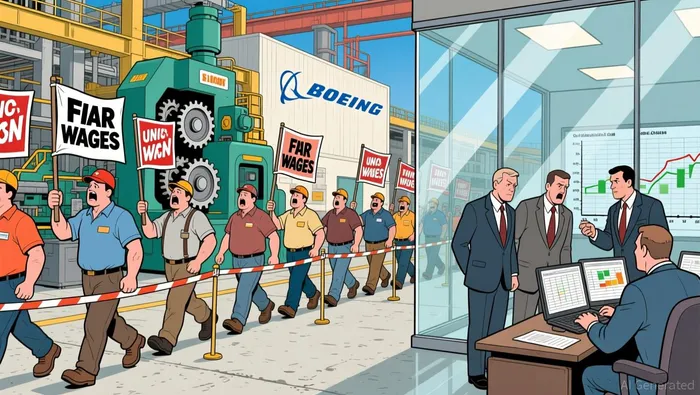
The St. Louis strike has forced Boeing to accelerate hiring of replacement workers and streamline operations, according to the Spokesman. But these measures come with their own risks. In industrial manufacturing, where production timelines are tightly coordinated, even a partial workforce replacement can lead to quality control issues, delays, and increased training costs. A 2025 study by Aon notes that operational continuity risks-driven by labor disputes, supply chain disruptions, and geopolitical volatility-have become a top concern for manufacturers, , according to the Aon study. The longer the strike drags on, the more pronounced these effects become, as seen in Boeing's recent stock volatility.
For context, , , according to the Globe and Mail report. While Boeing's defense contracts are less cyclical, the company's reliance on St. Louis for assembling fighter jets and munitions means any production slowdown could delay deliveries to the U.S. Department of Defense, potentially triggering penalties or reputational damage.
Strategic Implications for Shareholders
The St. Louis labor crisis is a microcosm of Boeing's broader challenges in managing labor costs while maintaining operational continuity. For investors, the key questions are:
1. Can Boeing secure a resolution without significantly increasing labor costs? The company's revised offer suggests a willingness to negotiate, but the union's rejection indicates that a compromise may require concessions on retirement benefits or wage growth.
2. How will the strike impact Boeing's 2025 earnings? , according to a StockTwits report, prolonged disruptions could pressure margins, especially if replacement workers prove less efficient.
3. What does this mean for the industrial manufacturing sector? If Boeing's experience signals a trend of escalating labor demands, other manufacturers may face similar pressures to raise wages or bonuses, squeezing profit margins across the board.
Conclusion: A Test of Resilience
Boeing's St. Louis labor crisis is more than a local dispute-it's a stress test for the company's ability to navigate the volatile intersection of labor costs, operational continuity, and shareholder expectations. While the revised contract proposal shows Boeing is willing to bend on incentives, the union's firm stance on retirement benefits and wages suggests a resolution may take time. For shareholders, the lesson is clear: in industrial manufacturing, where margins are thin and supply chains are fragile, labor peace is not just a HR issue-it's a financial imperative.





Comentarios
Aún no hay comentarios