
Boeing vs. RTX: Which Defense Stock Offers Better Value in 2026?
Heightened global unrest has served as a key tailwind for major aerospace and defense players like Boeing BA and RTX Corporation RTX. Ongoing conflicts, particularly in parts of Europe and the Middle East, have prompted the United States and its allies to increase defense spending in a bid to strengthen national security.
In January 2026, U.S. President Donald Trump proposed a significant increase in U.S. defense spending, targeting annual military outlays of about $1.5 trillion by 2027, up from the roughly $901 billion defense budget approved for fiscal 2026. The increase in spending signals a wider strategic emphasis on modernization and technological innovation, rather than a straightforward expansion of force capacity. Governments are increasingly channeling funds into upgrading existing fleets, advancing next-generation aircraft programs, enhancing missile and defense systems, and improving overall combat preparedness. This evolving spending pattern is creating a supportive environment for established contractors whose portfolios are aligned with long-term military priorities.
With substantial exposure to military aviation, advanced defense technologies, and government-funded programs, both companies remain highly sensitive to shifts in defense allocations and procurement trends.
Let's compare the two stocks' fundamentals to determine which one is a better investment option at present.
Factors Acting in Favor of BABA-- Stock
Boeing remains one of the largest aircraft manufacturers in the United States in terms of revenues, orders and deliveries, particularly in the commercial aerospace industry. Thanks to the steadily growing demand trend in commercial aerospace, BoeingBA--, being a prominent jet manufacturer, has been witnessing solid delivery and order activities lately.
Boeing’s diverse defense product portfolio and established footprint in the space technology industry drive a solid inflow of contracts. During the fourth quarter of 2025, the BoeingBA-- Defense, Space & Security (“BDS”) unit booked $15 billion in orders, including contracts for 15 KC-46A tankers from the U.S. Air Force and 96 Apaches from Poland, which resulted in a solid backlog amount of $85 billion for this segment as of Dec. 31, 2025. Such solid contract wins and subsequent backlog count should continue to bolster the BDS unit’s revenues, which improved a solid 37% in the fourth quarter.
Factors Acting in Favor of RTXRTX-- Stock
RTX continues to receive ample orders for its wide range of combat-proven defense products from the Pentagon and its foreign allies. Keeping up with its usual track record, the company won several notable defense awards during the fourth quarter, which resulted in solid bookings of $10.3 billion and a record backlog of $268 billion. Among the most significant awards is a $1.7 billion contract to deliver four Patriot air and missile defense systems to Spain. RTX also landed a $1.2 billion deal for the production of Tamir missiles.
The company recorded a solid defense backlog of $107 billion as of Dec. 31, 2025. Based on such solid bookings as well as backlog count, RTX’s management continues to expect both domestic and international program growth to remain robust for its defense business in the coming days.
How Do Zacks Estimates Compare for BA & RTX?
The Zacks Consensus Estimate for Boeing’s 2026 earnings per share (EPS) indicates a decrease of 31.58% over the past 60 days.
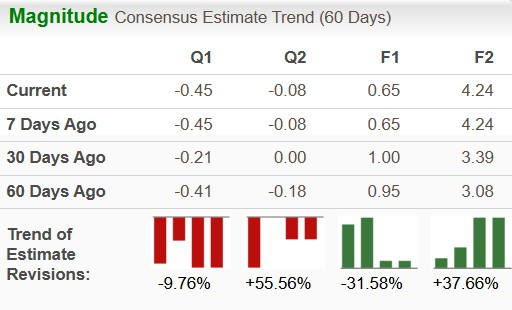
Image Source: Zacks Investment Research
The Zacks Consensus Estimate for RTX’s 2026 EPS indicates an increase of 1.49% over the past 60 days.
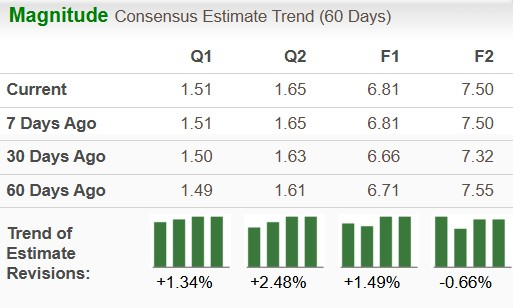
Image Source: Zacks Investment Research
Valuation for BA & RTX
BA shares trade at a forward 12-month Price/Sales (P/S F12M) of 1.84X compared with RTX’s 2.79X.
Debt Position of BA & RTX
Currently, Boeing’s total debt to capital is 90.84% compared with RTX’s 36.1%.
The time-to-interest earned ratio for Boeing and RTX is 2 and 6, respectively. The ratio, being greater than one, reflects the company’s ability to meet future interest obligations without difficulties.
BA & RTX’s Price Performance
In the past six months, shares of RTX have increased 22.9%, while those of Boeing have declined 2%.
BA or RTX: Which Is a Better Choice Now?
Boeing’s Defense, Space & Security segment is well positioned for long-term growth. Strong funding for fighter jet programs and the Space Force, combined with a diversified defense portfolio, has driven solid contract wins and solid backlog, reinforcing the unit’s positive momentum. RTX continues to benefit from steady demand for its proven defense systems, supported by strong order inflows from the Pentagon and international allies. Its growing backlog and consistent contract wins reflect solid momentum and reinforce expectations of sustained growth in its defense business.
Our choice at the moment is RTX, given its earnings growth projection, better debt management and price performance than Boeing. Both BA and RTX carry a Zacks Rank #3 (Hold) at present. You can see the complete list of today’s Zacks #1 Rank (Strong Buy) stocks here.
Just Released: Zacks Top 10 Stocks for 2026
Hurry – you can still get in early on our 10 top tickers for 2026. Handpicked by Zacks Director of Research Sheraz Mian, this portfolio has been stunningly and consistently successful.
From inception in 2012 through November, 2025, the Zacks Top 10 Stocks gained +2,530.8%, more than QUADRUPLING the S&P 500’s +570.3%.
Sheraz has combed through 4,400 companies covered by the Zacks Rank and handpicked the best 10 to buy and hold in 2026. You can still be among the first to see these just-released stocks with enormous potential.
See New Top 10 Stocks >>Want the latest recommendations from Zacks Investment Research? Today, you can download 7 Best Stocks for the Next 30 Days. Click to get this free report
The Boeing Company (BA): Free Stock Analysis Report
RTX Corporation (RTX): Free Stock Analysis Report
This article originally published on Zacks Investment Research (zacks.com).





Comentarios
Aún no hay comentarios