
Boeing's 777X Certification Progress and Its Implications for Long-Term Earnings
Regulatory Milestones: A Pathway to Operational Readiness
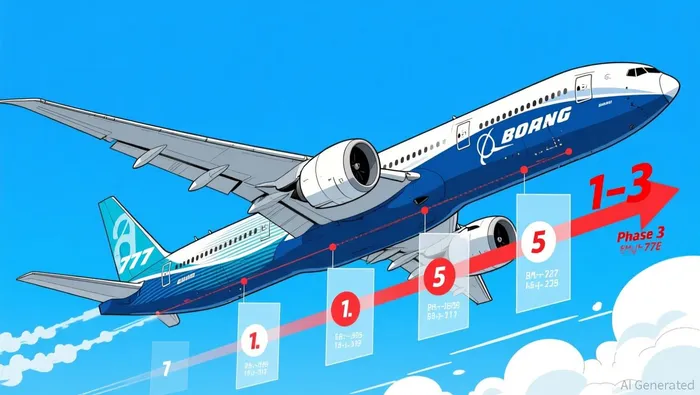
The FAA's approval to proceed with the third certification phase underscores Boeing's ability to navigate complex technical challenges, including structural testing and systems integration, as noted in the FAA certification reform efforts. These reforms, aimed at modernizing certification standards post-737 MAX, have added layers of oversight but also raised concerns about prolonged timelines.
Despite these bottlenecks, Boeing's recent progress is significant. The third phase of testing typically involves evaluating the aircraft's performance under extreme conditions, such as high-altitude operations and extended-range capabilities. Successful completion could pave the way for the fourth and fifth phases, which focus on final compliance checks and documentation, as reported by Air Current. For the aviation sector, such milestones often act as catalysts for re-rating, as they reduce uncertainty around delivery schedules and operational costs for airlines.
Financial Implications: Short-Term Pain, Long-Term Gain
The 777X's delayed certification has already exacted a toll on Boeing's financials. In Q3 2025, the company reported a $5.42 billion net loss, partly attributed to a $4.9 billion charge linked to 777X development and delivery delays, according to the Air Current report. The program's initial 2026 delivery target has been pushed to 2027, compounding costs for both Boeing and its customers. Yet, these challenges are juxtaposed with a robust order backlog of $636 billion, including commitments from major carriers like Qatar Airways and Emirates, as reported by the same source.
Analysts argue that the 777X's eventual certification could unlock substantial revenue streams. The aircraft's fuel efficiency and range make it a strategic asset for long-haul routes, positioning Boeing to reclaim market share from Airbus' A350. Moreover, the program's completion could stabilize Boeing's cash flow, which has been strained by prior setbacks. As stated by a Reuters report, Boeing's stock has demonstrated resilience, gaining 26% year-to-date and 48% over the past 12 months, reflecting investor confidence in its long-term recovery, as noted in the Air Current report.
Sector Re-Rating: Regulatory Catalysts and Market Dynamics
Historically, regulatory approvals have acted as turning points for aerospace valuations. For instance, the FAA's 2020 recertification of the 737 MAX triggered a 30% surge in Boeing's stock within six months, as operators resumed deliveries and demand for spare parts rebounded. A similar dynamic could unfold with the 777X, particularly if EASA aligns its certification timeline with the FAA's progress. While no direct data on EASA's status is available, European regulators typically mirror U.S. standards for major programs, reducing the risk of divergent approvals.
However, the sector's re-rating potential is not without risks. The recent FAA grounding of MD-11 freighters-due to a fatal crash in Kentucky-has disrupted cargo operations and highlighted the sector's vulnerability to regulatory shocks, as reported in a UK Aviation news report. Such events underscore the need for Boeing to ensure the 777X's certification is not only timely but also perceived as robust by global regulators.
Conclusion: Balancing Certainty and Caution
For long-term investors, Boeing's 777X program represents a high-stakes bet on regulatory progress and operational execution. While delays have dented short-term earnings, the aircraft's commercial potential and Boeing's order backlog suggest a path to recovery. The FAA's ongoing reforms, though slowing current timelines, may ultimately create a more predictable certification environment for future programs.
As the 777X nears final approval, the aerospace sector's valuation could see a re-rating driven by reduced uncertainty and renewed confidence in Boeing's ability to deliver. Yet, investors must remain vigilant about broader regulatory risks and the competitive landscape. For now, the third certification phase stands as a pivotal milestone-one that could redefine Boeing's earnings trajectory and the sector's outlook in the years ahead.







Comentarios
Aún no hay comentarios