
Boeing 777X Certification Delays: Operational Risks and Valuation Implications
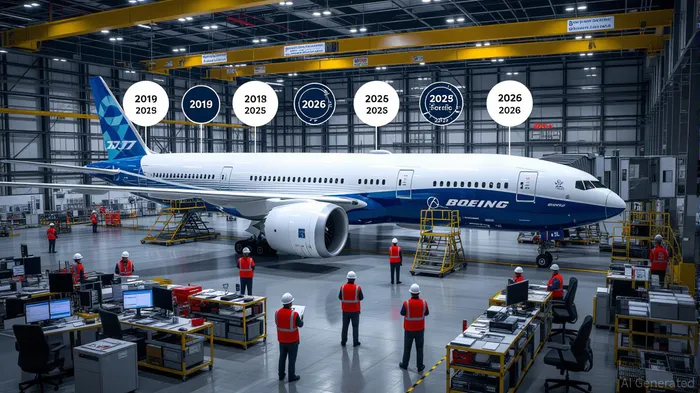
The BoeingBA-- 777X, a flagship widebody jet designed to compete with Airbus's A350, has become a focal point of operational and financial scrutiny due to persistent certification delays. Originally slated for delivery in 2019, the program now anticipates its first delivery in 2026, with Lufthansa as the launch customer [1]. This three-year delay, compounded by broader systemic challenges at Boeing, raises critical questions about the company's operational resilience and long-term valuation.
Operational Risks: A Perfect Storm of Challenges
Regulatory Hurdles
The Federal Aviation Administration (FAA) has maintained heightened scrutiny of Boeing since the 737 MAX crisis, which eroded trust in the company's internal safety protocols [2]. This regulatory wariness has extended to the 777X, with the FAA demanding rigorous validation of design changes and operational procedures. The agency's cautious approach, while necessary for safety, has elongated certification timelines and increased compliance costs.
Technical Challenges
The GE9X engines, a technological marvel designed for fuel efficiency, have emerged as a key bottleneck. According to a report by Pontifications, unresolved technical issues with the engines—such as blade durability and integration with the 777X's folding wingtips—have forced iterative redesigns and testing cycles [1]. These delays are emblematic of Boeing's broader struggle to balance innovation with reliability in an increasingly competitive market.
Production Setbacks
A stressed aerospace supply chain has further complicated matters. Engine suppliers, including General Electric, have faced capacity constraints and technical bottlenecks, delaying component deliveries [3]. Meanwhile, Boeing's own production infrastructure, still recovering from 737 MAX-related disruptions, lacks the agility to absorb these external shocks.
Valuation Impacts: Revenue Loss and Investor Sentiment
Revenue Erosion
The 777X's delayed entry into service directly impacts Boeing's revenue pipeline. With 138 firm orders as of 2025, the program's deferred deliveries translate to lost leasing and maintenance revenue for Boeing, as well as potential penalties for missed delivery windows. Analysts estimate that each additional month of delay could cost the company $50–$70 million in incremental costs and lost profits [1].
Investor Sentiment
Investor confidence has been further strained by Boeing's repeated failure to meet deadlines. A 2023 Pontifications analysis noted that the company's stock underperformed the S&P 500 by 12% in 2023, reflecting concerns over management's ability to execute complex projects [2]. This sentiment is compounded by the lingering shadow of the 737 MAX crisis, which has made institutional investors more risk-averse toward Boeing's long-term bets.
Competitor Dynamics
Airbus has capitalized on Boeing's delays, securing market share with its A350 and A330neo models. The A350, in particular, has attracted 777X-targeted customers with its proven reliability and shorter delivery timelines. This competitive erosion threatens Boeing's dominance in the widebody segment, a critical revenue driver for its Commercial Airplanes division.
Investment Implications
For investors, the 777X saga underscores a broader narrative of operational fragility. While Boeing's recent cost-cutting measures and leadership changes signal a pivot toward stability, the company's ability to recover hinges on resolving these delays without further setbacks. A successful 2026 launch could reinvigorate investor optimism, but repeated missteps risk permanent damage to Boeing's reputation and valuation multiples.





Comentarios
Aún no hay comentarios