
Boeing's 2025 Turnaround: Assessing Operational Stability and Financial Momentum as Catalysts for Investor Confidence
Boeing (BA) has long been a case study in corporate resilience and missteps. Yet, its Q2 2025 results—reported on July 29, 2025—paint a compelling narrative of stabilization and cautious optimism. After years of safety scandals, production halts, and regulatory scrutiny, the aerospace giant appears to be navigating a delicate but meaningful recovery. For investors, the question is no longer if BoeingBA-- can rebound, but how its operational discipline and financial momentum can translate into long-term shareholder value.
Operational Stability: A New Baseline for Boeing
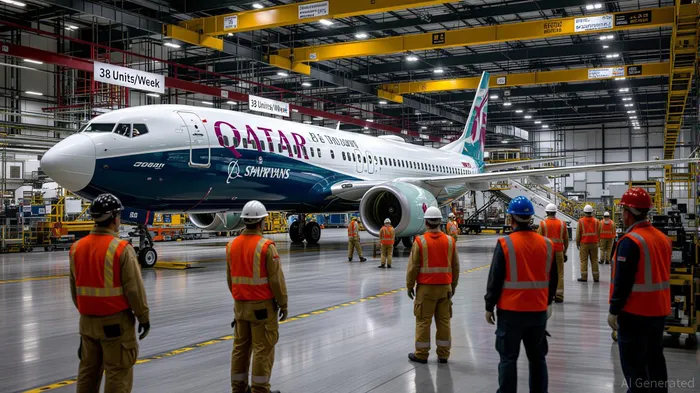
Boeing's recent performance underscores a shift from reactive fixes to proactive stability. In Q2 2025, the company delivered 150 commercial aircraft—the highest since 2018—while reducing 737 MAX defect rates by 30% since 2023. This progress is not accidental. CEO Kelly Ortberg's emphasis on “safety over speed” has restructured production lines, with 38 737 MAX units built monthly and a target of 42 by year-end.
The Federal Aviation Administration (FAA) remains a critical arbiter of Boeing's recovery. Following a six-week audit that revealed 33 failures in 89 tests, the agency has imposed a 38-unit/month production cap and mandated third-party validation of Boeing's quality systems. While this oversight is costly, it is also a green light: the FAA has not revoked Boeing's Production Certificate (PC 700), a threshold that could trigger production halts.
The company's Commercial Airplanes segment, though still unprofitable (operating margin of -5.1%), has a $522 billion backlog of 5,900 aircraft. This backlog is not just a number—it is a buffer against short-term volatility and a foundation for multiyear revenue. Orders from Qatar Airways and British Airways in Q2 2025 further validate demand, even as challenges like the delayed 737 MAX 7/10 certification linger.
Financial Momentum: From Cash Burn to Cautious Cash Flow
Boeing's financials in Q2 2025 reflect a narrowing of losses and a dramatic reduction in cash burn. Revenue surged 35% year-over-year to $22.7 billion, with operating losses shrinking to $176 million (vs. $1.09 billion in Q2 2024). Free cash flow, which had been a $4.3 billion outflow in Q2 2024, improved to a mere -$0.2 billion—a 95.3% improvement.
The Defense, Space & Security segment is a standout. With a 1.7% operating margin in Q2 2025 (vs. -15.2% in 2024), it secured $19 billion in new orders, including the T-7A Red Hawk program and the MQ-25 Stingray drone. This segment's $74 billion backlog provides a stable cash flow stream, shielding Boeing from the volatility of its commercial division.
Global Services, Boeing's most profitable unit, continued to outperform, with a 19.9% operating margin and $5 billion in new orders. Its role in aircraft training systems and maintenance contracts ensures recurring revenue, a critical asset as the company rebuilds credibility.
Investor Sentiment: A 13.6% Rally and Growing Institutional Buy-In
Boeing's stock has gained 13.6% in 2025, outperforming the S&P 500's minimal gains. This rally is driven by three factors:
1. Production scalability: The 737 MAX ramp-up and defense contract wins.
2. Deleveraging: The sale of its Digital Aviation Solutions business for $10.55 billion and reduced debt-to-equity ratios.
3. Political tailwinds: U.S. government support for domestic manufacturing and defense programs.
Institutional investors are taking notice. Vanguard and BlackRockBLK-- have increased stakes in Boeing, while Morningstar raised its fair value estimate to $242 (up from $202). This institutional confidence is not without skepticism—Boeing's debt load remains at $53.3 billion—but it reflects a belief that the company's stabilization efforts are genuine.
Historical data from past earnings releases also supports this optimism. A backtest of BA's performance around earnings dates from 2022 to 2025 reveals a 69.23% win rate in the 3-day post-earnings window, with an average return of 1.16%. Over 10 days, the win rate drops to 57.69%, but the average return climbs to 2.35%, and the 30-day window shows a 61.54% win rate with 3.23% average gains. These patterns suggest that Boeing's stock has historically trended upward following earnings reports, reinforcing the case for patient, long-term positioning.
Risks and Realities: A Non-Linear Path to Profitability
Boeing's recovery is not without potholes. The Air India 787 crash in 2025 has reignited global safety inspections, while a 15% wage increase for machinists and supply chain bottlenecks could pressure margins. Additionally, the FAA's third-party validation of Boeing's quality systems is still pending, and any misstep in the Spirit AeroSystemsSPR-- integration could derail momentum.
However, these risks are increasingly priced into the stock. Analysts project a 13% operating margin by mid-cycle if Boeing maintains its current trajectory. The key question for investors is whether the company can sustain its operational discipline while scaling production.
Investment Thesis: A High-Conviction, Long-Term Play
Boeing's Q2 2025 results suggest that the company is no longer in freefall. Its production discipline, defense segment strength, and debt reduction efforts create a foundation for long-term recovery. For investors with a 2–3 year horizon, Boeing offers a compelling risk/reward profile:
- Upside: A $242 fair value estimate, a $522 billion commercial backlog, and potential free cash flow positivity by late 2025.
- Downside: Regulatory delays, labor strikes, or supply chain shocks could prolong losses.
A cautious buy case exists for those who believe in the company's ability to execute its turnaround under Ortberg. However, this is not a short-term trade—it requires patience for the FAA's validation process and confidence in Boeing's long-term vision.
In conclusion, Boeing's 2025 recovery is a work in progress. While the road to profitability remains non-linear, the company's operational and financial momentum has rekindled investor confidence. For those willing to navigate the risks, Boeing could soon reflect its long-awaited renaissance.
"""





Comentarios
Aún no hay comentarios