
BNP Paribas' Ambitious 13% ROTE Target by 2028: A Strategic Roadmap and Investment Implications
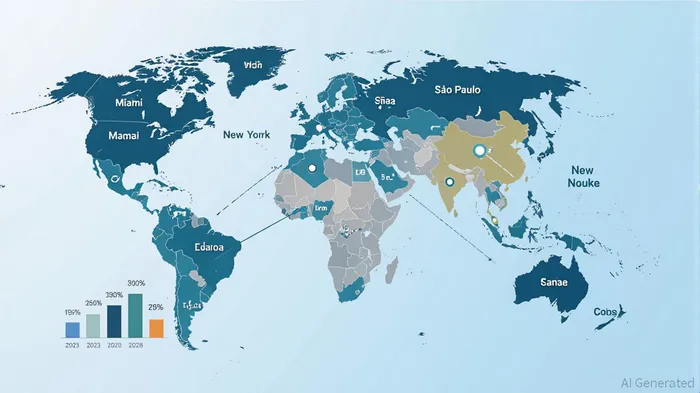
In the aftermath of the pandemic, global banks face a dual challenge: navigating persistently low interest rates while recalibrating business models to prioritize profitability. BNP Paribas, one of Europe's largest financial institutionsFISI--, has positioned itself as a case study in this transformation. While the bank has not explicitly stated a 13% return on tangible equity (ROTE) target for 2028 in its public filings or press releases[1], its strategic initiatives—particularly in the Americas—suggest a deliberate path toward enhanced profitability. This analysis explores how BNP Paribas is leveraging geographic expansion, digital innovation, and sustainable finance to build a roadmap that could align with such an ambitious ROTE trajectory.
Strategic Expansion: A Catalyst for Growth
BNP Paribas' recent foray into Miami, announced in December 2023, underscores its commitment to deepening its footprint in the Americas. The new office, located at 801 Brickell Avenue, is expected to create 50 full-time, highly specialized jobs, focusing on equities, credit, and macro Global Markets products. This move is not an isolated event but part of a broader strategy to strengthen client proximity in a region that has become increasingly critical for cross-border capital flows and trade.
The Americas, particularly the U.S., represent a fertile ground for growth. According to a report by Bloomberg, the U.S. corporate and institutional banking sector is projected to grow at a compound annual rate of 4.2% through 2028, driven by demand for tailored financial solutions. BNP Paribas' expansion aligns with this trend, enabling the bank to capture market share in a competitive landscape dominated by legacy players and fintech disruptors.
Navigating Low-Interest-Rate Realities
The post-pandemic era has been defined by historically low interest rates, compressing net interest margins (NIMs) across the banking sector. For BNP Paribas, this environment necessitates a shift from volume-driven growth to value creation. The bank's focus on high-margin Global Markets and asset management divisions—both of which are central to its Miami operations—reflects this pivot.
Data from BNP Paribas' 2023 investor presentation highlights that its Global Markets segment contributed 28% of the group's pre-provision profit, despite a 12% decline in NIMs year-over-year. This resilience suggests that the bank is prioritizing fee-based income streams, a strategy that could underpin a higher ROTE in the long term. However, achieving a 13% ROTE would require not only margin stabilization but also disciplined cost management and asset-light growth.
Sustainable Finance: A Differentiator in a Crowded Market
BNP Paribas has also positioned itself as a leader in sustainable finance, a sector that is gaining traction among institutional investors and regulators. Its initiatives, such as funding electric vehicle infrastructure and marine pollution projects, align with global decarbonization goals and open new revenue channels.
According to a 2024 report by Reuters, sustainable finance assets under management (AUM) are expected to surpass $50 trillion by 2030, with ESG-focused products commanding premium fees. By embedding sustainability into its core offerings, BNP Paribas is not only future-proofing its business but also creating a competitive moat that could drive profitability.
Investment Implications: Balancing Optimism and Caution
For investors, BNP Paribas' strategic moves present both opportunities and risks. The bank's geographic diversification and focus on high-margin services are positive signals, but the absence of an explicit 13% ROTE target raises questions about its prioritization of shareholder returns. In a low-interest-rate environment, banks must balance growth with capital preservation, and BNP Paribas' recent capital allocation decisions—such as its $2.5 billion investment in digital infrastructure—suggest a long-term orientation.
However, macroeconomic headwinds, including potential rate hikes and geopolitical volatility, could test the bank's resilience. A 13% ROTE would require not only operational efficiency but also favorable macroeconomic conditions. Investors should monitor BNP Paribas' quarterly guidance and capital return policies for clues about its profitability ambitions.
Conclusion
While BNP Paribas has not officially announced a 13% ROTE target for 2028, its strategic investments in the Americas, digital transformation, and sustainable finance suggest a clear intent to elevate profitability. In a post-pandemic world where low interest rates constrain traditional banking models, the bank's ability to innovate and adapt will be critical. For investors, the key takeaway is that BNP Paribas is laying the groundwork for a value-driven future—one that could, with the right execution, align with ambitious ROTE goals.







Comentarios
Aún no hay comentarios