
The BNB Treasury Bet at CEA Industries: Governance War or Strategic Drift?
The rise of digital asset treasuries has redefined corporate finance in 2025, with companies like CEA IndustriesBNC-- (NASDAQ: BNC) staking their futures on blockchain-based assets. Yet, as the governance battle between CEABNC-- and YZi Labs intensifies, the viability of its BNB-focused strategy is under scrutiny. This analysis examines whether the conflict reflects a governance power struggle or a deeper strategic misalignment, contextualized against broader trends in crypto treasury management.
Governance Conflict: Poison Pills and Shareholder Rights
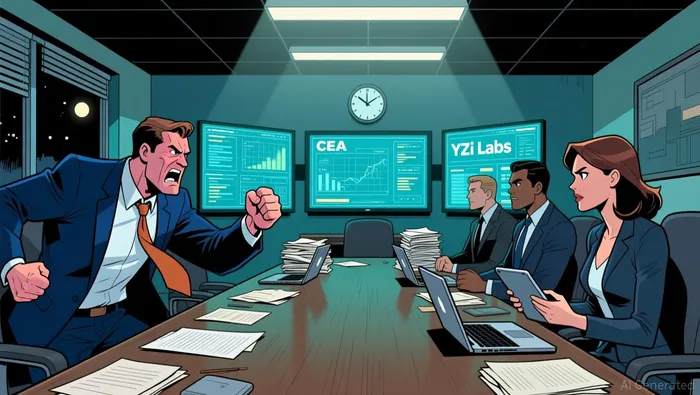
YZi Labs, the family office of Binance founder Changpeng Zhao, has escalated a high-stakes dispute with CEA Industries over governance controls. The company's adoption of a poison pill stockholder rights plan and bylaw amendments-restricting shareholder ability to act via written consent-has drawn sharp criticism. YZi argues these measures entrench the board and undermine investor interests, particularly as CEA's stock has plummeted over 90% from its July 2025 peak, despite BNB appreciating by nearly 38% in the same period.
The poison pill, triggered if any shareholder acquires 15% of CEA's shares without board approval, allows other shareholders to purchase additional shares at a 50% discount, diluting the acquirer's stake. CEA defends these actions as standard defensive measures against hostile takeovers, while YZi warns of "manipulative behavior" in delaying the 2025 annual meeting and complicating director nominations. This conflict underscores the tension between board autonomy and shareholder accountability in crypto-linked firms.
Strategic Fidelity: BNBBNB-- as a Core Asset
CEA Industries has positioned itself as a leader in BNB-native treasury management, with holdings of 515,554 BNB tokens valued at approximately $464.6 million as of November 2025. The company's Treasury Dashboard emphasizes real-time transparency, aligning with its goal to control 1% of the total BNB supply by year-end. CEO David Namdar has highlighted BNB's utility in the BNB Chain ecosystem, including staking and automated burning mechanisms, which differentiate it from speculative assets.
However, YZi Labs has raised concerns about strategic drift, citing Namdar's November 2025 comments about exploring alternative tokens like SolanaSOL--. This perceived shift contradicts CEA's stated focus on BNB and has fueled accusations of board incoherence. The company's capital allocation strategy-balancing share buybacks, ATM offerings, and BNB accumulation-mirrors MicroStrategy's Bitcoin-centric model, yet its execution has faced volatility. For instance, CEA repurchased 1.17 million shares at $6.77 while selling 856,275 shares via an ATM offering at $15.09, reflecting a disciplined but high-risk approach.
Industry Benchmarks and Risks
The broader market for digital asset treasuries (DATs) has expanded rapidly, with over 200 publicly traded companies collectively holding $115 billion in crypto assets as of September 2025. These firms leverage tools like convertible notes, PIPEs, and ELOCs to fund acquisitions, while governance frameworks increasingly include custody arrangements and investment limits. However, DAT equities have faced significant drawdowns, with some trading at discounts to their net asset value (NAV) amid crypto market corrections.
CEA's strategy aligns with industry trends but faces unique challenges. Unlike Bitcoin-focused peers, its reliance on BNB-a token with deflationary mechanics and high transaction volume-requires navigating the BNB Chain's ecosystem dynamics. Regulatory clarity, including updated accounting standards, has bolstered confidence, yet volatility remains a persistent risk. For example, Strategy Inc. (MSTR) saw its shares fall nearly 50% in 2025 despite holding $62 billion in BTC, illustrating the fragility of crypto treasury models during downturns.
Strategic Drift: Lessons from the Sector
Case studies of strategic drift in corporate crypto strategies highlight the risks of misalignment. SharpLink Gaming Inc., for instance, experienced an 86% drop from its peak after a 2,600% surge driven by BitcoinBTC-- adoption, underscoring the perils of overreliance on a single asset. Similarly, CEA's governance conflict mirrors broader sector tensions between board control and shareholder influence. YZi's consent solicitation to replace the board reflects a demand for strategic clarity, particularly as CEA's stock performance lags its BNB holdings.
The outcome of this dispute could set a precedent for how crypto-linked firms balance governance and strategy. If CEA's board prevails, it may reinforce the trend of defensive governance in DATs. Conversely, a shareholder victory could signal a shift toward more transparent, stakeholder-driven approaches.
Conclusion: Viability Amid Uncertainty
CEA Industries' BNB treasury bet remains a high-risk, high-reward proposition. While its strategic focus on BNB's utility and deflationary attributes aligns with industry benchmarks, the governance conflict exposes vulnerabilities in execution. The board's defensive measures, though legally defensible, risk alienating shareholders and eroding trust. Meanwhile, the broader DAT sector's volatility-exemplified by MSTR and SharpLink-suggests that long-term viability depends on disciplined capital management, regulatory adaptability, and clear strategic communication.
As the 2025 annual meeting looms, investors must weigh whether CEA's governance structure supports its BNB-centric vision or exacerbates the very risks it aims to mitigate. In a market where crypto treasuries are both a lifeline and a liability, the line between strategic innovation and drift is perilously thin.





Comentarios
Aún no hay comentarios