
Can BNB Sustain Its Surge to $1,000 Amid Institutional Adoption and Regulatory Progress?
The Binance Coin (BNB) ecosystem has entered a pivotal phase in 2025, driven by aggressive deflationary mechanics, institutional adoption, and regulatory progress. With BNBBNB-- trading near $700 in early September 2025, the question of whether it can sustain a surge to $1,000 hinges on its ability to maintain momentum in these critical areas.
Ecosystem Growth and Institutional Adoption: A Flywheel of Utility
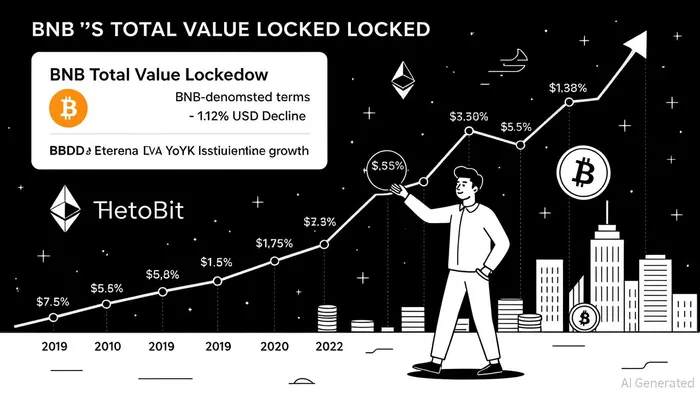
BNB Chain’s ecosystem has demonstrated resilience and innovation. Total value locked (TVL) on BNB Smart Chain grew by 14.7% in BNB terms in Q1 2025, despite a modest 1.2% QoQ decline to $5.3 billion in USD [3]. This divergence underscores the chain’s growing utility, as institutional demand for BNB outpaces short-term price volatility. Decentralized exchange (DEX) volume on BNB Chain surged by 38% in March 2025, with PancakeSwap generating $2.7 billion in daily trading volume—surpassing UniswapUNI-- [5].
Institutional adoption has been a cornerstone of this growth. BNB’s institutional holdings increased by 21% year-over-year, totaling over $4.6 billion in crypto hedge funds and custodians [1]. A $2 billion investment from UAE state-owned firm MGX further solidified BNB’s institutional appeal [5]. Meanwhile, strategic partnerships like the BNB Good Will Alliance—which reduced sandwich attacks by over 90%—and Lista Lending’s $10 million BNB supply cap (fully borrowed in under an hour) highlight the chain’s focus on security and DeFi utility [3].
Staking ETFs: A Regulatory Breakthrough
The proposed REX-Osprey BNB Staking ETF represents a watershed moment for institutional integration. This fund, which allocates 80% of its capital to BNB or a Cayman subsidiary, offers investors exposure to BNB while earning staking rewards of 1.5–3% annually [4]. Anchorage Digital Bank’s role as custodian ensures regulatory compliance, while the SEC’s recent guidance on liquid staking (clarifying that staking tokens are not securities) removes a major hurdle [6]. If approved by November 2025, the ETF could catalyze a new wave of institutional inflows, mirroring Ethereum’s ETF success but with BNB’s unique deflationary edge.
Comparatively, EthereumETH-- staking ETFs benefit from a deflationary supply model and a reclassification as a utility token, while Solana’s ETFs offer higher staking yields (7.3–7.4%) but face regulatory uncertainty [5]. BNB’s staking ETF, however, leverages Binance’s institutional credibility and a proven deflationary framework, positioning it as a hybrid between Ethereum’s regulatory clarity and Solana’s yield potential.
Deflationary Mechanics: BNB’s Secret Weapon
BNB’s tokenomics remain a key differentiator. The chain’s auto-burn mechanism has reduced its circulating supply from 200 million to 139 million tokens by August 2025, with a 5.2% annual deflation rate driven by quarterly burns and real-time gas fee destruction [2]. In Q1 2025 alone, 1.94 million BNB worth $1.17 billion was burned, contributing to a projected 30% supply reduction since 2017 [5]. This contrasts with Ethereum’s -0.7% annualized inflation rate (despite EIP-1559 burns) and Solana’s 2.2% inflation rate [3].
BNB’s deflationary flywheel—combining supply reduction with growing demand from DeFi, stablecoins, and institutional accumulation—creates a compelling narrative. For instance, the World Liberty Financial USD (USD1) stablecoin’s $100 million daily trading volume and the “Zero Fee Carnival” promotion (eliminating gas fees for USDTUSDC-- and USD1 transactions) further enhance BNB’s utility [5].
Market Positioning: Competing with Ethereum and Solana
While Ethereum’s post-Merge deflationary model and Solana’s high-speed, low-cost infrastructure remain formidable, BNB’s ecosystem growth and regulatory progress offer a unique value proposition. Ethereum’s $4.62 million ETH burned since EIP-1559 and its 4–7% staking yields attract institutional investors, but its supply remains inflationary during low-usage periods [3]. Solana’s 7.3% staking yield and 99% ETF approval probability by October 2025 are enticing, yet its 2.2% inflation rate and validator-centric tokenomics pose long-term risks [2].
BNB, by contrast, combines deflationary supply dynamics with a maturing DeFi ecosystem and regulatory-friendly staking products. Its TVL growth in BNB terms (14.7% QoQ) and institutional holdings (21% YoY increase) suggest a self-reinforcing cycle of value creation [3][1].
Conclusion: A $1,000 BNB Is Plausible—But Not Guaranteed
BNB’s surge to $1,000 depends on three factors: (1) the approval and success of the REX-Osprey ETF, (2) sustained ecosystem growth in DeFi and stablecoin adoption, and (3) continued deflationary supply reductions. While Ethereum and SolanaSOL-- remain strong competitors, BNB’s institutional traction, regulatory progress, and deflationary mechanics create a compelling case for long-term value. If the ETF launches as expected and BNB’s supply continues to shrink, the $1,000 milestone could be within reach by late 2025.
Source:
[1] BNB Statistics 2025: Key Figures and Market Trends [https://coinlaw.io/bnb-statistics/]
[2] BNB Tokenomics: How Binance's Strategic Buybacks and ... [https://www.ainvest.com/news/bnb-tokenomics-binance-strategic-buybacks-ecosystem-expansion-reshaping-long-term-2508/]
[3] State of BNB Chain Q1 2025 [https://messari.io/report/state-of-bnb-chain-q1-2025]
[4] BNB Price Prediction: Could Rex Osprey Staking ETF Push [https://coincentral.com/bnb-price-prediction-could-rex-osprey-staking-etf-push-token-past-1400-target/]
[5] Why BNB Chain Grows in March 2025: Memecoins & More [https://www.dwf-labs.com/research/533-bnb-chain-reasons-for-growth]
[6] SEC: Liquid Staking Doesn't Run Afoul of Securities Laws [https://www.coindesk.com/policy/2025/08/05/liquid-staking-doesn-t-run-afoul-of-securities-laws-sec-says]






Comentarios
Aún no hay comentarios